Germany’s governing coalition — SPD and CDU — is systematically dismantling the only legal instrument capable of exposing government failure after the fact. The pattern is not new. Jean-Claude Juncker described it in 1999.
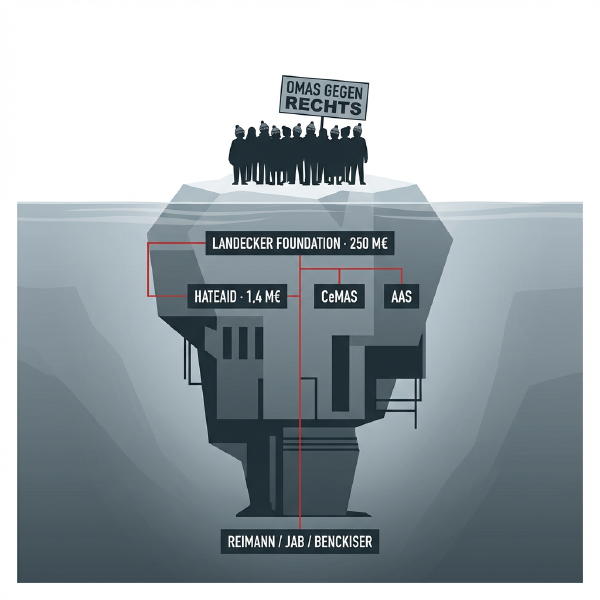
Since June 2025, HateAid holds a status that received almost no press coverage: EU Trusted Flagger under Article 22 of the Digital Services Act. What that means: platforms such as Meta, YouTube and X are legally required to process HateAid’s reports faster and with priority. Not as a courtesy — as a legal obligation.
On 4 May 2026, at 08:00, three parties in the German Bundestag post on X almost simultaneously. The text differs by exactly one word.
Greens in the Bundestag (@GrueneB…):
“X has descended into chaos in recent years. Political debates thrive on exchange that reaches and informs people. X, however, increasingly promotes disinformation. That is why we will no longer use this account.”
Four stations, one data point that remains unanchored between them.
26 August 2021 — UN Special Rapporteur on Torture Nils Melzer sends an official communication, file reference AL DEU 6/2021, to the German Federal Government. Trigger: numerous reports and video recordings of disproportionate police force against protesters at anti-Covid demonstrations in Berlin, particularly on August 1, 2021.1
Anyone entering this matter through the question “How can a rejected asylum seeker sit on the BR Broadcasting Council?” is already in the wrong frame. That frame has been delivered since September 2025 in dense frequency by a recognisable clickbait cluster — Apollo News, Tichys Einblick, Junge Freiheit, Politikversagen — and that frequency itself is the material on which the actual process is built. The actual process is a function inversion: a member of an oversight body, mandated by the Bavarian Broadcasting Act to safeguard plurality, has run a wave of criminal complaints since the late summer of 2025 against media plurality outside the public-broadcasting sector.
On 24 April 2026, in the early afternoon, Germany’s Paul-Ehrlich-Institut (PEI) — the federal agency for vaccines and biomedical medicines — posts from its official X account @PEI_Germany a card marking the end of European Immunisation Week. On the card: a cartoon family — mother, child, teenager, adult, elderly woman, male nurse in headscarf. Above it, in friendly green, with an exclamation mark:
On 25 February 2026, the VII Civil Senate of Germany’s Federal Court of Justice (Bundesgerichtshof, BGH), presided by Judge Pamp, with judges Halfmeier, Graßnack, Borris and Dr Hannamann, issued a decision that, in the broadcasters whose entire funding mechanics it directly affects, has to this day never been reported. Case number: VII ZB 29/24. Matter: enforcement by Bavarian Broadcasting (Bayerischer Rundfunk, BR) against an individual fee debtor in Allgäu over unpaid broadcasting fees. Outcome: the enforcement is declared inadmissible, the creditor — the BR — bears the costs. Both lower courts, the local court of Kaufbeuren and the 4th Civil Chamber of the regional court of Kempten, had ruled the opposite way. The Federal Court overturned them both.
On April 23, 2026, the Bundestag Enquete Commission “Processing the Covid Pandemic and Lessons for Future Pandemic Events” convened in public session. Block subject: Critical Infrastructures (KRITIS) and the role of the Bundeswehr in pandemic situations. Expert witness: Stephan Kohn, former senior official at the Federal Interior Ministry (BMI), author of the 80-page internal evaluation of May 2020 that assessed the then-current Covid policy as a false alarm — a paper that has since served as a case study, depending on whom you ask, of either bureaucratic dissent or bureaucratic discipline.
What Additionally Happened on April 22, 2026 # April 22, 2026 was a dense news day. We already documented it in a separate article: In the morning, the German cabinet adopted the third suspicionless IP-data retention bill with extended intelligence-service access. Defence Minister Pistorius unveiled the Federal Republic’s first formal military strategy (Russia as primary threat, Bundeswehr growth to 460,000 personnel). The EU Council waved through the 20th Russia sanctions package plus a €90 billion Ukraine loan. And Spiegel published its exclusive on the Klöckner Signal phishing story, which rhetorically delivered exactly the threat picture the first three decisions required.
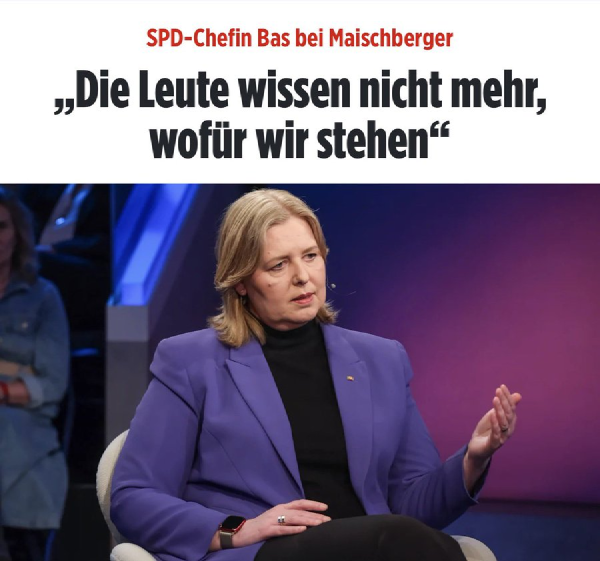
The leader of Germany’s Social Democratic Party, Bärbel Bas, on Sandra Maischberger’s talk show this week:
“People no longer know what we stand for.”
We’re happy to help, Ms. Bas. Here is the list.
What Actually Happened on April 22, 2026 # On Wednesday, April 22, 2026, an unusually dense sequence of security- and surveillance-policy events moved in parallel through Germany and Brussels: