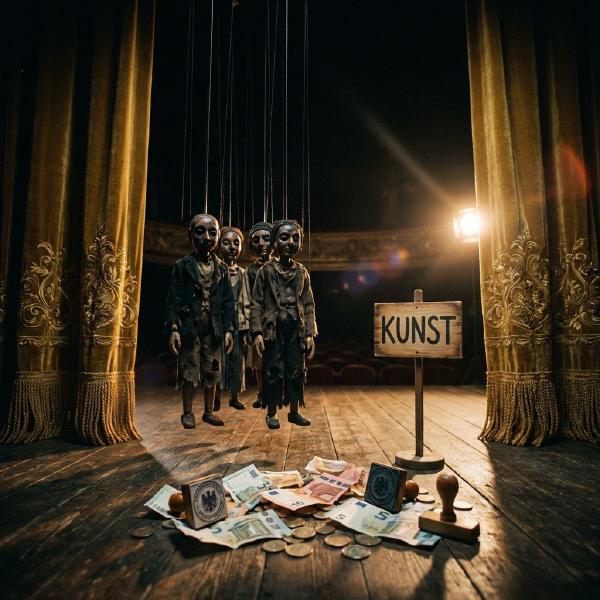
“Funded by private individuals.” That is what the website says. Bundestag printed paper 19/1426 tells a different story. # What ZPS says # The Centre for Political Beauty (Zentrum für Politische Schönheit, ZPS) describes itself as a “stormtroop for the establishment of moral beauty” [1]. Founder and director: Dr. Philipp Ruch, philosopher and action artist, born 1981 in Dresden [2].
Germany’s public broadcaster demands whistleblower protection – as long as it doesn’t affect their own network
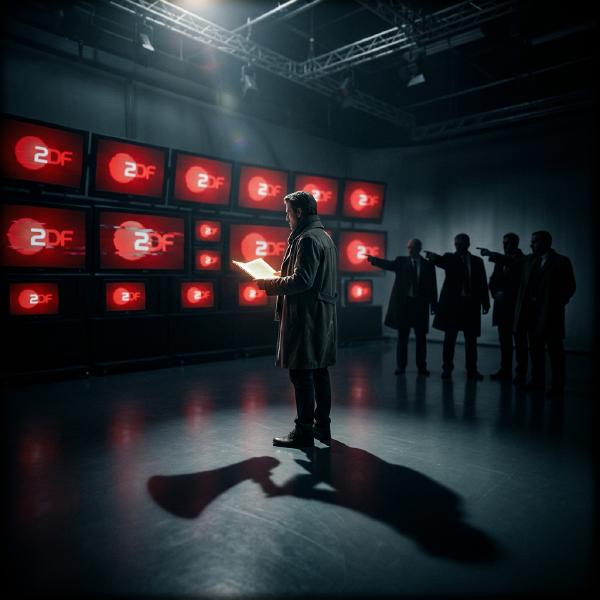
There are moments when institutions expose themselves so thoroughly that all you can do as an observer is sit back in disbelief. Germany’s ZDF just delivered one such moment – a double one, at that.
There are moments on the internet where you sit in front of your screen, stare at what you’ve just watched, and genuinely ask yourself: Did someone actually make this? And then you realize: Yes. Yes, they did. And it’s the best thing you’ll see all week.
The Stasi, the Ministry for State Security of the GDR, was a symbol of total surveillance and oppression. With a vast network of official and unofficial collaborators, it infiltrated the most intimate areas of citizens’ lives. But what was once considered the epitome of a surveillance state now seems almost primitive compared to what Big Tech and artificial intelligence (AI) have made possible.
Definition Tension Case # The tension case, defined in Article 80a Paragraph 1 GG, activates certain provisions that are normally only applicable in the defense case. This enables the application of security and precautionary laws. These laws allow measures such as the reintroduction of conscription, compulsory assignment to work in war-critical sectors, seizure of means of transport, and restriction of fundamental rights such as freedom of movement, housing guarantee, and postal and telecommunications secrecy. The Bundestag can lift these measures at any time, whereby the lifting must be immediate and complete.
Introduction: # The introduction of “Chat Control” represents a dangerous development for our digital freedom and privacy. Under the guise of “security,” our personal messages and communications are being monitored and analyzed. This measure not only threatens our privacy but also the integrity of our entire digital communication. It’s time to stand up against this surveillance and defend our rights.
While the tech world debates EchoLeak and data exfiltration in Microsoft 365 Copilot, there’s another issue that frustrates content creators daily: Copilot simply changes your texts – unsolicited and at its own discretion. What was meant to be a helpful assistant turns into an overeager editor that overwrites your writing style, your statements, and your authenticity.
In 2019, long before the outbreak of the COVID-19 pandemic, the European Commission, together with the European Centre for Disease Prevention and Control (ECDC), conducted a secret pandemic exercise called “Blue Orchid.” This exercise, which took place on February 8, 2019, remained largely hidden from the public until Austrian MEP Gerald Hauser (FPÖ) brought it to light through his parliamentary inquiries.
The Julia Ruhs case represents an unprecedented incident that exposes the structural problems and ideological fault lines within German public broadcasting (ÖRR). As a conservative journalist at Bavarian Broadcasting (BR), she became the center of the biggest media-political controversy in German public broadcasting in 2025, after 250 NDR employees successfully ensured her removal from a joint ARD format. This incident raises fundamental questions about freedom of expression and ideological diversity in the German media system.
The Charlie Kirk case has impressively demonstrated how AI tools can create false narratives in real-time and spread them at breakneck speed, often bypassing traditional news processes. This has led to considerable confusion and a lack of clarity about the actual events.
Germany faces a series of challenges that threaten to plunge the country into a profound crisis. This crisis is the result of a complex shift in the political, social, and economic landscape, characterized by a multitude of factors. Many experts and citizens feel that it may already be too late to save the country - that Germany is “already dead” in essential areas. In this article, we examine the forces dragging Germany into the abyss and why information distortion hinders social progress.
In the complex landscape of global politics and economics, a network of influential organizations and individuals is shaping the future of our world. This post delves into the interconnected web of power that includes the Club of Rome, the Bilderberg Group, the World Economic Forum (WEF), major philanthropists, and financial giants like BlackRock and Vanguard. Let’s explore how these entities are influencing global agendas and what it means for our society.