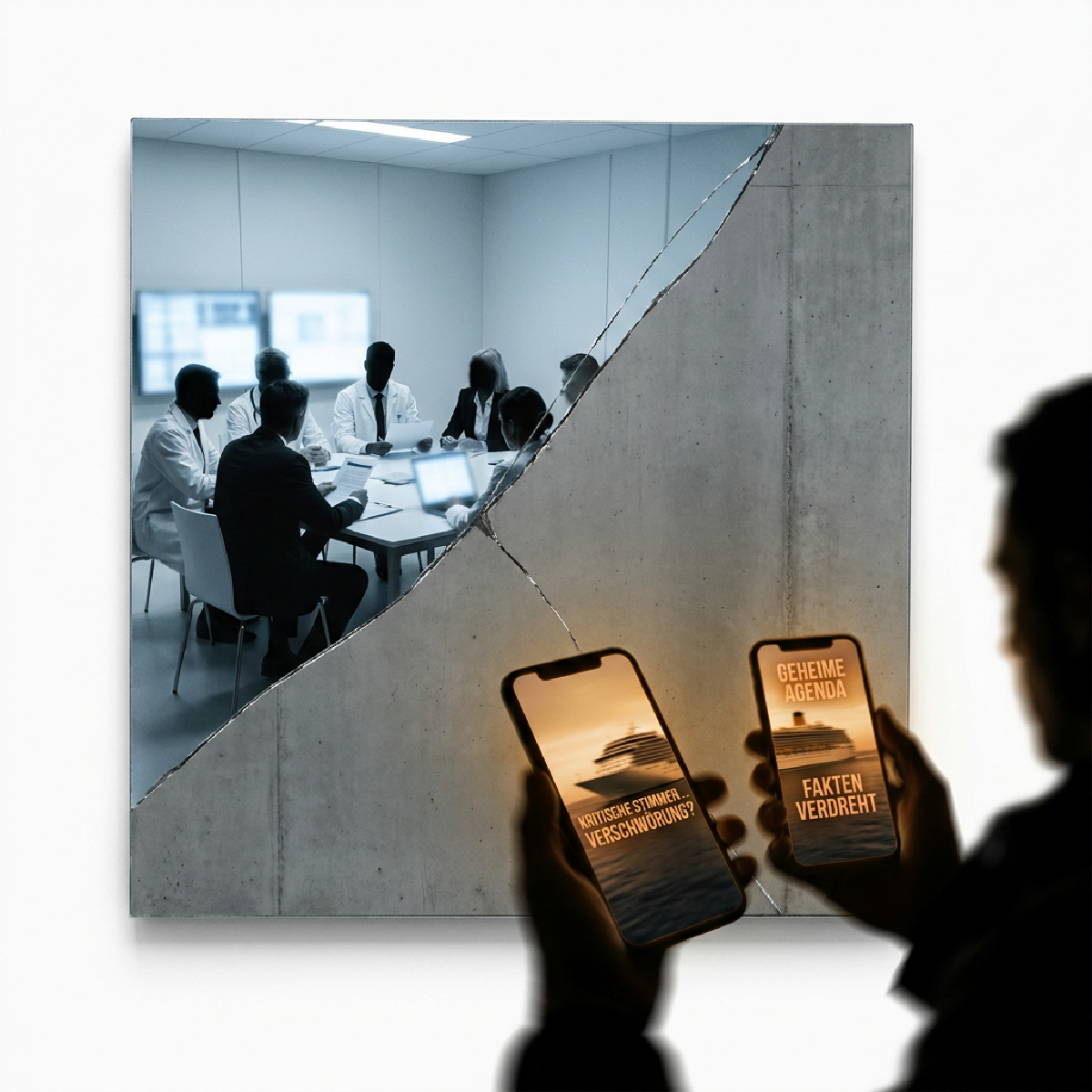
A mechanism repeats itself. Legitimate institutional self-criticism reaches a peak — and at the same moment conspiracy rhetoric appears, occupying the same space. The result: whoever asks the right questions sounds like the wrong person.
The Backdrop: Hantavirus at Sea#
On the cruise ship MV Hondius, which departed Ushuaia on 1 April 2026, an Andes hantavirus cluster broke out. As of 9 May: three dead, six confirmed cases. The WHO rates the risk as „low" — correctly. Andes is the only hantavirus strain with documented person-to-person transmission, but only through close, prolonged contact, and it has been known for decades.
On 4 May, ARD/Tagesschau broadcast an explainer clip describing the generic European hantavirus — without addressing the Andes strain. Technically not wrong. For an outbreak involving the only P2P-transmissible strain: an omission with a reassurance effect. Jonas Schmidt-Chanasit of the BNITM Hamburg publicly corrected this within 48 hours.
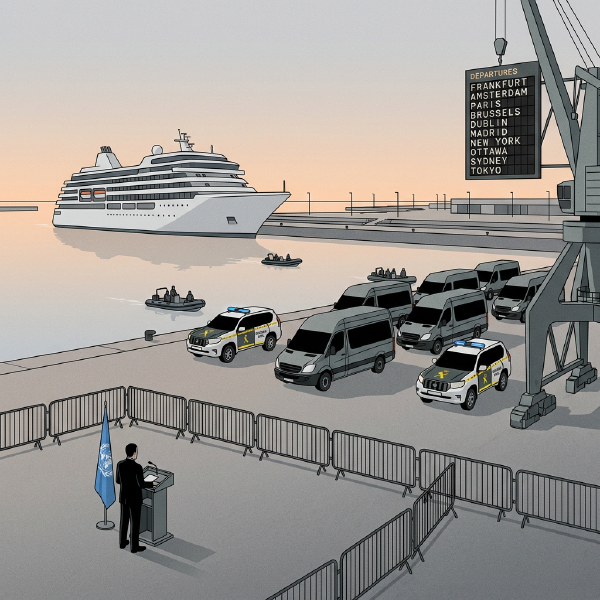
Update, 9 May: On the same day, WHO Director-General Tedros Adhanom Ghebreyesus published a direct message to the people of Tenerife — and flew personally to the island to oversee the evacuation. For six confirmed cases with a WHO risk rating of “low,” this is an unusual deployment at the highest level. The key quote: “But I need you to hear me clearly: this is not another COVID.” The comparison to COVID is drawn by Tedros himself — in order to deny it. That is pre-bunking: summoning the image you want to prevent, and thereby making it discursively available. Passengers are to be transported, per the statement, in “sealed, guarded vehicles” through a cordoned corridor. Six cases. Risk rating: low.
What Then Circulated#
The following video circulated on X/Twitter and was shared by multiple accounts. It originates from the channel “The Dr. Margaret Show” and shows footage from the Hondius response — commented with the framing that has since taken hold:
Shortly afterwards, an English-language post spread on social media (unattributed, screenshots in the editorial team’s possession): hazmat suits were “mismatched,” the WHO “jumps in immediately,” patients are “casually loaded onto planes.” Conclusion: three suggestive bullets without a single source. Climate lockdowns. mRNA rollout. Digital IDs. “Sloppy. Or deliberate.”
The post contains one correct fact — Andes does transmit person-to-person. Everything else is rhetoric. Hazmat suits vary by protection class and task (decontamination ≠ patient transport ≠ sampling); that is standard. WHO response to a multinational ship cluster is a mandatory obligation under IHR 2005, not an agenda signal. The pattern: one correct detail as a lever to support unsubstantiated conclusions.
The post works because it connects to something real: a genuine communication failure and an accountability wave that is currently gaining momentum.
The Accountability Wave#
Three findings published in recent months:
Measures zero-sum. An international team — Bernhard Müller, Ralph Brinks, Sally Cripps and John Ioannidis among others — reanalysed the data from the RKI’s own StopptCOVID study using nine competing statistical models. Result (published in Scientific Reports): the confidence intervals are substantially wider than the official analysis suggests; for most of the measures examined, no robust effect can be derived. The study targets RKI methodology — not named individual politicians. At the Corona Inquiry Commission hearing of 7 May 2026, Rehfuess stated it was “only conditionally useful” to assess the effectiveness of individual measures — what mattered was “always a package of measures.” RKI head Schaade put COVID deaths at around 172,000. The methodological critique by Müller/Brinks/Ioannidis — that individual measure effects are statistically unverifiable — went unmentioned at the hearing.
Dilettante admission. Martin Sprenger (Public Health, Medical University Graz, former Austrian Corona Task Force) and Prof. Andreas Radbruch (Immunologist, DRFZ Berlin, former EFIS President) wrote in September 2024 in the Berliner Zeitung, looking back: on the question of protection of others, “primarily immunological dilettantes had spoken up.” The EMA itself states that COVID vaccines were not specifically authorised to prevent transmission — the third-party-protection communication rested on early, short-term observational studies without a regulatory basis.
The money. The EU Court of Auditors established in its Annual Report 2024 that six of the 28 grants paid out in 2024 under the Recovery and Resilience Facility — total value 59.9 billion euros — did not comply with applicable rules. The Commission collects no data on actual expenditure per measure, even when member states could provide such data. The European Parliament described this as a scandal — 750 billion euros in debt, no overview.
The Mechanism#
The coincidence of accountability and a new fear wave is opportunism, not coordination: when institutional self-criticism becomes visible, a space for reckoning opens — and that space is occupied by those who want to use it for something else.
The conspiracy post pretends to stand on the side of the exposers. It uses the same language: institutional failure, media failure, loss of control. But it flips the narrative. Not “authorities have failed, we must account for it” but: “authorities are staging it, we must unmask them.” The difference is fundamental.
Accountability requires evidence, sources, names, procedures. It works because Sprenger and Radbruch name who claimed what. Because a team subjects the study to methodological review. Because the Court of Auditors writes reports.
Conspiracy rhetoric needs none of that. It only needs the timing.
The Concrete Danger#
When the RKI minutes became public in 2024 and FDP deputy chairman Kubicki demanded consequences, Lauterbach warned: “I urgently warn against distorting the past with speculation, insinuations and conspiracy theories.” The debate about the minutes — that is, about government agency conduct in an exceptional situation — was placed in the same sentence as conspiracy theories. That is the mechanism: whoever asks for accountability ends up linguistically adjacent to those who treat accountability as a prop.
That is the real harm of the hazmat-theatre post: not the thesis itself, but the association. Every post that converts legitimate criticism into control-narrative bait makes it a little easier to dismiss the Court of Auditors’ findings and the Sprenger/Radbruch analysis as “the same milieu.”
Further reading on elizaonsteroids.org: MV Hondius: What Really Happened · The Tagesschau Strain Confusion