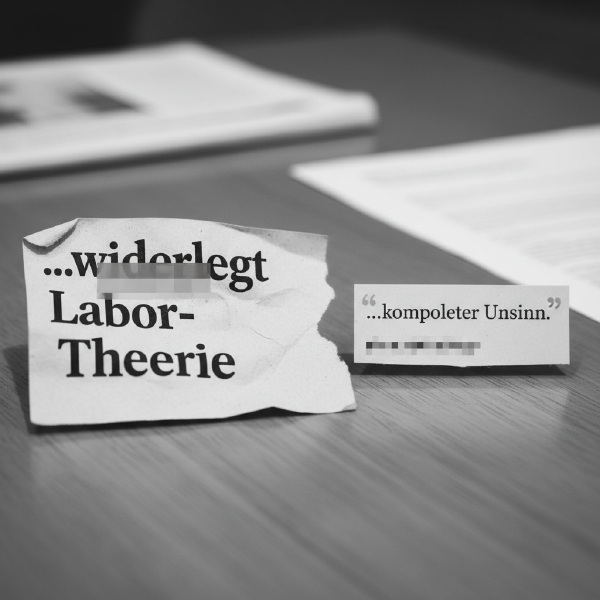
There is a sentence that has been publicly accessible since 2021, in a 69-page grant application financed with taxpayer money. It reads:
“Despite the gain-of-function approach in these experiments, we do not believe we will generate viruses with increased virulence or DURC potential.”
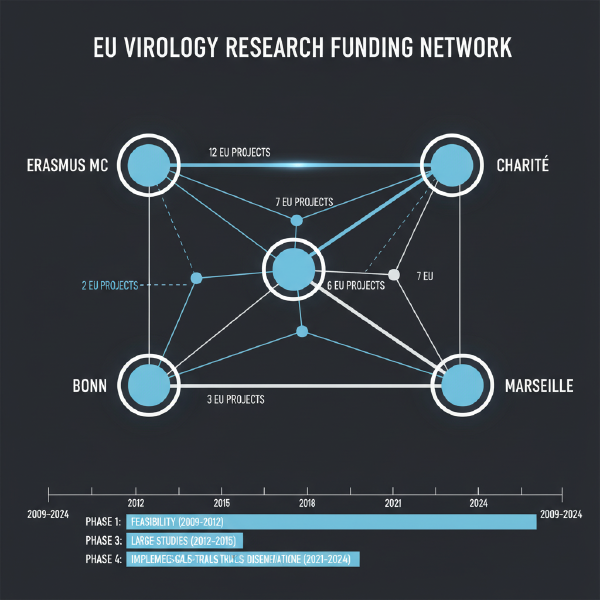
The application belongs to the research consortium RAPID — “Risk Assessment in Prepandemic Respiratory Infectious Diseases,” funded by the German Federal Ministry of Research from 2017 to 2022 with around four million euros. The consortium’s coordinator and spokesperson: Christian Drosten, Charité, Institute of Virology.
In February 2020 that same Christian Drosten co-signed the Lancet letter — the statement by 27 scientists declaring a natural origin of the virus the probable one and labelling competing assumptions, the lab hypothesis among them, as “conspiracy theories.”
These are two documented facts. They have stood side by side for years, without anyone laying them side by side. That is exactly the point.
What Is Actually Documented — and What Is Not#
Before any assessment comes, the facts, cleanly separated. We are not building a scandal on an insinuation. We lay out what holds and what does not.
The gain-of-function evidence exists verbatim. The quoted sentence comes from the publicly accessible grant application itself — not from a secondary source, not from a leaked document, not from an interpretation. Anyone claiming that “gain of function” was pinned on Drosten by critics is mistaken: the term stands in the paper his own working group submitted.
The reach of that evidence is limited — and that belongs in the same paragraph. The application describes loss- and gain-of-function experiments on cultured cells, not on viruses. It concerns the identification of host factors, not the deliberate increase of virulence or transmissibility in a pathogen. A Charité spokesperson stated in 2025: “The gain-of-function experiments in the Rapid research consortium do not relate to viruses but to cultured cells and carry no risk whatsoever.” That is the exculpatory reading, and it is not pulled from thin air — the qualifying follow-up sentence stands in the application itself.
Anyone who turns this evidence into “Drosten ran Wuhan-style gain-of-function on dangerous viruses” overreaches. We do not make that leap.
The Lancet letter is equally documented. Drosten is one of 27 signatories; the statement appeared on 19 February 2020; its wording and the list of signatories have been public for years. That several signatories simultaneously held professional ties to precisely the research whose risks the letter was meant to remove from the debate has been broadly documented since 2021.
So much for the facts. Each one holds on its own. Now what they add up to together.
The Elephant in the Room#
Let us place the two sentences side by side, verbatim.
In his own grant application: “Despite the gain-of-function approach in these experiments…”
In the co-signed Lancet letter, in substance: Anyone who considers a lab origin of the virus is spreading a conspiracy theory.
You do not need to be a virologist to see what does not fit here. Gain-of-function research is precisely the mechanism that makes a lab origin conceivable in the first place — it sits at the centre of the very debate the Lancet letter declared closed. And a scientist who uses the term “gain of function” in his own publicly funded application — even if for cell cultures, even with a risk disclaimer — at the same time signs the document that declares public discussion of the lab origin a conspiracy narrative and thereby clears it away.
This is not proof of a conspiracy. It is something more sober and harder to argue away: a conflict of interest. A person active in the matter itself simultaneously shapes, in public, the rule that the matter may not be discussed with an open outcome. In any other field — pharma, finance, construction law — this would be the textbook case in which you check for bias before you trust the assessment.
In Germany this conflict of interest has never been named as one. Not because the facts are missing — they have lain open for years. But because the naming itself was placed under the very suspicion the Lancet letter established.
Cui Bono — Who Benefits From the Silence#
The question is not whether Drosten sat in a Wuhan lab. He did not, and no one here claims that.
The question is why a documented dual role — actor in gain-of-function-adjacent research and co-author of the gag order on the lab-origin debate — is allowed to be a non-topic in the German public sphere, while the same structural questions are long since being litigated in the United States in committees of inquiry, FOIA emails and Congressional reports.
The exculpatory arguments are real and they stand above: cell cultures, no pathogen, risk disclaimer. But a conflict of interest does not vanish because the concrete activity was harmless. It resides in the constellation — being active and simultaneously setting the rules of the debate — not in the outcome of the activity. It is precisely this distinction that was never drawn. It was skipped over by shoving everyone who wanted to draw it into the camp of the cranks.
What This Has to Do With the ODNI Files — and What It Does Not#
In the ODNI documents declassified in June 2026, Drosten does not appear as an actor. A full-text pass across all four parts yields two hits, both in bibliographies. “RAPID” appears there not once. Anyone selling the Drosten thread as the content of this release hangs a real body of facts on the wrong source — and thereby makes it attackable, even though the facts beneath it hold.
That is exactly why this finding stands on its own legs. It does not need the new release. It needs no freshly declassified intelligence folder, no “revealed” label. The grant application and the Lancet letter have lain open for years. The material was always there. What was missing was someone to lay the two documents side by side and call by its name what then becomes visible.
Precision here is not a question of which camp you belong to. It is not agitation to call an openly documented conflict of interest a conflict of interest. And it is not enlightenment to keep overlooking it, merely because naming it was once deemed a conspiracy theory.