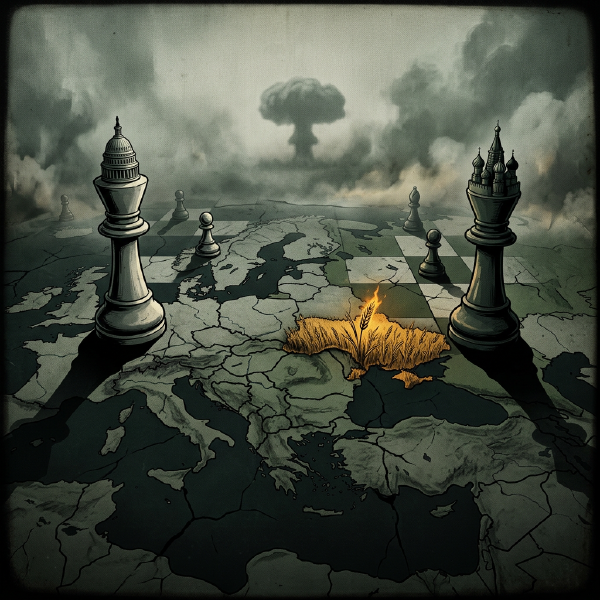
In a remark at the US Department of State, Donald Trump dismantled Germany’s sitting Federal Chancellor Friedrich Merz on four axes — immigration, energy, Ukraine, Iran. What is structurally interesting about this remark is not Trump. It is the asymmetry between what he is saying and what is being said about the same matters in the German public discourse.
1. The four axes#
| Charge | Factual standing |
|---|---|
| Immigration | Merz / CDU built migration into the central campaign theme of 2025. In government, work continues essentially with the apparatus inherited from the Faeser period. No break, only a re-branding. |
| Energy | German electricity prices: top of the EU ranking. Gas supply largely via expensive US LNG. Simultaneous trifecta of nuclear phase-out, coal phase-out, and accelerating industrial flight. — Bonus irony: the very speaker delivering the criticism is the supplier of the LNG that German industry is breaking on. |
| Ukraine | Trump’s phrasing — “they’re in this shit” — is crude. Substantively it is not wrong: the Taurus-delivery debate has been used by the Federal Government as a lever for strength-signalling, while the communicated escalation costs remain unspoken. |
| Iran | “Would you like a nuclear weapon in the hands of Iran? No? Well then.” — false dichotomy. Iran policy is not the binary choice between “atom bomb for Iran yes or no”. This is a rhetorical trick. Trump reports that Merz “had no answer” — more probable: Merz had no appetite for the trick. |
2. Three hits, one trick#
Bilan: three points (immigration, energy, Ukraine) hit structurally. They describe matters that can be looked up in Eurostat data, in line items of the federal budget, and in the CDU’s own 2025 campaign programme. They are no secret knowledge — and yet they are very rarely heard in the German mainstream commentary on the Federal Government with this kind of sharpness.
The fourth point — the Iran question — is a rhetorical trick. That too has to be named. Structural analysis means calling three hits three hits and calling a trick a trick.
3. What Trump can say#
There is an old German expression: “One crow does not peck out another crow’s eye.” It describes the unwritten code of a closed system — members spare one another, because each member could fill the next vacancy, because loyalty is reciprocal, and because breaking the code is expensive.
The German political-media establishment is such a flock of crows. One crow is the governing party; another is the recently-governed party; a third is the leading newspaper; a fourth is the publicly-funded foundation; a fifth is the talk-show circle. They all live off a shared consensus apparatus — and inside that apparatus, the situation in energy, migration, and Ukraine is difficult, complex, in flux, but never simply “a terrible job”.
Trump is not a German crow. He is a foreign one — bigger, rougher. His incentive is not to spare the consensus system — his incentive is to use it. And so he can articulate what the German crows cannot articulate, because they are not permitted to articulate it.
That is the observation. It is not a Trump endorsement. It is a diagnosis of the asymmetry: the most diagnostically clear thing can be said by the one who stands outside. What this says about those who stand inside is the second question — and it is the more important one.
4. Methodological note on the observation#
This article assesses no person. It observes an asymmetry between a foreign and a domestic mode of speaking about the same matter. Three of the four charges Trump raised are factually accurate, they were so before Trump’s remark and they will be so after. The fourth is a rhetorical trick and that too was true before and after. What changes through the remark is solely this: the three accurate observations have now been spoken under a loudspeaker loud enough that German consensus silence can no longer successfully drown them out.
Conclusion#
Anyone who, in the past years, has been patient with the diagnosis that German energy, migration, and foreign policy operates inside a closed consensus silence may regard 1 May 2026 as a date on which that silence took its first audible crack. A foreign crow has started pecking.
The show has begun.
Sources and references
- Donald Trump, remark at the US Department of State, early May 2026 (video recording embedded above).
- EU electricity prices in comparison: Eurostat, Energy Statistics 2025 / H1.
- Federal Budget 2026 — defence and Ukraine-aid line items vs. other departments: Federal Ministry of Finance, public budget plan.
- CDU 2025 campaign programme: migration chapter; comparison with implementation status BMI 2026.
- Taurus debate: plenary records of the German Bundestag, spring 2026.
Methodological note: This article follows the methodology of the structural-analysis series (see Methodology). What is observed is the asymmetry between speech and matter, not a person.