The hope was real: Donald Trump back in the White House, known for statements in favour of a negotiated solution in Ukraine, and Vladimir Putin, who has signalled for years that an agreement is possible — if Russia’s security interests are respected. But where does that stand now?
Publicist and former ARD correspondent Christoph Hörstel takes the current situation apart in a recent interview — and arrives at a sobering conclusion: Trump cannot deliver what Putin needs. And as long as that remains true, the war will continue.
The Structural Problem: Trump and the Limits of His Power#
Hörstel recalls that Trump, already in his first term in 2017, announced he wanted to meet Putin and reach an agreement with Russia. It took eighteen months before a personal meeting finally happened. And when Trump dared to sit with Putin without handlers, US media ran the headline: “Trump sells America to Russia.”
The pattern is repeating. Trump’s special envoy Witkoff regularly assures the Russians that Trump has goodwill. But concrete commitments — genuine security guarantees, clear agreements on the status of occupied territories, binding neutrality assurances for Ukraine — remain absent.
Hörstel’s explanation: Trump does not govern alone. Institutional forces in Washington — intelligence agencies, the foreign policy establishment, and transatlantic networks — significantly limit his room for manoeuvre. A US president seeking a genuine course change toward Russia within this system faces structural resistance.
What Putin Needs — and Is Not Getting#
Russia’s position, in Hörstel’s analysis, reduces to one core: Russia cannot accept a ceasefire that leaves Ukraine as a potential threat. That means three things: no NATO membership for Ukraine, no Western troops on Ukrainian soil, and binding guarantees for the Russian-speaking population in regions not yet under Russian control.
There is also a trust deficit. The Minsk Agreement — which Putin publicly welcomed as a peace opportunity — was later admitted by leading Western politicians to have never been treated as a genuine agreement, but as time bought for Ukrainian rearmament. Anyone who knows that will not trust the next agreement without hard facts.
Hörstel argues that in this situation, Putin sees no reason to trade the military superiority Russia has now achieved against vague promises. What is at stake for him is not only Russia’s territorial control — but whether the Russian-speaking population in Ukraine will ever receive protection.
The Nuclear Risk#
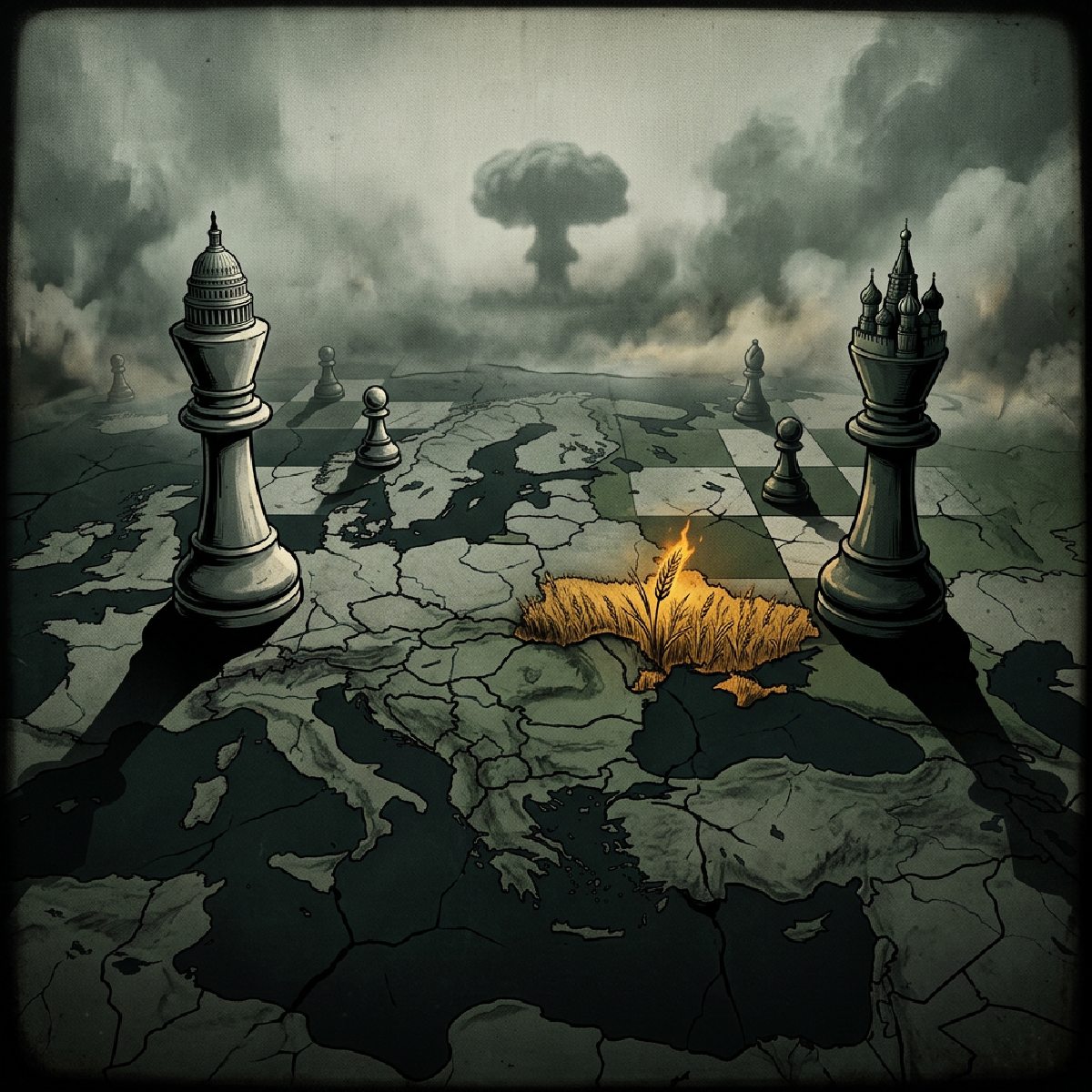
The sharpest part of Hörstel’s analysis concerns the escalation scenario. Should NATO ever attempt to defeat Russia militarily through conventional means, nuclear consequences would follow — on this he is unambiguous. Conventional NATO superiority exists on paper, but effective joint warfare across 30 member states with diverging interests is barely achievable in practice.
What makes the situation more acute: certain strategic analyses — he references planning documents from the American RAND Corporation — have developed a scenario logic in which a phase of reduced combat intensity from 2025–2026 is followed by renewed escalation. Ceasefire as pause, not as end. Ukrainian rearmament during that window — and then another push.
Whether this analysis is accurate is open. But the question of which interests are actually served by a lasting end to the conflict — on either side — is a legitimate one.
Greenland and the Logic of Lawless Space#
Hörstel also addresses Trump’s Greenland ambitions, placing them in a broader context: the tendency of powerful actors — states and corporations alike — to create or open up spaces outside established legal systems. Greenland, with its sparse population, its resources, and its strategic Arctic position, would lend itself to such purposes.
Greenland’s colonial history under Danish rule is not a marginal detail here. Denmark made deep incisions into Inuit culture and social fabric over decades — a legacy that shapes the political mood on the island today. That Greenlanders respond with scepticism or outright rejection to American takeover ambitions is understandable against this backdrop.
Power Concentration and the New Oligarchy#
An overarching theme of the conversation is the concentration of economic and political power among a shrinking group of global actors. Hörstel uses the term “new pharaohs” for actors who increasingly operate outside classical nation-state legal frameworks and set their own rules.
This is not a new observation. The debate about democratic accountability vis-à-vis global technology and finance giants, about tax havens, lobbying power, and the growing revolving door between government advisers and the private sector, has long entered the mainstream — from Oxfam to the World Economic Forum. The question of who ultimately decides on the rules is becoming more pressing.
What Remains#
Hörstel’s analysis is pessimistic but not fatalist. His closing message is one of personal agency: those who wait for rescue from above wait in vain. Sovereignty begins small — in trusting one’s own values, one’s own networks, one’s own judgement.
That is an uncomfortable message. It evades the left-right political schema dominating many debates. And perhaps that is precisely its value: the demand to think things through for yourself — independently of what one’s preferred party happens to be saying.
Source#
The full interview:
The assessments and analyses in this article reflect the personal political views of Christoph Hörstel.