A Former Nazi Family, Two Federal Ministries, a Campaign NGO, and a PR Consultant. The Network Behind the Organization Demanding Mandatory Real-Name Identification Online.#
What HateAid Is#
HateAid is a Berlin-based non-profit GmbH, founded in 2018. Official purpose: counseling and supporting victims of digital violence. 54 employees. 143 cease-and-desist letters and 49 civil lawsuits in 2024.
That sounds good. Against hate online — who could be against it?
The question isn’t whether HateAid does good work. The question is: who pays for it? And what else is the money paying for?
The Shareholders#
HateAid publishes its ownership structure on its own website. Transparency requirement. All public:
| Shareholder | Share | Location |
|---|---|---|
| Campact e.V. | 33.32% | Berlin |
| Anna-Lena von Hodenberg | 33.34% | Berlin |
| Fearless Democracy e.V. | 33.34% | Hamburg |
Three equal thirds. Three actors. Let’s look at them.
Campact: €24.6 Million and a Pre-Written Article#
Campact e.V. is one of Germany’s largest campaign organizations. 4.25 million supporters. In 2024, Campact raised €24.6 million in donations — a record. An additional €4.3 million went to the affiliated foundation.
Campact says: no state money, no corporate money. Only donations.
That’s true — for Campact itself. But Campact holds 33.32% of HateAid. And HateAid receives state funding. A clean separation that, on closer inspection, isn’t one.
On March 19, 2026, Spiegel published its cover story about Collien Fernandes and Christian Ulmen. On March 20 — one day later — Campact had a finished article online. 2,000 words, a Gisèle Pelicot comparison, political demands.
Campact doesn’t write a 2,000-word article overnight. The text was prepared. The shareholder knew what its subsidiary was planning.
Fearless Democracy: A PR Consultant Founds an NGO#
Fearless Democracy e.V. was founded in 2017 by Gerald Hensel. Hensel is not an activist — he’s a communications and digital expert, an advertising consultant.
The association is funded in part by the Robert Bosch Foundation.
A PR consultant founds an NGO against “hate online,” the NGO co-founds a non-profit GmbH with a campaign organization, the GmbH receives state funding and demands mandatory real-name identification. This is not a grassroots movement. This is professional campaign work.
The Funders: Who Pays More Than 10%?#
HateAid is legally required to disclose funders whose annual contribution exceeds ten percent of total revenues. For 2024, these are:
- Alfred Landecker Foundation
- Federal Ministry of Justice
- Federal Ministry for Family, Seniors, Women and Youth
According to Spiegel, HateAid finances itself approximately 50% from private funding, and approximately 20% each from public funding and free donations.
The Bundestag’s budget committee explicitly extended the funding in 2024 — even though the government’s draft budget had no longer provided for it.
Alfred Landecker Foundation: €260 Million from a Former Nazi Family#
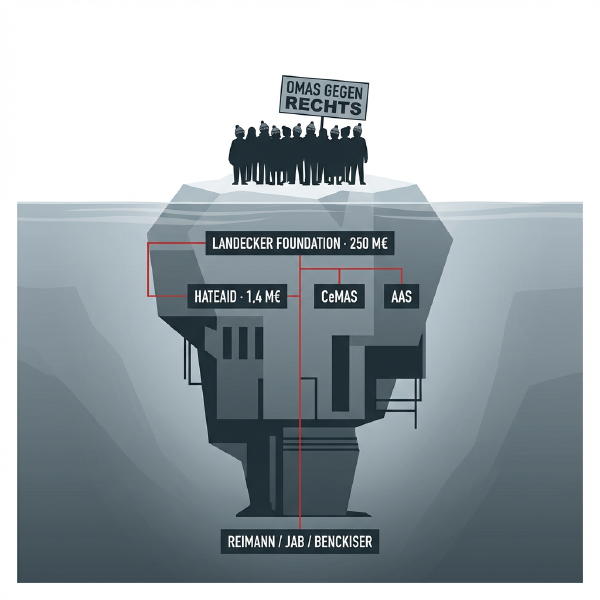
The Alfred Landecker Foundation is the foundation of the Reimann family of entrepreneurs. Endowment: €260 million.
The Reimanns are one of Germany’s wealthiest families. Estimated total fortune: €35 billion. Their holding company JAB controls a global empire — brands that millions of people use daily without knowing who stands behind them:
- Coffee: Jacobs, Senseo, Tassimo (JDE), Peet’s Coffee, Caribou Coffee, Stumptown, Intelligentsia
- Restaurants: Pret A Manger, Panera Bread, Einstein Bros Bagels, Krispy Kreme, Insomnia Cookies
- Beverages: Keurig Dr Pepper
- Cosmetics (COTY): Calvin Klein, Covergirl, OPI, Marc Jacobs, Clairol
- Household (Reckitt Benckiser, minority stake): Calgon, Sagrotan, Finish, Vanish, Kukident, Durex, Nurofen
- Luxury: Jimmy Choo, Bally
The family’s history: Albert Reimann senior and Albert Reimann junior were “ardent supporters of the Hitler regime.” In the facilities of Joh. A. Benckiser GmbH in Ludwigshafen during the Nazi era, there was forced labor, violence, and abuse of forced laborers — including at the family’s private villa.
In 2019, the family publicly acknowledged its past for the first time. It paid €10 million to former forced laborers and their descendants. €10 million — out of €35 billion.
In the same year, the family founded the Alfred Landecker Foundation. Official purpose: Holocaust remembrance, combating antisemitism, strengthening democracy.
One of the largest funders of HateAid — the organization demanding mandatory real-name identification online — is thus the reparations foundation of a family that profited from forced labor.
The Chain#
Laying the publicly available information side by side, the following picture emerges:
Funding:
- Reimann family (€35bn) → Alfred Landecker Foundation (€260m) → HateAid (>10% budget)
- Federal Ministry of Justice → HateAid (~20% budget)
- Federal Ministry for Family → HateAid (~20% budget)
Shareholders:
- Campact (€24.6m/year, 33.32%) → HateAid
- Fearless Democracy (PR consultant Hensel, 33.34%) → HateAid
- Von Hodenberg (CEO, 33.34%) → HateAid
Fernandes/Ulmen Campaign (March 2026):
- HateAid works with Fernandes
- HateAid CEO Ballon knew about the case for months
- Campact has a finished article within 24 hours
- Fernandes demands mandatory real-name identification in an interview
- Rally at the Brandenburg Gate in 72 hours
What the Timeline Doesn’t Explain#
- Until September 2025: Fernandes and Ulmen film joint commercials for Shop Apotheke — in pajamas, as a happy couple.
- September 2025: Separation. Shop Apotheke switches to separate clips — pre-produced.
- Late 2025: Complaint filed in Spain.
- March 2026: Spiegel cover story, HateAid campaign, rally, draft legislation.
- March 2026: Shop Apotheke suspends advertising entirely.
The question: exactly when did the allegations begin — and what did HateAid CEO Ballon know when she said she’d known about the case “for months”? Was that before or after the separation? Before or after the joint commercial shoots?
What This Means — and What It Doesn’t#
This article does not claim that HateAid does no meaningful work. Digital violence is real. Deepfakes are a problem. Victims need support.
This article also does not claim that a conspiracy exists. Everything described here is publicly accessible — on the websites of the organizations involved, in Bundestag printed papers, in annual financial statements.
What this article shows:
The funding is not neutral. Whoever is funded by two ministries and a former Nazi family’s foundation is not independent — regardless of what the website says.
The campaign structure is professional. Campact co-founds HateAid, HateAid prepares the case for months, Campact has the finished article, politicians demand new laws. This is not organic outrage. It is a pipeline.
The goal is political. Mandatory real-name identification on the internet is not a protective measure for deepfake victims. It is a surveillance instrument that strips whistleblowers, journalists, dissidents, and critics of their anonymity.
The question isn’t whether HateAid does good work. The question is: for whom?
Sources#
- HateAid: Transparency Report hateaid.org
- taz (08.08.2025): Campact transparency report: more money than ever before
- Campact: How Campact finances itself campact.de
- Campact (20.03.2026): Article on the Fernandes/Ulmen case
- politik&kommunikation: Hensel founds Fearless Democracy
- Robert Bosch Foundation: Who are you on the digital stage?
- Spiegel (25.12.2025): HateAid: What does the organization do? And how is it funded?
- Bundestag (2024): Budget 2024: ‘Hate Aid’ funding continues
- Alfred Landecker Foundation: Who We Are alfredlandecker.org
- DW (24.03.2019): Nazi past catches up with billionaire Reimann family
- Handelsblatt (12.12.2019): Reimann family pays €10 million to former forced laborers
- Apotheke ADHOC / RTL (2026): Shop Apotheke suspends advertising with Ulmen and Fernandes
Whoever criticizes HateAid gets branded as a hate advocate. That’s part of the strategy. Because who could be against an organization that fights “against hate”? Nobody. That’s exactly what they’re counting on. The question isn’t whether hate should be combated. The question is: who decides what hate is — and who gets paid to define it?
Update (23 April 2026): “If we don’t get it, we’ll just have to shut down half of our counselling work”#
In a short video (original linked below as source [21]), Josephine Ballon and Anna-Lena von Hodenberg step in front of the camera and say the sentence that confirms this entire structural analysis in four seconds:
“We’re not being funded for now. We can re-apply. It’s completely unclear whether we’ll continue to be funded… […] We have to re-apply now. We don’t know whether we’ll be funded again from the Family Ministry. And yes, if we’re not, then we’ll just have to shut down half of our counselling work.”
— Josephine Ballon and Anna-Lena von Hodenberg, HateAid video April 2026 [21]
Two sentences contain everything that a 2,500-word structural analysis would otherwise have to build up:
- The economic existence of the organisation hangs on the goodwill of the BMFSFJ. Not on citizens’ donations, not on membership fees, not on a private foundation model that would buffer existence. On a ministerial grant decision. If the ministry does not renew the funding, half of the offer disappears. A civil-society self-organisation of “those affected by digital violence”, as HateAid presents itself, looks different.
- HateAid says so itself. No critical research is needed, no whistleblower, no leaked Drucksache — the CEOs say it on camera. That ends any debate about whether the structural analysis of this blog overstates: HateAid confirms it verbatim.
Immediately afterwards the video quotes Markus Söder: “NGOs as octopuses that have nestled themselves into the state.” The reaction of the two HateAid CEOs: collective laughter — and the slogan “Free speech needs boundaries”.
That is self-reveal in pure form. Söder criticises the octopus arm. The CEOs of an organisation that without BMFSFJ money would have to shut down half of its operational activity respond with a sentence that confirms exactly the self-understanding Söder is criticising: that it is legitimate when a state-financed private organisation publicly defines where the boundaries of free speech should run.
What this means for the structural analysis#
Three points from this self-reveal:
- The staff knows what they do. The usual defensive line “the activists are just engaged young people who support those affected” is here refuted — by the CEOs themselves. They make no naivety claim. They thematise the federal funding as their economic basis of life. They know what they are.
- The bypass of the population. Over the construction “federal ministry funds private organisation that helps shape free-speech boundaries and submits draft laws on its own demands to the same justice ministry”, there was never a referendum. There was no election decision on it. There was only a funding logic running in the background, until the loss of funding makes it visible.
- The displacement dynamic. Whoever co-funds, co-defines. An NGO half-financed by the BMFSFJ cannot simultaneously be the independent watchdog against digital encroachment and the legislative cue-giver of the justice ministry. It is both — and thereby has a conflict potential with its own self-presentation that, in the video, for the first time, is no longer publicly hidden.
What happens if the funding is not renewed#
If the BMFSFJ does not renew the HateAid funding, that is not the end of the work against digital violence. It is the stress test for the claim that HateAid emerged “from civil society”. If, in the absence of federal funding, no significant donation surge from civil society materialises to compensate, then HateAid was not a civil-society organisation with occasional state co-financing, but a state-borne programme-outsourcing post with occasional donations. The stress test will answer that question empirically.
The reaction of the CEOs in the video already gives an advance answer. Anyone who responds to the loss of state funding with “then we’ll just have to shut down half of our counselling work” has no Plan B from civil society. There is none, because there never was one. That is what structural analyses are for: so that reality is not left to the communications of those staging it — even when those staging it voluntarily disprove it on camera.
[21] HateAid (April 2026): short video with Josephine Ballon and Anna-Lena von Hodenberg on the funding uncertainty and Söder reaction. youtu.be/KaKs4-nFvic