The paper that became the global PCR standard had twenty-four co-authors. Submitted: January 21, 2020. Accepted: January 22, 2020. Published: January 23, 2020. Cross-referencing the institutional affiliations of those co-authors against the EU funding database CORDIS reveals a network documented at least eleven years earlier.
Five EU Projects, One Constant#
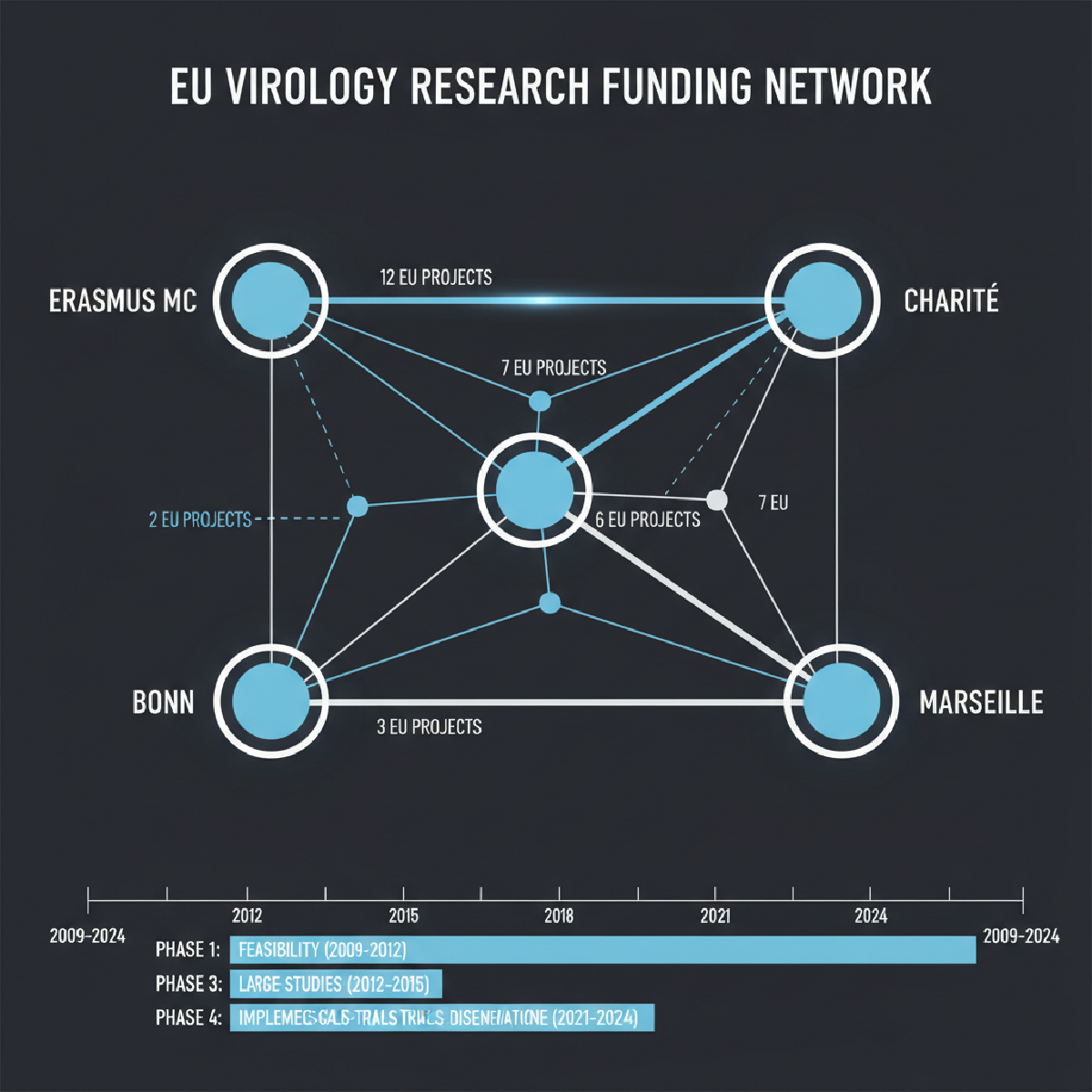
The CORDIS database of the European Commission lists EU-funded research projects with partners, budgets, and durations. For the period 2009 to 2024, five projects in the area of Emerging Infectious Diseases / Zoonoses are relevant — projects in which the principal institutions of the Corman-Drosten paper participated.
EMPERIE (Grant 223498, FP7, 2009–2014): Budget €15.9 million. Coordinator: Erasmus Universitair Medisch Centrum Rotterdam. Consortium member: University Hospital Bonn.
ANTIGONE (Grant 278976, FP7, 2011–2016): Budget €15.7 million. Coordinator: Erasmus MC Rotterdam. Consortium member: University Hospital Bonn.
COMPARE (Grant 643476, Horizon 2020, 2014–2019): Budget €20.8 million. Coordinator: Danmarks Tekniske Universitet. Consortium members: Erasmus MC Rotterdam, University Hospital Bonn, Charité Berlin — all three listed as separate participants.
EVAg (Grant 653316, Horizon 2020, 2015–2020): Budget €12.2 million. Consortium members: Erasmus MC Rotterdam, University Hospital Bonn, Charité Berlin.
EVA-GLOBAL (Grant 871029, Horizon 2020, 2020–2024): Budget €13.9 million — 100 percent EU-funded. Consortium members: Erasmus MC Rotterdam, Charité Berlin.
Erasmus MC appears in all five projects — as coordinator in the early FP7 projects, as consortium member from Horizon 2020 onward.
Drosten’s Move and Its Trace in the Database#
Christian Drosten moved from University Hospital Bonn to Charité — Universitätsmedizin Berlin in March 2017. The CORDIS project list reflects this transition with documentary precision.
In COMPARE (2014–2019) and EVAg (2015–2020), both University Hospital Bonn and Charité Berlin are listed as separate consortium members. The Bonn participation was terminated early in both projects; the Charité participation continued. In EVA-GLOBAL (2020–2024), Bonn no longer appears — only the Charité.
The CORDIS entries map the known institutional trajectory without gaps.
The PCR Paper: An Author List From the Network#
Corman et al. 2020 has twenty-four co-authors. According to available source documentation, eight come from Erasmus MC Rotterdam (Richard Molenkamp, Daphne Mulders, Bart Haagmans, Bas van der Veer, Sharon van den Brink, Lisa Wijsman, Gabriel Goderski, Marion Koopmans) and six from Charité Berlin (Victor Corman, Tobias Bleicker, Sebastian Brünink, Julia Schneider, Marie Luisa Schmidt, Christian Drosten).
Jean-Louis Romette — a co-author from Marseille — comes from the EVA network, the predecessor of EVAg and EVA-GLOBAL, whose coordination is also based in Marseille.
The paper was produced within an author group whose home institutions had jointly received EU funding for eleven years.
Chantal Reusken, also a co-author, was Associate Editor of Euro Surveillance at the time of submission. So was Drosten. Both were excluded from the journal’s own investigation into the retraction petition — explicitly to avoid potential conflicts of interest. The three transparency problems — editorial board dual role, TIB-Molbiol conflict of interest, 24-hour peer review — are documented in a separate article.
What Is Not in CORDIS#
Marion Koopmans held several WHO positions: Director of two WHO Collaborating Centres, member of the WHO R&D Blueprint Scientific Advisory Group, member of the EU Scientific Advisory Group on COVID-19 (from March 2020). Whether she was a formal member of the COVID-19 IHR Emergency Committee — the body advising the PHEIC declaration — could not be verified from accessible sources. The relevant WHO PDF was not parseable. The distinction between the WHO R&D Blueprint Advisory Group and the IHR Emergency Committee is precise and non-trivial; it is not blurred here.
Formal WHO or ECDC advisory functions held by Drosten before 2020 are not documented in primary sources. The Associate Editor role at Euro Surveillance (an ECDC publication) at the time of submission is documented.
What the CORDIS Data Show#
A research network that collaborated across five EU-funded projects from 2009 to 2024 produced a paper in January 2020 that became the global diagnostic standard within weeks. The institutional connections between the participating organizations are documented in the EU’s public funding database — not in investigative reports, not in leaks, but in CORDIS.
The network does not explain how the decision was made to peer-review this paper in 24 hours. It does not explain why two co-authors simultaneously served as Associate Editors of the publishing journal. Those questions have their own answers — or none.
What it shows: the authors of the paper that defined global COVID-19 diagnostics knew each other. Their institutions had jointly coordinated projects. That is the finding. It is in CORDIS.
Further reading on elizaonsteroids.org:
- Three Transparency Gaps in the Key PCR Paper — Editorial board conflict, TIB-Molbiol, 24h review
- An Inquiry That Predetermined Its Findings — on the Enquete Commission