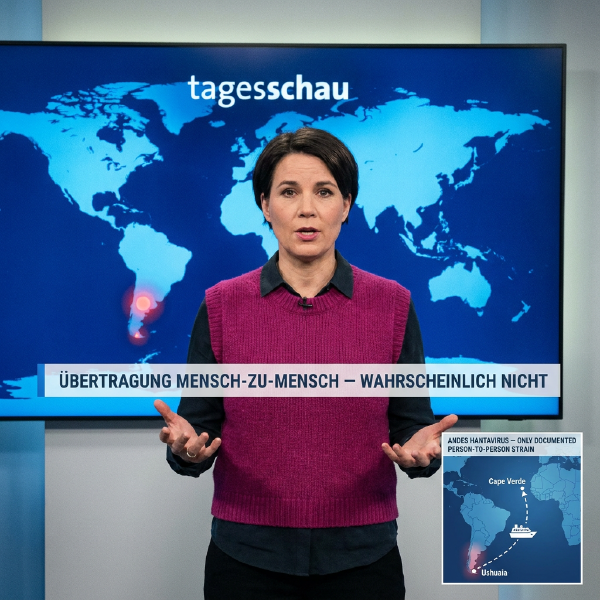
On May 4, 2026, the WHO confirms: three people have died following a virus outbreak aboard the MV Hondius. The ship — a polar expedition vessel operated by Dutch company Oceanwide Expeditions — was en route from Ushuaia, Argentina, to Cape Verde. Laboratory confirmed: Andes hantavirus.
What looks at first glance like a tragic isolated incident reveals, on closer inspection, a textbook case of institutional response patterns — and names we recognise from a different outbreak.
1. The Outbreak: What Is Confirmed#
| Fact | Source |
|---|---|
| 7 cases (2 confirmed, 5 suspected), 3 dead | WHO, 05.05.2026 |
| Laboratory confirmed: hantavirus (two fatalities) | WHO |
| Route: Ushuaia → Antarctica → Saint Helena → Cape Verde | WHO, MercoPress |
| Ship: MV Hondius, Oceanwide Expeditions | Berliner Zeitung, 04.05.2026 |
| HQ Oceanwide Expeditions: Vlissingen, Netherlands | Oceanwide Expeditions |
| 70-year-old passenger dies on board (Saint Helena) | WHO |
| 69-year-old Dutch woman: deteriorated during flight to Johannesburg, died on arrival at Mediclinic Sandton Hospital (26 April) | WHO DON |
| Third fatality: German national, 2 May | WHO |
| Person-to-person transmission officially suspected | WHO, 05.05.2026 |
| Cape Verde refuses docking — ship anchors off coast | NBC News, 05.05.2026 |
The ship is named after Jodocus Hondius — a Flemish cartographer born in 1563 in Wakken, Flanders, who died in Amsterdam in 1612. Oceanwide Expeditions documents the name’s origin on its own website.
2. Andes Virus: The One Hantavirus That Is Different#
Hantaviruses are typically transmitted through contact with infected rodents — urine, faeces, saliva. Person-to-person transmission is considered extremely rare to non-existent for most strains.
Andes virus is the exception.
Documented cases of human-to-human transmission: Argentina 1996, Chile 2011, Argentina 2014. A systematic review in the Journal of Infectious Diseases (2021) confirms the evidence base while discussing methodological questions around the precise transmission rate.
The endemic area: Patagonia — Neuquén, Río Negro, Chubut. Ushuaia lies at the southern edge of this region. Incubation period: 9 to 40 days.
This explains the shipboard cluster without further speculation: exposure during shore excursions in Patagonia, followed by person-to-person transmission on board — biologically consistent with established Andes virus properties.
3. The Institutional Network#
When a hantavirus outbreak occurs — who gets called?
Heinz Feldmann — NIH Rocky Mountain Laboratories#
- MD and PhD, University of Marburg (1987/1988)
- Postdoctoral research: Institute of Virology Marburg (hantaviruses and filoviruses)
- Since 2008: Chief, Laboratory of Virology, NIAID, NIH Rocky Mountain Laboratories (Hamilton, Montana)
- Since 2014: Scientific Advisory Board, BNITM Hamburg
- WHO consultant for viral haemorrhagic fevers
- Paper: “Development of a minigenome system for Andes virus” (Archives of Virology, 2012)
Feldmann is the leading NIH researcher on Andes virus and simultaneously sits on the advisory board of the German institution that runs the WHO reference centre for exactly this type of outbreak.
Jonas Schmidt-Chanasit — BNITM Hamburg#
- Professor of Arbovirology, University of Hamburg
- Deputy Director, WHO Collaborating Centre for Arbovirus and Haemorrhagic Fever Reference and Research, BNITM
- Doctoral thesis (Charité, 2006): “Development and evaluation of serological assays for the detection of human infections by New World hantaviruses imported to Europe”
That last point deserves a pause: Schmidt-Chanasit’s dissertation is literally about this outbreak type — New World hantavirus (= Andes virus), imported to Europe. The WHO Collaborating Centre he co-directs is institutionally designated for haemorrhagic fever reference — which is exactly what this is.
altona Diagnostics — Hamburg#
- Molecular diagnostics company, Hamburg
- Portfolio: RealStar® Hantavirus-HPS RT-PCR Kit — HPS stands for Hantavirus Pulmonary Syndrome, the South American Andes virus type
- BNITM connection via Panadea Diagnostics (joint SARS-CoV-2 diagnostics project)
4. Cape Verde: 20 Days Earlier#
On 14 April 2026 — three weeks before the MV Hondius anchors off the port of Praia — the WHO Representative in Cape Verde, Ann Lindstrand, visits the Hospital Universitário Dr. Agostinho Neto in Praia. This is Cape Verde’s only university hospital and the receiving facility for any medical evacuation in the region.
Accompanied by: Health Minister Jorge Figueiredo. Received by the hospital’s Board of Administration, led by Dr. Evandro Bernardino das Neves Pires Monteiro — surgeon, former Secretary of State for Health of Cape Verde, appointed by cabinet decree as Director and President of the Board of Administration (PCA) of HUAN in March 2025.
Departments visited: Intensive care, dialysis, oncology, maternity, neonatology, paediatrics, emergency department.
Stated purpose of the visit: to assess the hospital’s operations, achievements, challenges, ongoing projects, and diagnostic capacity — particularly for rare and oncological diseases.
Lindstrand: the visit helped her understand how WHO can continue supporting Cape Verde’s health system.
Sources: Facebook post by Ministério da Saúde de Cabo Verde (14.04.2026, 12:31 local time); Facebook post by OMS Cabo Verde (14.04.2026, 17:25 local time); Voz do Archipelago (04.05.2026, explicitly referencing the 14 April visit).
20 days later, the MV Hondius lies off the same port with a confirmed hantavirus cluster. The WHO confirms the outbreak — and coordinates the medical evacuation.
5. Cape Verde Refuses Docking#
On 5 May 2026, Cape Verde denies the MV Hondius entry to port. The ship anchors off the coast of Praia — the hospital Ann Lindstrand had visited twenty days earlier is, for now, out of reach.
The WHO officially confirms on that same day what was already biologically expected: person-to-person transmission is suspected as the transmission route. Andes virus is the only hantavirus strain for which this route is documented.
Status as of 05.05.2026: 7 total cases (2 laboratory-confirmed, 5 suspected), 3 dead. Third fatality: a German national who died on 2 May — two days before the WHO confirmed the first two deaths.
6. The Vlissingen Overlap#
A footnote on naming geography: Oceanwide Expeditions (HQ Vlissingen) owns the MV Hondius. Martje Fentener van Vlissingen — Director of the Erasmus Laboratory Animal Science Centre and co-author of the ferret SARS paper with Koopmans and Fouchier — carries Vlissingen as a family name. The Fentener van Vlissingen family ranks among the wealthiest in the Netherlands (SHV Holdings, Makro, ~€11 billion). No operational connection between the shipping company and the family has been established. The naming overlap is documented.
7. Familiar Names, Familiar Institutions#
The institutional network activated when an Andes virus outbreak occurs aboard a European vessel is the same one that set the scientific framework for COVID-19. Not coincidence — this is the global expert network for dangerous pathogens, concentrated in a handful of institutions.
Ron Fouchier — Erasmus MC Rotterdam
Fouchier is the virologist who in 2011 made H5N1 transmissible between ferrets through targeted mutations — the most high-profile gain-of-function experiment to date. The publication triggered an international dual-use research debate; the US National Science Advisory Board for Biosecurity (NSABB) initially recommended withholding key details. The paper appeared in Science in full in 2012. Fouchier sits in the WHO influenza surveillance network and was co-author of the ferret SARS-CoV-2 transmission paper (2020).
Marion Koopmans — Erasmus MC Rotterdam
Koopmans led the WHO H5N1 Reference Laboratory and was among the first European voices on SARS-CoV-2 transmissibility within the WHO structure from January 2020. She sits on the WHO Strategic and Technical Advisory Group on Infectious Hazards (STAG-IH) and was a member of the WHO-China joint study mission in February 2021 — the mission whose report classified the lab hypothesis as “extremely unlikely.” Koopmans was co-author of the ferret SARS paper and a long-term collaborator of Fouchier’s at Erasmus MC.
Heinz Feldmann — NIH Rocky Mountain Laboratories
After his Marburg doctorate, Feldmann worked on Ebola and hantavirus — two of the few pathogens with BSL-4 classification. At the NIH he leads the Disease Modelling and Transmission Section, which develops experimental infection models for high-consequence pathogens. His 2012 Andes virus minigenome system is a tool for studying viral replication in high-containment settings. As a member of the BNITM Scientific Advisory Board, he directly bridges NIH and the Hamburg WHO reference centre.
Jonas Schmidt-Chanasit — BNITM Hamburg
The BNITM WHO Collaborating Centre that Schmidt-Chanasit co-directs is officially designated for Arbovirus and Haemorrhagic Fever Reference and Research — meaning Andes hantavirus outbreaks occurring outside the endemic zone. Schmidt-Chanasit built his academic career on New World hantavirus diagnostics. When a European ship arriving from Patagonia presents with a hantavirus cluster, his centre is the institutionally designated point of contact.
The amplification chain — documented live
On 5 May 2026, Schmidt-Chanasit reposted on X a TikTok video by travel photographer Jake Rosmarin (@jakerosmarin, Boston, Emory University) — a passenger aboard the MV Hondius. Rosmarin had filmed a statement from his cabin that accumulated over 3,900 likes on TikTok. Schmidt-Chanasit comments: “The video impressively shows how stressful the situation on board is” — and identifies the pathogen as “probably #Andes #virus.” German public broadcaster ZDF picked up the TikTok video, with Schmidt-Chanasit’s quote, for its “hallo deutschland” format.
A passenger’s TikTok entered the national news stream within hours, routed through the institutional expert network.
The framing — also documented live
Also on 5 May — the same day the WHO officially confirmed person-to-person transmission as the suspected route — Marion Koopmans (@MarionKoo, Erasmus MC Rotterdam) tweeted about the Hondius outbreak:
“Hanta virus outbreak, cruise ship: I see lots of posts on this. What are we looking at? A cluster of cases of hantavirus, a rare but known zoonotic disease, present in rodents. There are many different hantaviruses across the world, so it matters to know exactly which virus it is.”
Koopmans correctly identifies hantavirus as a zoonosis — transmitted through rodents. What she does not mention: Andes virus is the only hantavirus strain with documented person-to-person transmission. That distinction is the defining feature of the Hondius outbreak. The WHO confirmed it on the same day.
Schmidt-Chanasit amplified the alarm. Koopmans dampened the framing. Both on the same day. Both from the same institutional network.
The structure underneath
Marburg → BNITM Hamburg → Erasmus Rotterdam → NIH Rocky Mountain: these four nodes form the transatlantic high-security virology network. Their representatives sit on WHO panels, define reference standards, and weigh in on outbreak classifications. That the same institutions appear at the front of every major outbreak response — whether influenza, SARS, Ebola, or now hantavirus — is systems logic.
What this logic produces is documentable: a very small group of institutions and individuals shapes, globally, how outbreaks are assessed, communicated, and managed. That is not a conspiracy. It is institutional concentration. And it is verifiable.
8. The Polaris Window#
Research credit: The connection between Exercise Polaris and the MV Hondius was identified by @FrauHodl.
Two weeks before the Hondius outbreak, the largest WHO pandemic exercise to date was underway.
Exercise Polaris I — 3–4 April 2025
- 15+ countries, 350+ experts, 20+ global partners (Africa CDC, GOARN, UNICEF, IFRC)
- Scenario: “Mammothpox” — a virus released from a well-preserved woolly mammoth carcass exposed by melting Arctic permafrost. Spread via cruise ship.
- Tool deployed: AI-assisted SEIR modelling — R₀ 2.0, 40% ICU demand, 100 intensive care beds at 80% occupancy — intervention testing from day 7.
Exercise Polaris II — 22–23 April 2026
- Expanded to 26 countries, 600 experts, 25+ partners
- Scenario: Novel bacterium spreading across the planet
- Real national emergency centres activated — including Malaysia’s National Crisis Preparedness & Response Centre (Ministry of Health)
- Tedros: “Global cooperation is not optional — it is essential.”
- Exercise ended: 23 April 2026
The MV Hondius enters international news: 4–5 May 2026. Gap between the end of Polaris II and the Hondius outbreak: 11 days.
The Polaris scenario is not identical — Mammothpox is not Andes hantavirus, and melting permafrost is not a Patagonian rodent reservoir. The overlap is the vector: cruise ship as transmission vehicle — simulated April 2025, real April/May 2026.
Moderna: Hantavirus mRNA pipeline
On 4 July 2024, the Vaccine Innovation Center at Korea University and Moderna held a joint seminar in Seoul under the title mRNA Access Partnership, focused on the co-development of a hantavirus vaccine on an mRNA platform. That pipeline is already in development at the time of the Hondius outbreak.
Update 06.05.2026 — WHO Statement#
Case count: 8 cases, 3 laboratory confirmed (as of 06.05.2026).
Swiss case confirmed: A passenger from the MV Hondius presented himself to a hospital in Zurich following an email from the ship’s operator, and is receiving care there.
Virus type laboratory-confirmed as Andes hantavirus by:
- National Institute for Communicable Diseases (NICD), South Africa
- Geneva University Hospitals (HUG), Switzerland
- Support: Institut Pasteur de Dakar, Senegal
- Support: ANLIS Malbran, Argentina (national reference laboratories for Andes virus)
IHR activated: WHO is working with affected countries on international contact tracing under the International Health Regulations (IHR).
This confirms: the outbreak is no longer contained aboard the ship. Passengers travelled to multiple countries — Switzerland as the first confirmed downstream case. IHR activation means WHO is formally treating this as a potential cross-border spread event.
What Remains Open#
- Further cases in other countries? (Contact tracing ongoing)
- How many of the 170+ passengers were tested?
- Why Institut Pasteur Dakar (Senegal) in the laboratory network — ship route connection?
What does not remain open: the network worked. The exercises served their purpose. The institutions were prepared — and the people on the ship were parameters in a system built for its own response capacity, not for their sovereignty.
Sources: WHO (04.05.2026), Berliner Zeitung (04.05.2026), MercoPress, CDC Hantavirus Guidance, NIH/NIAID Feldmann profile, BNITM website, Nature Communications DOI 10.1038/s41467-020-17367-2, Journal of Infectious Diseases 2021 (person-to-person transmission), Archives of Virology 2012 (Andes minigenome), altona-diagnostics.com, Oceanwide Expeditions; Ministério da Saúde de Cabo Verde (Facebook, 14.04.2026), OMS Cabo Verde (Facebook, 14.04.2026), Voz do Archipelago (04.05.2026); WHO/GHEC Exercise Polaris I (April 2025), WHO/GHEC Exercise Polaris II (April 2026); Moderna × Korea University VIC Joint Seminar (04.07.2024); X/@ChanasitJonas (05.05.2026); X/@MarionKoo (05.05.2026); TikTok/@jakerosmarin (05.05.2026); ZDF hallo deutschland (05.05.2026). Polaris connection via @FrauHodl.