On 18 May 2026, the 79th World Health Assembly (WHA79) opens in Geneva. On the agenda: the PABS annex to the WHO Pandemic Agreement — the mechanism that is supposed to determine what countries receive in return for sharing pathogen data that enables vaccine and drug development.
On 22–23 April 2026, the WHO conducted Exercise Polaris II: a two-day pandemic simulation involving 26 countries, 600 health experts, and more than 25 partner organisations. The scenario: a fictional new bacterial strain spreading across 27 countries. Ten days later, the WHO confirmed the first hantavirus cluster aboard the MV Hondius.
Süddeutsche Zeitung Magazin, 03 May 2026. Christian Drosten, Director of Virology at the Charité, speaking with forester and author Peter Wohlleben:
“I do believe that professional quality assurance is very important — in publishing, journalism, film and podcasts.”
On 4 May 2026, at 08:00, three parties in the German Bundestag post on X almost simultaneously. The text differs by exactly one word.
Greens in the Bundestag (@GrueneB…):
“X has descended into chaos in recent years. Political debates thrive on exchange that reaches and informs people. X, however, increasingly promotes disinformation. That is why we will no longer use this account.”
On May 4, 2026, the WHO confirms: three people have died following a virus outbreak aboard the MV Hondius. The ship — a polar expedition vessel operated by Dutch company Oceanwide Expeditions — was en route from Ushuaia, Argentina, to Cape Verde. Laboratory confirmed: Andes hantavirus.
In a remark at the US Department of State, Donald Trump dismantled Germany’s sitting Federal Chancellor Friedrich Merz on four axes — immigration, energy, Ukraine, Iran. What is structurally interesting about this remark is not Trump. It is the asymmetry between what he is saying and what is being said about the same matters in the German public discourse.
From Great Headquarters at Berlin, in the seventh year of the war.
The situation on every front is highly satisfactory. We report with gratification:
I. Pandemic Front # The plague that broke out in 2020 has been put down by the full striking power of the federal health apparatus. The excess mortality recorded in recent years at reliably new record highs is, according to authoritative sources, a statistical phenomenon. A figure in the suspected-case spreadsheet of the Paul-Ehrlich-Institut stood yesterday at 2,060 and today at 637 — clear evidence that the situation is clarifying in our favour. The reckoning was discontinued with proper restraint at exactly the moment it was due to begin. We are therefore winning.
On 28 April 2026, Berlin’s senator for science, health and care, Ina Czyborra (SPD), issued a press release titled “Senate weighs options to improve HPV vaccination coverage”. Core sentence: “HPV can cause cancer — and we have it in our hands to protect ourselves effectively against it.” The plan: information letters to parents of pupils in grades 4 through 10, integrating vaccination into the new U10 child-health check-up, and reminder systems where check-ups are missed.
This morning from Snicklink. Sixty seconds. No further words from me — the clip makes its own point.
Your browser can't play the video. Snicklink, "MC Fidi - Keiner mag mich" (German), X.com, 2026-04-29 — original tweet. Listen. Think for yourself.
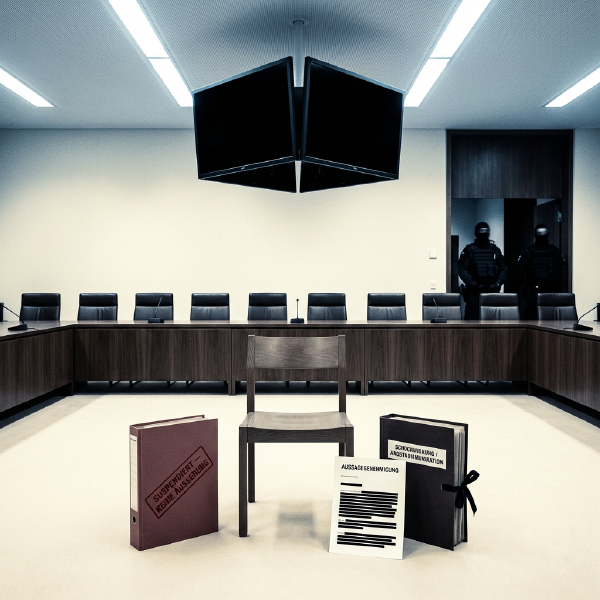
In spring 2020 the German Federal Ministry of the Interior produced two documents which together document the German application of the tabletop language-regulation architecture. Six years later the two papers meet again — as witness and as questioned, in the great hearing room of the German Bundestag, in the framework of the federal inquiry commission “Aufarbeitung der COVID-19-Pandemie.” What happens there is not accountability. It is a second application of the same mechanism.
On 18 October 2019, in a conference hall at the Pierre Hotel on Fifth Avenue in New York, fifteen people gathered around an oval table. The seating chart, viewed from a distance, looks like a list of the world industries that would become central to a pandemic response. Four hours later, the fictional crisis cell had played out a coronavirus outbreak that, over eighteen months, produced 65 million dead and disrupted supply chains, the travel industry, vaccine procurement, and crisis communications across the entire globe.
On 15 May 2018, in the conference hall of the Mandarin Oriental Hotel in Washington, ten former or sitting US senior politicians and senior public-health officials gathered. 150 invited guests watched. A live stream ran simultaneously on Facebook. The exercise was called Clade X, lasted a single day and ended with a fictional outcome of 900 million dead worldwide over eighteen months. Convener: Johns Hopkins Center for Health Security.