In December 2020, Germany’s Paul Ehrlich Institute (PEI) launched the SafeVac 2.0 smartphone app. More than 700,000 people used it to report adverse reactions following COVID-19 vaccination. It was the largest vaccine safety study Germany had ever conducted.
On March 24, 2026, Donald Trump posted that he was pausing strikes on Iranian power plants. Minutes before: $580 million in oil futures, opposite bets on stock futures — simultaneously, with no public trigger.
This article is the fourth in a series. If you missed the background:
Part 1: The Epstein Files – How Pandemics Became a Financial Product Part 2: October 2019 – The EU Practiced Suppressing the Lab Theory Part 3: Kostaive – The Self-Amplifying mRNA Vaccine Without Safety Review If you know all three, you now see the complete picture.
Update April 3, 2026: Article expanded with Japanese PMDA approval documents: missing studies, S-protein detected in ovaries, post-marketing data from Japan.
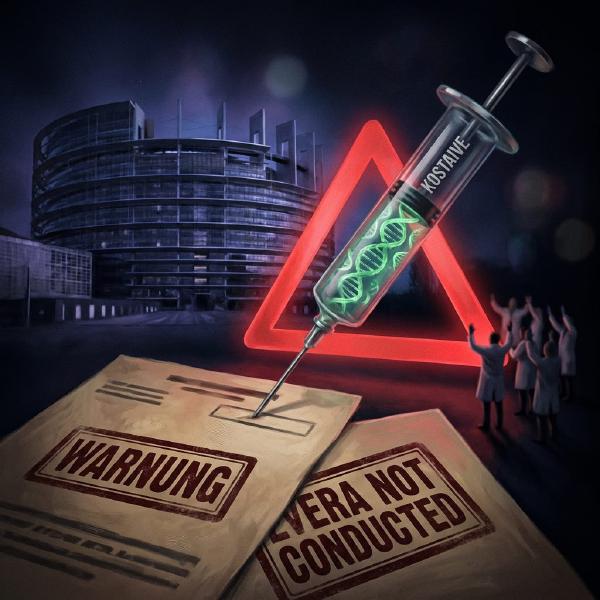
There is one critical difference between a conventional mRNA vaccine and what the EU approved in February 2025.
Some information is so precise, so perfectly timed, that you’d rather not think about it. This is one of those pieces.
October 2019. 27 EU member states. Greece.
While in New York City the famous Event 201 is running — a Gates Foundation pandemic simulation with a coronavirus scenario — a second exercise takes place in parallel, almost unnoticed by the public. Organizer: the European Centre for Disease Prevention and Control (ECDC). Participants: all 27 EU member states.
There is one sentence from an internal JPMorgan document dated 2011 that sums it all up:
“A silo based proposal that will get Bill more money for vaccines.”
Not more healthcare. Not more research capacity. More money. For vaccines. That is the language of capital formation, not charity.
This morning I posted on X pointing to Germany’s public parliamentary lobby register.
The content: HateAid submitted a four-page draft law to the Federal Ministry of Justice on February 6, 2026 — documented, publicly accessible, no interpretation required. A few weeks later, Justice Minister Hubig announced exactly this law in an interview with Der Spiegel.
When The Telegraph revealed in February 2026 that a German businesswoman had called Jeffrey Epstein “Baby” and “Mr Wonderful” — the latter while he was in prison — Nicole Junkermann resigned from the board of a royal charity within days.
Noelia Castillo Ramos didn’t want to die because she was sick.
She wanted to die because no one was there.
At 13, after her parents separated, she was placed in state care. While in a foster family, she was raped in her sleep by her ex-boyfriend. In 2022, she was gang raped by three men. Later that year, she attempted suicide with medication. When that failed, she jumped from a fifth-floor window. The fall left her paraplegic, in permanent pain.
Nikola Brindley had been a dental nurse for over a decade. She knew vaccines. When she was asked to take AstraZeneca’s COVID jab in July 2021, she agreed without hesitation. Within hours, she was in A&E. Multiple organ systems began to fail. “I collapsed on the doorway and pretty much lost the ability to walk,” she recalls. Today, she uses a wheelchair.
There’s a moment when it becomes clear just how absurd the game is. You put an AI assistant on a problem. It gets it wrong. Confidently. Over and over. Your production environment is down for 40 minutes. And at the end of the month, you get the bill — for the tool that caused the damage.
This week, the EU Parliament rejected chat control for the second time. 311 MEPs voted against, 228 in favor. Sounds like a victory. It isn’t.
The third attempt is coming. It always comes. Every time with a new name, new framing — but “child protection!” remains the lever that never changes. And interestingly, this time the Social Democrats (S&D) voted mostly in favor. Left-right logic has long ceased to explain anything in surveillance debates.