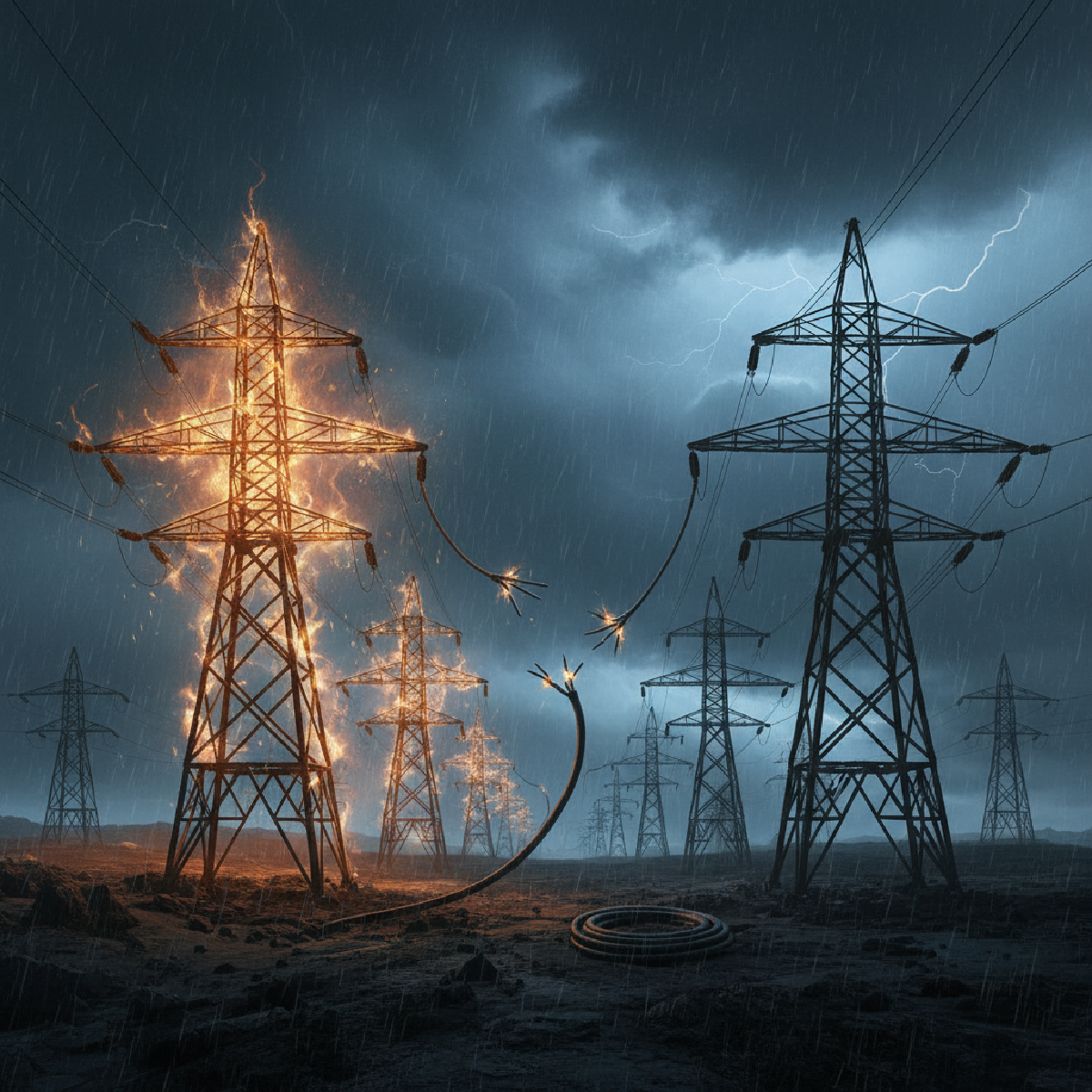
Power is generated. Power is paid for. Power does not flow.
This is no exception. It is the standard situation in the German power grid on every day with strong winds in the north or intense solar radiation across the country. The procedure is called redispatch. The transmission system operator orders: a wind farm in Schleswig-Holstein curtails its output, a gas power plant in Bavaria ramps up. The curtailed wind farm is compensated for the electricity it didn’t produce. The ramped-up power plant receives payment above the market price.
Double costs — once for power that doesn’t flow, once for replacement power that should. In 2023, this added up to 3.1 billion euros.
Preliminary note: The Berlin power outages of 2024 to 2026 — particularly Lichterfelde on January 3, 2026 — were targeted acts of sabotage by the »Vulkan group«, not grid overload cases. Both are real problems; they have different causes. This article addresses the structural grid problem.
What Redispatch Is#
The physical problem is simple: Northern Germany produces more power than the north-south transmission lines can transport. The electricity exists on paper — it has been fed into the grid or stands ready. But the electrons can’t get through.
Electricity takes the path of least resistance. When high-voltage lines approach their capacity limit, overload threatens — in the worst case, a blackout across the entire interconnected grid. So the grid operator intervenes: generation north of the bottleneck down, generation south of the bottleneck up. This protects the grid. It produces no additional energy. It costs money.
In 2023, 34 terawatt-hours of electricity were redistributed this way. For comparison: Austria’s annual electricity consumption is around 70 TWh. Germany managed electricity equivalent to nearly half of Austria’s annual demand through redispatch interventions in 2023.
The Numbers — and Why the Trend Deceives#
Redispatch costs have fallen over the past two years:
| Year | Volume | Cost |
|---|---|---|
| 2022 | ~26 TWh | ~€4.2 bn |
| 2023 | 34.3 TWh | €3.1 bn |
| 2024 | 30.3 TWh | €2.7 bn |
This sounds like progress. The Federal Network Agency explains it precisely: »The decline in costs is mainly attributable to falling fuel and wholesale prices.«
The volume of interventions has not fallen. The price for the interventions has fallen because natural gas has become cheaper. If energy prices rise again — for geopolitical reasons, supply bottlenecks, or regulatory changes — redispatch costs rise with them. The structural problem that forces the interventions is unchanged.
The Gap: Grid vs. Generation — and Who Caused It#
The reason for the bottleneck is known and documented. The four major transmission system operators jointly submitted the Grid Development Plan 2037/2045 with the Federal Network Agency. Result: 4,800 km of new lines, 2,500 km of reinforcements, five new HVDC connections from north to south. Investment volume through 2045: 360 to 390 billion euros.
The key project is SuedLink: a direct-current line from Brunsbüttel in Schleswig-Holstein to Großgartach in Baden-Württemberg. SuedLink was originally supposed to go into service in 2022 or 2023. Full planning approval came in October 2024. Commissioning: end of 2028 — roughly five years late.
The cause is politically documented in concrete terms: The Bavarian cabinet under Minister President Seehofer and his successor Söder publicly blocked every overhead line route through Bavaria from 2012 onward. The underground cable solution — technically more complex, more expensive, more complicated in terms of planning law — was the political compromise enshrined in the Energy Line Expansion Act of 2015. It produced the five-year delay.
The question of whose political decision created the billions in interim costs has a clear answer.
2028 is also not the end of the problem: SuedLink relieves the north-south bottleneck from Schleswig-Holstein to Baden-Württemberg. Simultaneously, SuedOstLink (Bavaria–Saxony-Anhalt) and further projects are being built into the 2030s. The NEP 2037/2045 runs until 2045. 2028 is a partial relief, not an endpoint.
What the Consumer Pays — and Who Receives It#
Redispatch costs are passed on to all electricity users via network charges. Average transmission network charges recently stood at 6.43 cents per kilowatt-hour; network costs account for around 25 percent of the average household’s electricity bill.
On the receiving end, the picture looks like this: The four transmission system operators that manage and pass on the costs are largely owned by foreign investors. TenneT belongs to the Dutch state. 50Hertz is owned by the Belgian Elia group and an Australian infrastructure fund. Amprion is owned by institutional investors. TransnetBW is a subsidiary of EnBW. The ramped-up gas power plants — RWE, Uniper, EnBW, LEAG — receive their redispatch compensation above the respective market price. That is not an accusation; it is the structure.
In 2026, network charges are falling by almost 20 percent. The federal government explains how: 6.5 billion euros from the Climate and Transformation Fund (KTF) flow directly to the four transmission system operators — a one-time measure for 2026. This reduces the costs passed on through network charges. It changes nothing about the physical bottlenecks and nothing about the 390-billion-euro investment requirement. It pushes the bill to next year.
The Market Signal: Negative Prices#
The stock exchange offers a precise signal for the structural problem: negative prices. In 2024 there were 457 hours with negative electricity prices, in 2025 already 465 hours — a record.
Negative prices arise when more power is generated than the grid can distribute and consumers can absorb, and power plants continue to run regardless. That is the correct price signal for »the grid is full«. The battery market is responding: According to the Federal Network Agency, more than 50 GW of large-scale storage projects were in planning or permitting at the start of 2026. Currently in operation: around 4 GWh / 2.5 GW — growing fast, but still far smaller than the 30 TWh annual redispatch volume. The storage that would structurally address the problem does not yet exist at the necessary scale.
Federal Economics Minister Katharina Reiche presented a grid package in February 2026 intended to synchronize the expansion of renewables with grid expansion: renewable energy operators are to finance grid connections more themselves, compensation for forced curtailment is being reduced. This is the logic of “those who cause costs bear them.” As a side effect, it slows the expansion of renewables. And it does not explain who will cover the difference in the years until full grid infrastructure is in place.
The answer appears in every network charge notice.
Sources: Federal Network Agency Quarterly Report on Grid Congestion Management Q4/2023 and Q4/2024; Grid Development Plan 2037/2045 (BNetzA confirmation March 2024); Federal Network Agency data on network charges and electricity storage; German federal government on 2026 network charge reduction; E-Control Austria electricity statistics; pv magazine negative prices 2024/2025; TenneT SuedLink project page.