A pattern consists of repetitions. This one is documented.
The Timeline#
November 2020 — ZDF heute journal#
Uğur Şahin in an interview on the BioNTech vaccine: the mRNA candidate was safe, 50 million doses would be delivered before the end of 2020. The decisive trial data were imminent. 1
The EMA authorisation followed on 21 December 2020 — at record speed, eleven months after the trial began.
April 2021 — RTL, Immunology Day#
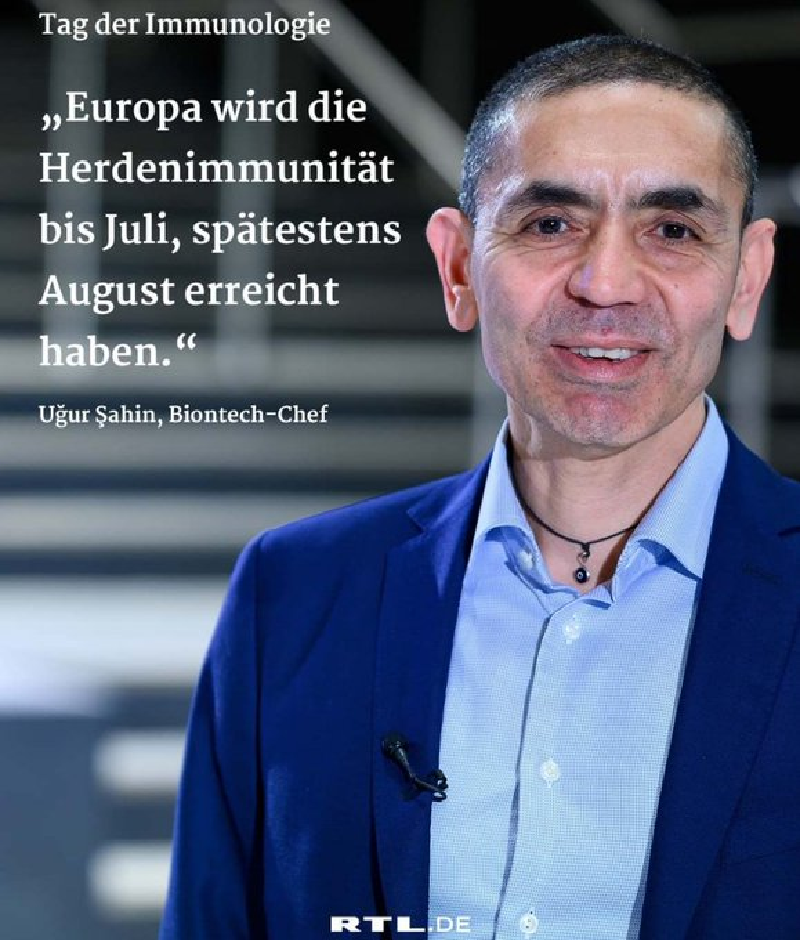
“Europe will have achieved herd immunity by July, at the latest August.”
Context: Şahin spoke at an event of the Association of Foreign Press in Germany. He estimated that 50 to 60 percent of EU citizens would be vaccinated by the end of summer — together with those already recovered, sufficient for herd immunity. He planned a celebration for that moment. 2
What happened: No herd immunity. Autumn 2021 brought the Delta wave, then Omicron. The term disappeared from official communications.
June → December 2021 — Four Bild Headlines#
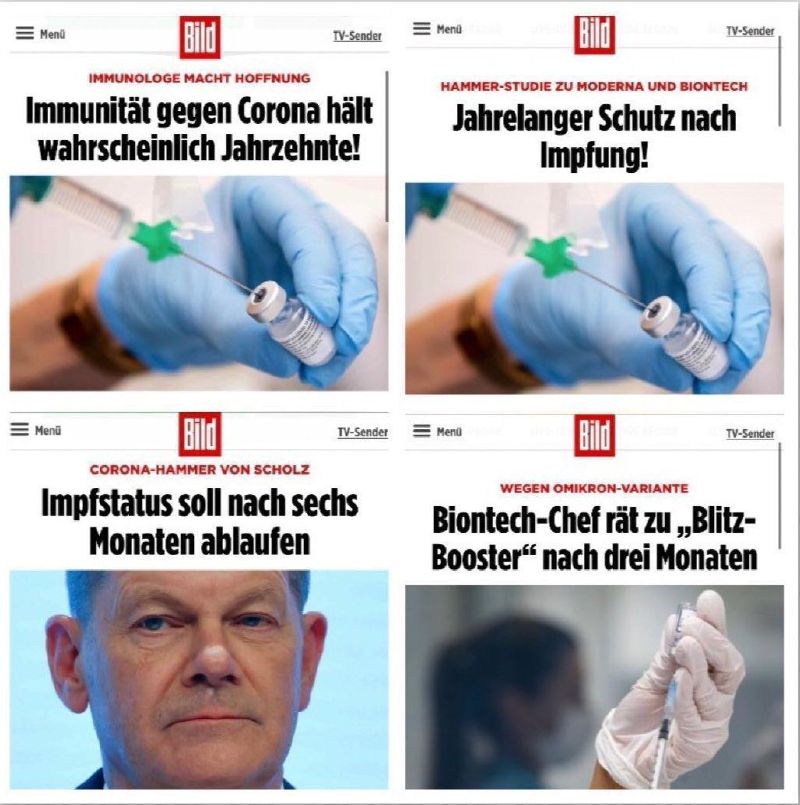
Four headlines, half a year:
| Headline | Message |
|---|---|
| “Immunity probably lasts decades!” | Immunologist gives hope |
| “Years-long protection after vaccination!” | Hammer study Moderna/BioNTech 3 |
| “Vaccination status should expire after six months” | Scholz |
| “BioNTech CEO recommends ‘flash booster’ after three months” | Due to Omicron variant |
The last panel is Şahin himself. The same person who promised herd immunity by July in April was recommending a booster after three months in December.
2022/2023 — Cancer by 2030#
At World Cancer Day and in multiple media appearances, Şahin formulated the next forecast: “By 2030 we want to have a large portfolio of cancer therapies on the market.” First approvals were to follow from 2026. 4
Phase 1 and Phase 2 studies are ongoing. Phase 3 results for melanoma and pancreatic cancer remain pending. The promise has until 2030 — and is therefore not yet falsified. 5
The Financial Curve#
BioNTech was a research company with negative cash flow until 2019. COVID changed that.
| Year | Result |
|---|---|
| 2022 | Profit €9.4 billion |
| 2023 | Profit €930 million |
| 2024 | Net loss €700 million |
| 2025 (forecast) | Revenue €1.7–2.2 billion, continued high expenditure |
Simultaneously: job cuts of 950 to 1,350 full-time equivalents across Europe and North America by 2027. Site closures in Marburg and Idar-Oberstein. 6
The Network#
Gates Foundation#
In 2019 — before COVID — the Bill & Melinda Gates Foundation invested $55 million directly in BioNTech. Purpose: development of vaccine candidates against HIV and tuberculosis. 7
In parallel, the Gates Foundation channels funding through CEPI (Coalition for Epidemic Preparedness Innovations): in 2022, Gates and Wellcome jointly committed $300 million to CEPI. 8
In 2023, up to $90 million from CEPI flowed to BioNTech — this time for an mRNA Mpox vaccine. 9
The chain: Gates Foundation → CEPI → BioNTech. Each step is a separate, publicly documented contract.
Strüngmann Brothers#
Andreas and Thomas Strüngmann — founders of Hexal, Germany’s largest generics manufacturer, sold to Novartis in 2005 for €5.6 billion — invested €136 to €180 million in BioNTech as founding investors in 2008.
Peak value of their stake: August 2021, over $50 billion. Current stake: approximately 43.5 percent, valued at circa €10 billion (April 2026). Held through Santo Holding (Zug) and Athos KG (Munich). 10
The Exit#
In March 2026, Uğur Şahin and Özlem Türeci announced they would leave BioNTech by the end of 2026. Goal: a new biotechnology company combining mRNA technology with artificial intelligence. BioNTech retains a minority stake in the spinoff plus licensing rights.
Market reaction: BioNTech shares lost 18 to 20 percent on the announcement. 11
The Pattern#
Şahin has made several forecasts in his scientific career that are precisely dated and publicly documented:
- Herd immunity by July/August 2021: did not materialise
- First cancer approval 2026: pending
- Cancer portfolio by 2030: pending
This is not an evaluation of a person. It is the identification of a pattern: public forecasts with specific dates, financial flows running in parallel, and an institutional reset when the cycle ends.
Ganymed Pharmaceuticals — Şahin’s first biotechnology company, founded in 2001 with Özlem Türeci and Christoph Huber — was sold in 2016 for over €400 million to Astellas Pharma. The main product Zolbetuximab received FDA approval in 2023. That was not a failure — that was an exit.
BioNTech is now the second exit. The new mRNA+AI startup is the third attempt.
Those who know the first exit understand the second better. And those who know the second have a framework for the third.
Sources#
ZDF heute journal: Ugur Sahin on the BioNTech vaccine (November 2020). ZDF.de ↩︎
BioNTech founder Ugur Sahin: herd immunity possible by end of summer (April 2021). t-online.de; ZDF ↩︎
Ellebedy AH et al. (2021): Germinal centre reactions in human lymph nodes after COVID-19 mRNA vaccines. Nature. Business Insider DE, 29.06.2021 ↩︎
“By 2030 we want to have a large portfolio of cancer therapies on the market” — Şahin, World Cancer Day 2024. puls24.at; blick.ch ↩︎
Three-year Phase 1 Follow-Up Data, mRNA-based Individualized Immunotherapy, Pancreatic Cancer. BioNTech Investor Relations ↩︎
BioNTech net loss approx. €700 million, job cuts. Epoch Times DE; finanzen.net ↩︎
BioNTech Announces New Collaboration to Develop HIV and Tuberculosis Programs. BioNTech Investor Relations (Gates Foundation $55M, 2019) ↩︎
Bill & Melinda Gates Foundation and Wellcome: $300 million for CEPI. CEPI.net ↩︎
BioNTech and CEPI Announce Partnership to Advance mRNA Mpox Vaccine (up to $90M). CEPI.net ↩︎
The Strüngmanns and BioNTech. Business Insider DE ↩︎
BioNTech loses its founders: Sahin and Türeci launch new venture. transkript.de; Biontech founders leave — stock drops over 20%. Business Insider DE ↩︎