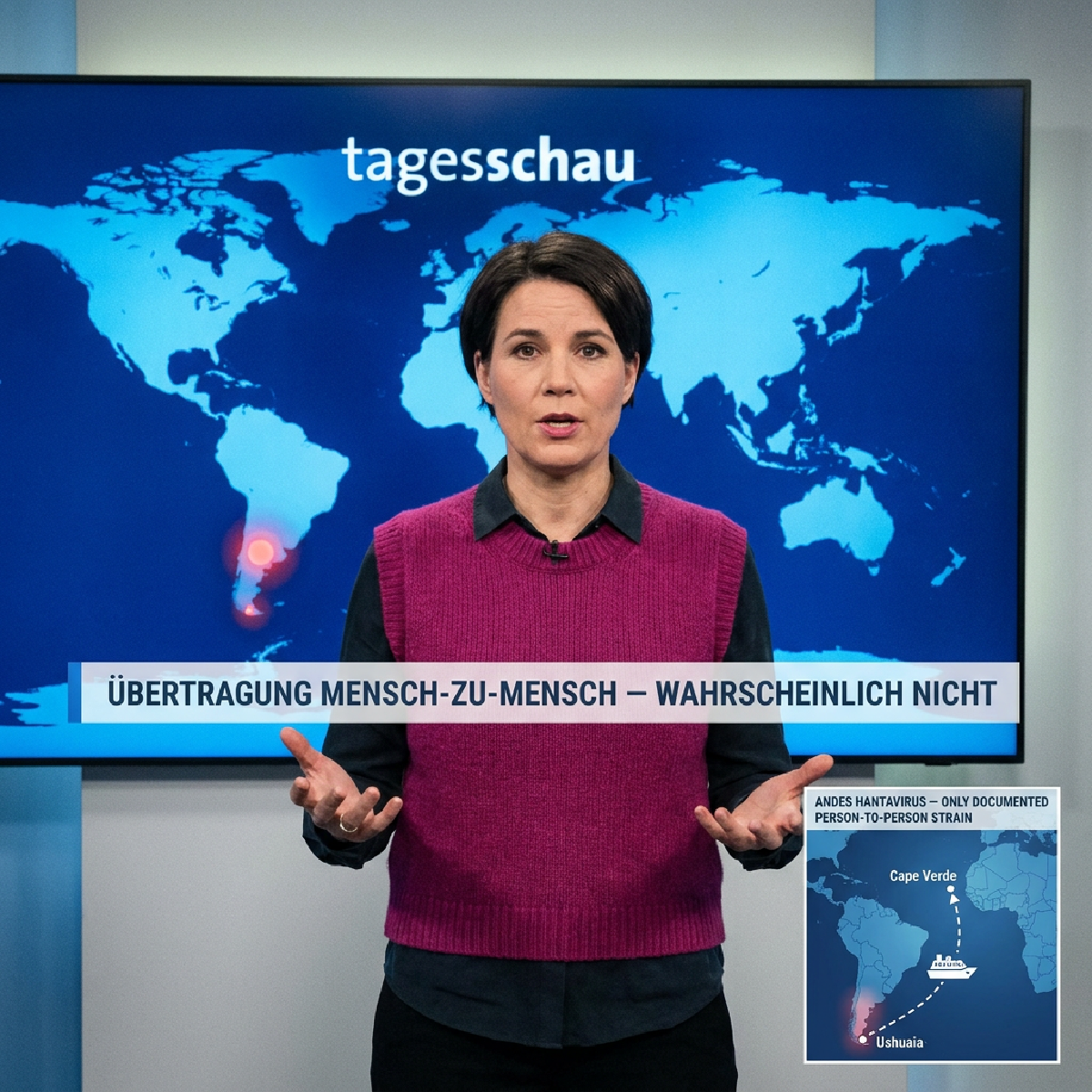
On 4 May 2026 — the same day the WHO officially confirms the hantavirus outbreak aboard the MV Hondius — Germany’s tagesschau airs a 99-second explanatory clip in its vertical social-media format. A young presenter stands before a glowing blue world-map backdrop with the tagesschau wordmark above her. Cut in: a statement by Stefan Schmiedel — “Infektiologe und Tropenmediziner” (infectious disease specialist and tropical medicine physician), identified in the lower third without further context. In substance, he is the leading Hamburg-UKE voice on imported tropical disease.
The clip ends with a reassurance. The reassurance is correct — for the wrong viruses.
1. The clip in one sentence#
tagesschau frames the story as a cruise-ship outbreak (= MV Hondius, three dead, vessel originating from Ushuaia/Patagonia). It then pivots to “the hantaviruses that occur in central Europe”, describes their symptomatology, and concludes: “Human-to-human transmission probably does not occur.” Tropical-medicine specialist Schmiedel confirms: hantaviruses transmit “not at all or only very, very rarely” between humans. “Therefore, hantavirus is not expected to develop into a human epidemic.”
That holds for central-European strains. It does not hold for the strain the ship cluster most likely carries.
2. What was known on 4 May#
| Fact | Source |
|---|---|
| MV Hondius — polar expedition vessel originating from Ushuaia | Oceanwide Expeditions / WHO |
| Route: Ushuaia → Antarctica → Saint Helena → Cape Verde | WHO / MercoPress |
| 7 cases, 3 dead — hantavirus laboratory-confirmed (2 deaths) | WHO 4 May 2026 |
| Ushuaia sits at the southern edge of the Andes virus endemic zone | CDC / Journal of Infectious Diseases 2021 |
| Andes virus: the only hantavirus strain with person-to-person transmission described in the literature (cluster studies Argentina 1996, Chile 2011, Argentina 2014; methodological limitations of studies acknowledged) | CDC / WHO / peer-reviewed cluster reports |
| Andes virus incubation: 9–40 days — fits the ship cluster | CDC |
A tropical-medicine specialist focused on imported tropical disease must know this. It is his domain.
3. What the clip does not say#
In 99 seconds, Andes virus is not mentioned once.
Not mentioned: that the ship’s route runs through the endemic zone. Not mentioned: that Andes virus is the documented exception to the “no human-to-human” rule. Not mentioned: that the incubation window matches the cluster.
What is mentioned instead: a generic hantavirus explainer about rodents, faeces, saliva, “the viruses that occur in central Europe”. A clean, accurate explanation — about the wrong hantaviruses.
The effect in the viewer’s head: “Right, the hantavirus on the ship doesn’t transmit between humans. Glad it’s not like Covid.”
This is not a lie. It is not a factual error. It is omission with a calming effect.
4. Why a Hamburg-UKE voice?#
Stefan Schmiedel heads the Infectious Diseases section at University Medical Center Hamburg-Eppendorf (UKE) and has been one of Germany’s regular pandemic-coverage voices since 2020. UKE is the academic neighbour of the Bernhard Nocht Institute for Tropical Medicine (BNITM) — same Hamburg medical campus, shared chairs, shared WHO-cooperation infrastructure.
BNITM hosts the WHO Collaborating Centre for Arbovirus and Haemorrhagic Fever Reference and Research. Its Deputy Director, Jonas Schmidt-Chanasit, wrote his PhD thesis (Charité 2006) precisely on “the detection of human infections by New World hantaviruses imported to Europe” — that is, on imported New-World hantaviruses arriving in Europe. Exactly this case.
When ARD selects, on 4 May 2026, a Hamburg voice from the UKE/BNITM cluster for a hantavirus explainer, it reaches into the same network that — in the days that follow (see the full Hondius structural analysis) — actively shapes the official framing of the outbreak: Schmidt-Chanasit amplifies the alarm via TikTok repost on 5 May; Marion Koopmans dampens the framing via tweet on the same day.
Schmiedel does not occupy the amplifier slot, and not the damper slot. He occupies the explainer slot. But he explains only what reassures — not what would unsettle. In a broadcaster that two days later picks up a passenger’s TikTok from a ship cabin as headline material, that produces a notable sequence: first the reassurance with the wrong strain, then the emotion with the right one.
5. Andrews hits the mark sarcastically#
The X account Pierre Andrews reposts the clip with the caption “Es geht los wie bei Corona: Pandemieleugnung und Hantaverharmlosung im ÖRR. Ich kaufe morgen Toilettenpapier und Nudeln.” — “Here we go like with Corona: pandemic denial and hantavirus minimization at the public broadcaster. I’ll buy toilet paper and noodles tomorrow.”
The line is sarcastic. Andrews is mocking alarmists who would label calm public-broadcaster reporting as “minimization”. The joke trades on the assumption that the broadcaster’s reassurance is factually sound.
It is not — but not for the reason the alarmism charge implies. The reassurance is unsound because it reassures about the wrong viral strain. Andrews lands on the word “Hantaverharmlosung” — but as the description of a concrete omission mechanism, not as a blanket charge.
6. Structural logic#
Anyone who works on hantavirus inside the Hamburg UKE/BNITM cluster knows about Andes virus. Anyone who explains a polar expedition vessel from Ushuaia knows where Ushuaia is. Anyone who frames a hantavirus cluster among Patagonia-route passengers knows the obvious hypothesis.
When ARD produces a 99-second clip on the day of WHO’s outbreak confirmation that omits exactly that hypothesis and pivots to central-European strains, that is not editorial randomness. It is a selection. A selection that produces a controlled reassurance effect — before, in the days that follow, the real picture comes officially into view (human-to-human suspected on 5 May, Andes laboratory-confirmed on 6 May, IHR activated on 6 May, first follow-on case in Switzerland).
Who benefits from the reassurance: the WHO, ramping up its response apparatus without public alarm. The authorities running contact tracing without public input. The ARD broadcaster, which does not want to be cast as a pandemic driver and at the same time keeps the Hamburg cluster cultivated as a reliable source.
Who loses: the ship’s passengers, calming their families without knowing that they themselves may be the most likely transmission source for their inner circle. General practitioners in destination countries, expected to pattern-match a Patagonia-returning patient with flu-like symptoms — walking into the consultation with the ARD frame “no person-to-person” still in their heads. The public capacity to distinguish between “hantavirus is generally harmless” and “Andes virus is the exception”.
7. What tagesschau could have said — in ten seconds#
“One caveat: Andes virus, found in Patagonia — the region where the ship started —, is the only hantavirus strain with documented human-to-human transmission. Should that strain be confirmed, the reassurance just stated applies only in part. We will report on this further.”
Ten seconds. Sober. Without panic, without minimization. Without pivoting the explainer arc away from the ship and onto central Europe.
Those ten seconds would have completed the clip. They are missing.
Closing#
tagesschau did not lie on 4 May 2026. It omitted. The omission was targeted: it covers the biologically most likely finding with the epidemiologically most reassuring finding, and it does so precisely in the window before official confirmation of the likely finding had landed.
Anyone who treats an omission of this precision as random is not looking. A tropical-medicine specialist from Hamburg whose entire career revolves around imported tropical disease does not accidentally forget that the only hantavirus with human-to-human transmission comes from Patagonia. A tagesschau social-media desk producing an explainer about a Patagonia-route vessel does not accidentally forget where Ushuaia sits.
This is the architecture of the calm voice: reassure first, concede later — by which point the attention curve has already flattened. This is not conspiracy. It is division of labour — between a public broadcaster and an institutional cluster that does not drive the outbreak, but controls its tone.
Pierre Andrews’ sarcasm hit the right word. For the wrong reason. From an angry blogger’s vantage point, ARD is “pandemic-denying” because it is not raising alarm. From the vantage point of the factual record, ARD on this day is minimizing — because it reassures about viruses that are not the finding. The first is a political pose. The second is a documented gap.
We close the gap here.
Update 6 May 2026 — The cluster confirms itself#
On 6 May 2026 at 10:45 a.m., Jonas Schmidt-Chanasit (BNITM Hamburg, Deputy Director of the WHO Collaborating Centre, the same Hamburg UKE/BNITM cluster as Schmiedel) posts on X (@ChanasitJonas):
“Sequencing in South Africa has now identified the #Andes #virus as the cause of the illnesses on the cruise ship 🛳️. Very good work by South Africa’s National Institute for Communicable Diseases. Kudos 👍 #hantavirus” (translated from German)
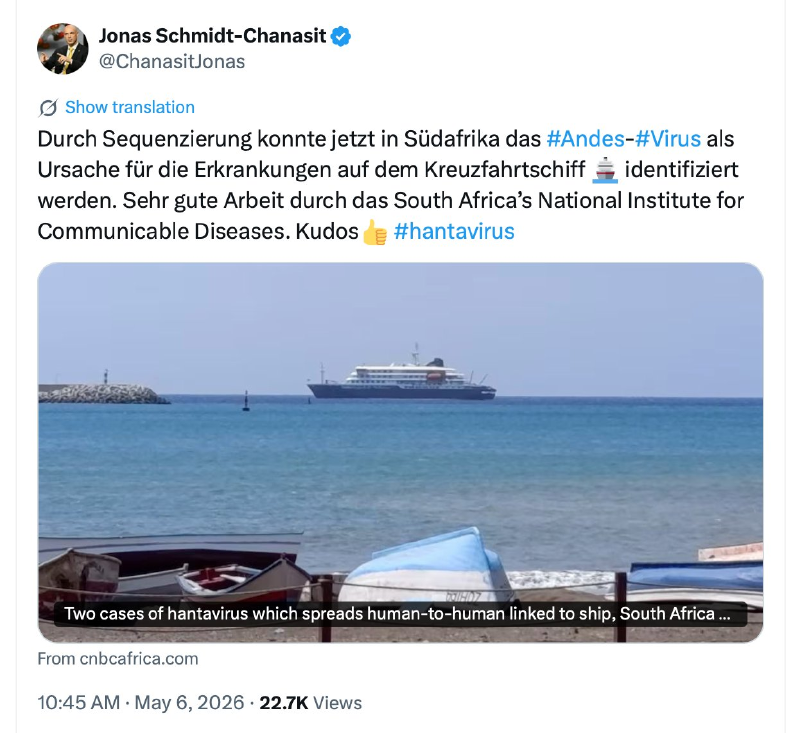
Attached in the tweet: a screenshot of the CNBC Africa headline “Two cases of hantavirus which spreads human-to-human linked to ship, South Africa …”. 22,700 views.
What the tagesschau clip of 4 May omitted is now in plain text: Andes virus, human-to-human, ship — confirmed by the very Hamburg voice whose UKE neighbour, 48 hours earlier and on the same public broadcaster, was reassuring viewers about central-European strains and “no person-to-person”.
Note the tone: “Very good work”, “Kudos 👍”. Three dead, an IHR-activated cross-border outbreak, a follow-on case in Zurich — communicated as a successful lab routine. That does not fit a pandemic driver. It fits a response apparatus that registers an outbreak matching its toolkit as a success of its own surveillance architecture.
The sequence is now fully documented:
- 4 May, around 10 a.m. CEST: Schmiedel/UKE on tagesschau — reassurance using the wrong strain.
- 5 May: WHO confirms human-to-human as the suspected route. Schmidt-Chanasit reposts the passenger TikTok; Koopmans dampens via tweet.
- 6 May, 10:45 a.m.: Schmidt-Chanasit celebrates the Andes confirmation with a thumbs-up.
One cluster, three registers, three days. The explainer slot reassures with the wrong strain, the amplifier slot amplifies the emotion, the reference slot books the confirmation as its own success. Anyone still wanting to call this “editorial randomness” should not speak so loudly.
Sources: tagesschau social-media clip, 4 May 2026 (broadcast date 4.5.2026 in-frame, length 1:39); X repost @PierreAndrews, 6 May 2026 (status 2052133158473081299); WHO Disease Outbreak News, MV Hondius (4–6 May 2026); CDC Hantavirus Guidance (Andes virus, endemic geography); Journal of Infectious Diseases 2021 (person-to-person transmission of Andes virus); UKE Hamburg / BNITM profile of Schmidt-Chanasit; full structural analysis: “MV Hondius: Three Dead, Andes Hantavirus, and the WHO Network Behind It”.