There’s a familiar reflex when a German corporate giant announces layoffs: look for the villain in the executive suite. This time it’s Oliver Blume, cutting 50,000 jobs at VW while collecting bonuses. It’s a convenient narrative. It’s also true — but it explains nothing.
Because what’s happening at Volkswagen right now isn’t a story of management failure. It’s the end result of a decade of systematic economic policy that first pushed Germany’s small businesses to their knees — and is now catching up with the big corporations. The tab, as always, is picked up by the worker at the bottom.
The Trigger That Isn’t One#
This morning’s news: VW profits halved. Porsche essentially at zero — down 98% year-over-year. Porsche, the symbol of German engineering, the combustion engine feeling, pure driving pleasure — driven into the wall.
The official explanation: “market conditions in China.” That sounds like bad luck. It isn’t bad luck.
At the same time, VW reports it sold 9 million cars last year — exactly as many as the year before. Revenue is barely down. Yet profits collapsed and tens of thousands are losing their jobs. When you sell the same amount but earn half as much, you don’t have a sales problem. You have a cost problem.
That cost problem has a name. Several, actually.
2020: The End of Self-Delusion#
Before Volkswagen made headlines, the small businesses had the problem. Long before.
From 2021 onward, exploding energy prices hit small and medium-sized businesses hardest: the baker, the foundry, the mid-sized machine builder. Energy was their biggest cost driver — and Germany’s energy policy had made it the most expensive in all of Europe. The “Energiewende,” judged by its core goal of securing supply at affordable prices, was an expensive experiment conducted at industry’s expense.
2022 brought the reckoning. The Ukraine war sent gas prices through the roof and made suddenly visible what experts had been saying for years: Germany had built its industrial base on cheap Russian gas — and that was not a natural law, but a political decision.
Insolvency figures among German SMEs hit their highest level in a decade in 2023. The headlines were swallowed by political noise. No crisis summit, no emergency session. Small business dies quietly.
The corporations held on. They have buffers, reserves, international markets. They could export the pain — across time and geography. Now the deadline has passed.
The Combustion Engine Betrayal#
To understand Porsche, you have to remember a decision made in Brussels: the EU’s ban on combustion engines from 2035. A political mandate that redefined the market by decree.
Volkswagen and Porsche responded the way German executives have responded to political programs for decades: they over-delivered. They invested billions in electric mobility, restructured R&D departments, aggressively marketed the green transformation. Not because the market demanded it — customers were still happily buying combustion cars — but because the political risk calculus seemed to point that way.
Toyota didn’t follow. Toyota trusted the customer. Toyota is thriving.
That’s not coincidence, it’s method. In a market economy, consumers decide what gets bought — not bureaucrats in Brussels, not executives managing their political optics. Volkswagen did the right thing for the supervisory board. For the market, it was wrong.
Then there’s the China factor. For years, China was the growth engine. Porsche built on that assumption. But the Chinese market changed: BYD, SAIC, Geely — Chinese manufacturers now offer vehicles technically on par with European models, at a fraction of the price. That hits premium brands hardest. Building a dedicated Chinese development division — Porsche’s current plan — is five years too late.
The Lower Saxony Problem#
One factor that regularly disappears from the public debate: the state of Lower Saxony holds roughly 20% of Volkswagen and has veto rights on the supervisory board. This means that in the most important strategic decision-making body of Europe’s largest carmaker, there are delegates from the Lower Saxony state parliament.
Volkswagen is not a purely private-sector company. It’s a hybrid — half market, half politics. And this hybrid produces exactly what such constructions always produce: compromise decisions that are neither economically optimal nor politically consistent.
The employee side, bolstered by Germany’s strong co-determination culture and the IG Metall union, successfully prevented or delayed compulsory redundancies in Wolfsburg for years. That’s understandable. It’s also part of the problem. Structural change that’s deferred comes back as crisis.
The Pattern: SMEs First, Then the Big Players#
What’s happening at VW isn’t new. It’s phase two.
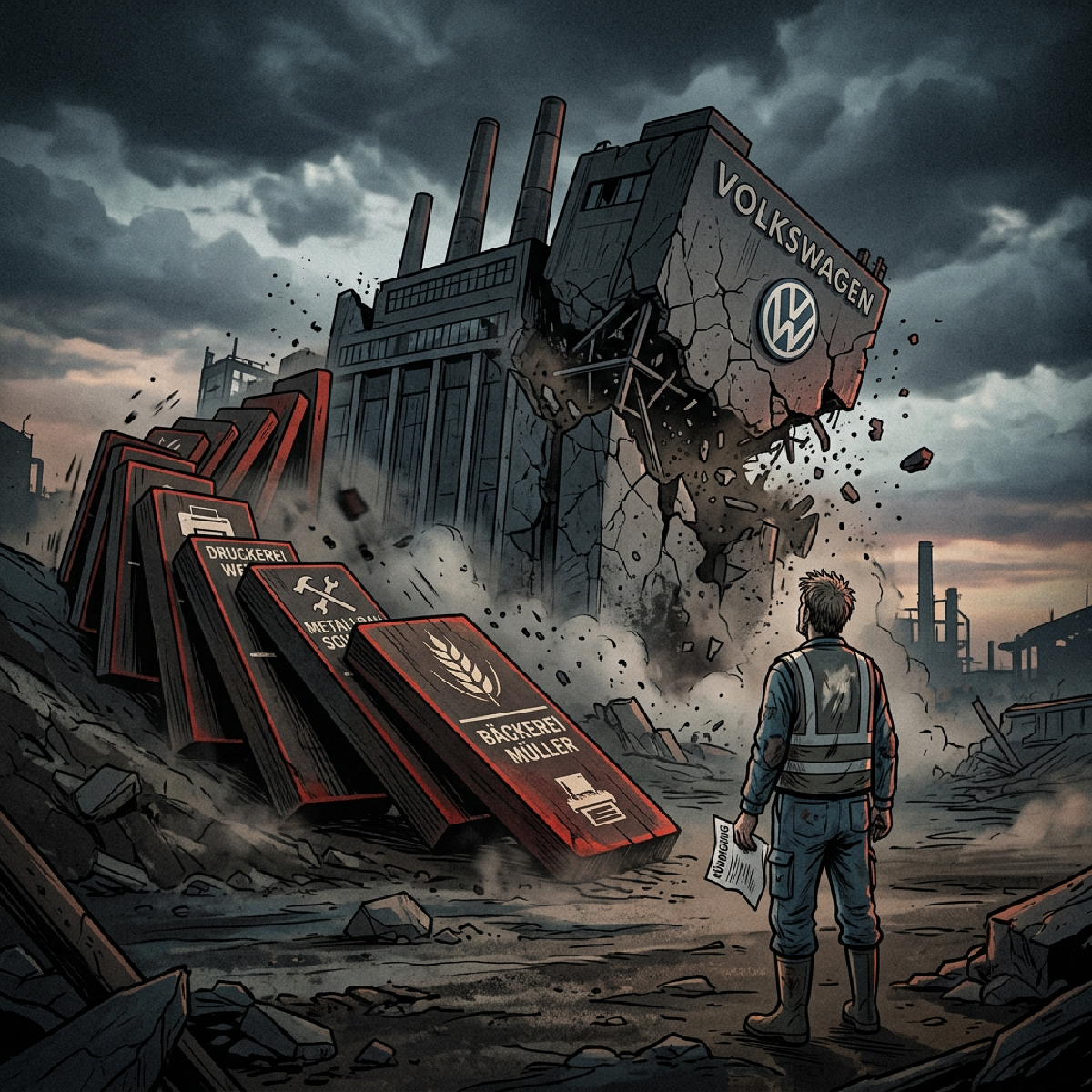
Phase one ran almost unnoticed between 2021 and 2024: thousands of small and medium-sized businesses quietly shut down. Bakeries, metal fabricators, print shops, textile manufacturers — all fighting the same forces: exploding energy costs, regulatory overload (the Supply Chain Due Diligence Act being just one example), a shortage of skilled workers, and a tax system that punishes entrepreneurs rather than rewarding them. They had no lobby, no supervisory board seats held by politicians, no shareholders capable of applying pressure. They disappeared.
Phase two is running now. The big players aren’t immune — they’re just delayed. Thyssenkrupp, BASF (moving capacity overseas), Intel Magdeburg (project cancelled), Northvolt (insolvency — VW had invested), and now VW. The list is growing.
The causes are identical. The numbers are bigger.
Who Pays? Always the Same Person.#
VW CEO Oliver Blume receives bonuses because cash flow improved. The stock price rose on the day the layoffs were announced. That’s systemically correct: executives are compensated for share price targets, not headcount.
The problem isn’t the bonus. The problem is that the system is built this way.
50,000 workers lose their jobs — many of them well-paid skilled workers whose income tax will be missing from government coffers, whose purchasing power will be missing from local retail, whose pension contributions will be missing from the system. Meanwhile, the same political establishment complains about a shortage of skilled workers.
This contradiction isn’t accidental. It’s the product of a policy that was never consistent: neither market nor plan, but the worst of both. Introduce EV subsidies, then abruptly cancel them. Mandate a combustion ban, then backpedal. Run state industrial policy while claiming to believe in markets.
The employee now holding a redundancy notice didn’t make these decisions. He worked within the system available to him. He is now paying the costs of a bill written by others.
What Would Help — and Won’t Come#
The diagnosis is clear: Germany needs affordable energy, less bureaucracy, a tax system that doesn’t drive out entrepreneurs, and an industrial policy that trusts markets rather than replacing them. Economists have been saying this for years. It appears in political programs that are never implemented.
March speeches from outgoing ministers sound correct. Actions are absent. This gap between word and deed isn’t incompetence — it’s structural. Political success requires short-term thinking. Industrial policy mistakes only materialize five to ten years later. By then, someone else is responsible.
Porsche traded the combustion engine for the electric motor — and in doing so, lost almost everything that made Porsche what it was. VW followed. Nobody said stop.
The small business owner always knew. He just wasn’t allowed to say it out loud.
Source#
Discussion on Newslive, March 11, 2026, with Antje Hermenau and Rainer Zitelmann:
Sources: Newslive broadcast 11.03.2026, Statista German insolvency figures, VW Annual Report 2025, Eurostat industrial energy prices