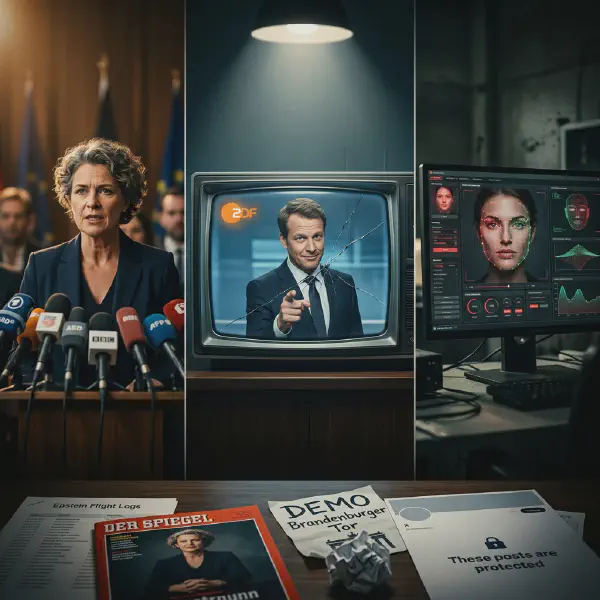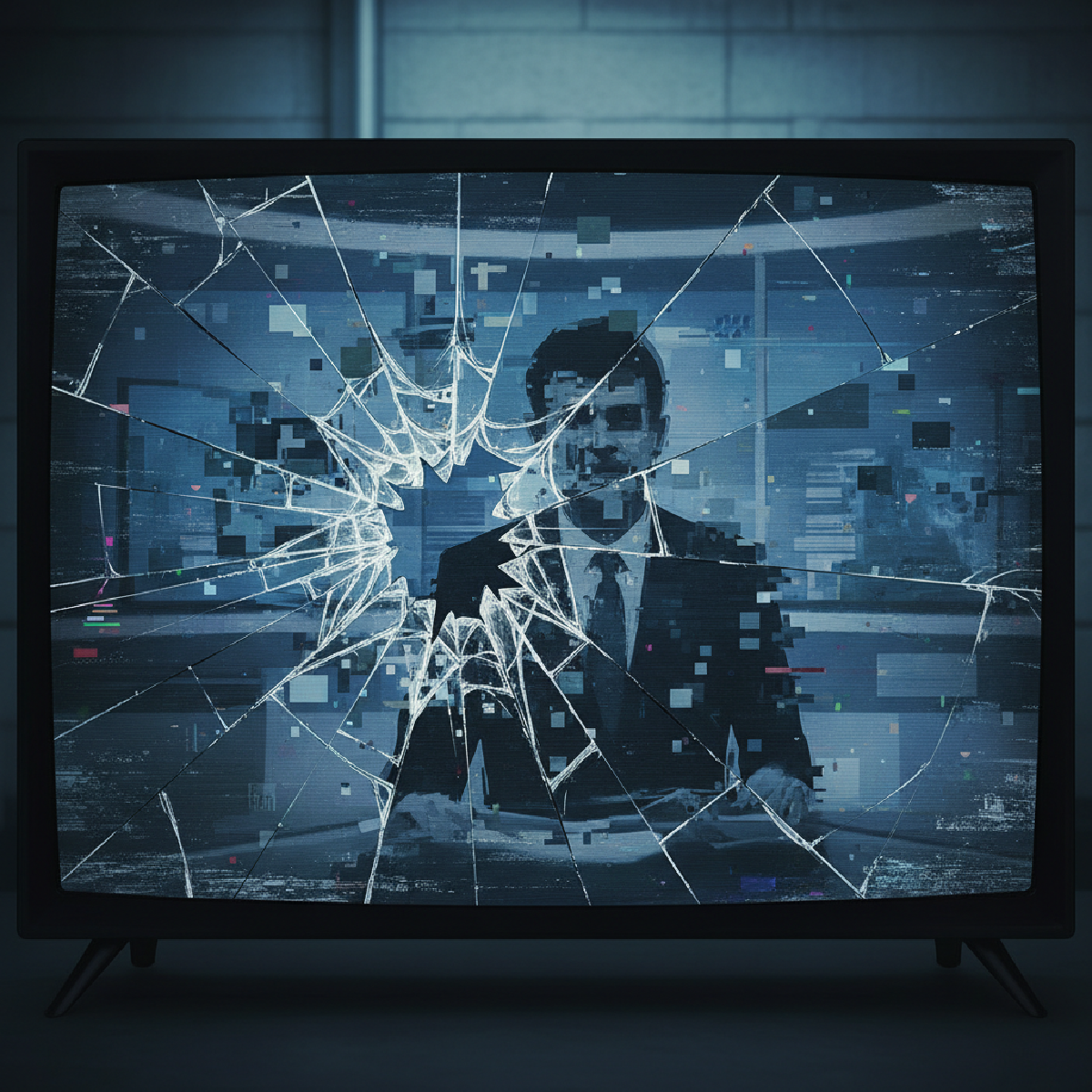
On 15 February 2026, the heute journal aired a report on the US deportation agency ICE showing a woman with crying children during an arrest. The image felt real and was falsely generated: a video produced with OpenAI’s Sora, with no labeling as synthetic material. A second sequence in the same report came from a different context — a school threat in Florida from 2022, presented as an ICE arrest.
The ZDF apologized two days later „without reservation", recalled a correspondent, and presented a set of measures — publicly, within 48 hours. Except: what is told as an oversight was a breach of a rule the broadcaster had given itself — two and a half years earlier.
And it was not the only one.
Its own rule, broken#
Since October 2023, the ZDF has had ten principles for handling generative AI. Point 9 is unambiguous: AI-generated images and videos of people, events, and political contexts are „not possible in the news area" — unless labeling occurs „directly on the product." The broadcaster’s tiered model says the same thing again in procedural language.
By the ZDF’s own admission, the ICE report violated exactly this point. The rule existed. It was known. It was not applied. That is the decisive shift that gets lost in the public account: the failure was not that there was no rule — but that the rule carried no weight in day-to-day operation.
The FAZ reported on 25 February that editor-in-chief Bettina Schausten had internally conceded the AI images were „deliberately inserted" — while the external account spoke of an error. The internal record the FAZ relies on remains sealed; the exact wording cannot be verified. What is verifiable is only that the house presented the matter externally as an oversight while the internal picture stays closed. Precisely this gap between the public version and the inaccessible internal state is the transparency problem — regardless of what the record says.
Four more cases in 24 months#
Anyone who takes the AI fake for a slip has to explain the other cases.
The Correctiv adoption (January 2024). In the lead-in to the heute journal, the ZDF adopted Correctiv’s account of the Potsdam meeting — in substance, that the „deportation of millions of people, including those with German citizenship" had been planned there. The Hamburg Regional Court barred the broadcaster from this statement in October 2024 as an untrue factual claim; the report had to be removed from the media library. The ZDF’s defense in court is the real finding: its own follow-up research was „as a rule not possible for time reasons within the scope of day-to-day reporting." The court did not accept this. Translated, it means: we pass on what others have researched, and we do not check it. Anyone who places the Correctiv structural analysis alongside it — state funding, a politically staffed supervisory board — sees why the unchecked adoption is not a detail.
The misquote about Charlie Kirk (September 2025). ZDF correspondent Elmar Theveßen said on Markus Lanz that Kirk had demanded „that homosexuals must be stoned." Kirk had referenced a Bible passage, not himself called for stoning. Theveßen apologized in writing on 1 October. A shortening, not a fabrication — we already described the case in September 2025. What is notable is the aftermath: the correction did not appear in the broadcast and to this day does not appear on the ZDF corrections page (as of 17 June 2026).
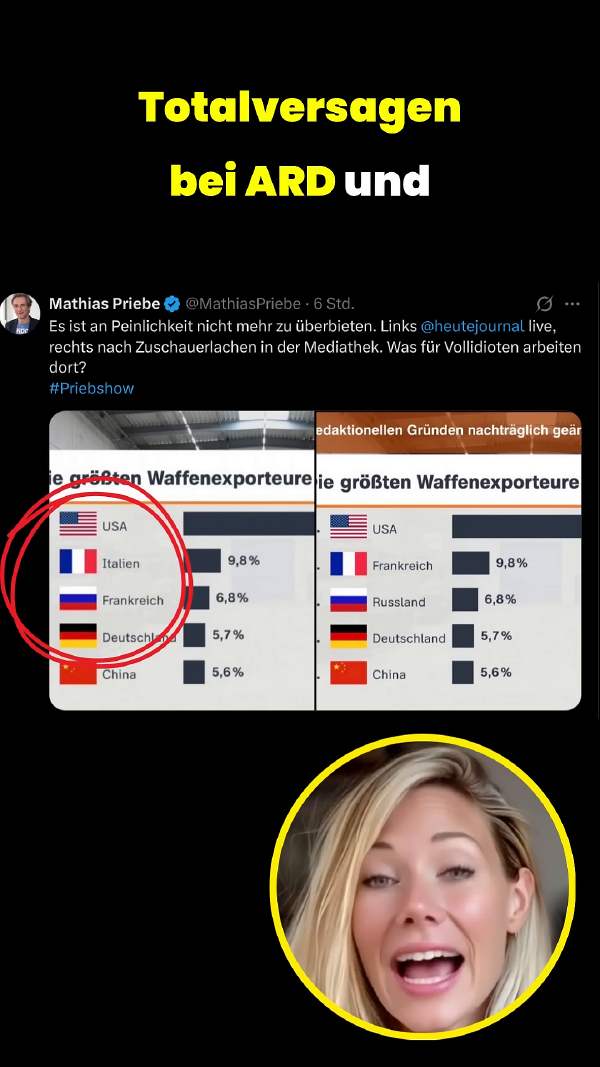
The false chart for the Baden-Württemberg election (March 2026). In „ZDF heute live" and „heute in Deutschland," a seat-distribution chart appeared in which the AfD, with 35 seats, was shown barely larger than the SPD with 10. Schausten conceded before the television council that the AfD’s share had been „proportionally too small." This case belongs to the honesty of the account: it was corrected the same day. That argues against systematic concealment — and belongs in any fair balance sheet.
The Brosius-Gersdorf reporting (July 2025). The ZDF issued a cease-and-desist declaration and subsequently obscured two displayed articles — even though, before the injunction proceedings, the ZDF conceded that the displayed articles were not themselves false reports. This case, too, is missing from the corrections page.
The pattern is not the error — it is how it is handled#
Errors happen in every newsroom. The measure is not their existence, but what follows. Here the line that connects the five cases becomes visible:
What gets corrected is what becomes public and can no longer be held — the AI fake, the election chart. What stays quieter disappears more quietly: the Kirk case, the Brosius-Gersdorf matter, the Correctiv ruling do not appear on the broadcaster’s own corrections page. The corrections page lists not a single court-established error of judgment. A corrections page that does not carry the false claim barred by the Hamburg Regional Court is not transparency but its appearance.
And the personnel consequences follow the same pattern — except that here it is a concrete reflex to protect upward. After the AI fake, the correspondent was recalled — the executor. The two-stage clearance, whose absence the broadcaster’s own catalog of measures later names, was a procedural duty, not discretion. Responsibility for this procedure lies with the editorial leadership, in whose house the broadcaster’s own AI rule had failed to take hold in live operation since October 2023 — 28 months. The one who executed was recalled. The one who is responsible for the procedure stayed in office. That is the constant we have described in this series from the start: whoever asks questions internally is declared the problem — not the error.
Why this is not bad luck#
The obvious objection runs: a cluster, not a system. Five cases in two years — perhaps a bad stretch, not a structural finding. That is worth honestly testing, and part of it holds: a continuous pattern spanning decades cannot be established from the accessible material. The documented cases cluster in 2024 to 2026.
But the accumulation does not stand in a vacuum. As early as 2009, the CDU-dominated ZDF administrative board rejected the contract renewal of editor-in-chief Nikolaus Brender — Roland Koch had found his reporting too critical. In 2014, the Federal Constitutional Court declared the ZDF’s state-aligned board composition unconstitutional. That is not an error case — it is the framework condition under which errors arise and go unaddressed. A broadcaster whose oversight bodies are shot through with party politics and that documents corrections selectively has no effective internal authority to protect it from the next case.
That this framework condition necessarily causes the concrete five cases cannot be proven — the connection is plausible, not seamlessly established. But it is the most obvious explanation for why the accumulation is not worked through but worked off.
That is the difference between bad luck and structure: bad luck repeats by chance. A structure that admits errors outwardly and leaves them without consequence inwardly produces them reliably.
Credibility is not a press-release term#
„At its core this is about the credibility of our reporting," Schausten said after the AI fake. The sentence is true. Only credibility is not something an apology produces. It arises when the correction has the same reach as the error, when responsibility lands where the decision was made, and when the broadcaster’s own corrections page is complete rather than curated.
On each of these three points, the record of the last 24 months shows the same thing: the ZDF can admit errors. It has not yet shown that it draws from them the consequence it would demand of any other institution.
This is Part 4 of our series on the ZDF and the oversight structure of public broadcasting. Parts 1–3: The Whistleblower as Enemy, No Alternative, The Director and the „Enemy".