June 25, 2026, 6 a.m.#
Five residential and commercial premises in Berlin. Chemnitz public prosecutor’s office. Warrants issued by Chemnitz district court. Spokesperson for the authorities: Ingrid Burghart.
The charges: Section 86a of the German Criminal Code — use of symbols of unconstitutional organizations. Plus defamation and insult.
The alleged instrument: a caricature.
ZPS on Bluesky, the same morning: “Today at 6 a.m., art was criminalized.” [1]
The Caricature#
On October 16, 2025, the Centre for Political Beauty unveiled a poster in front of the Chemnitz police headquarters.
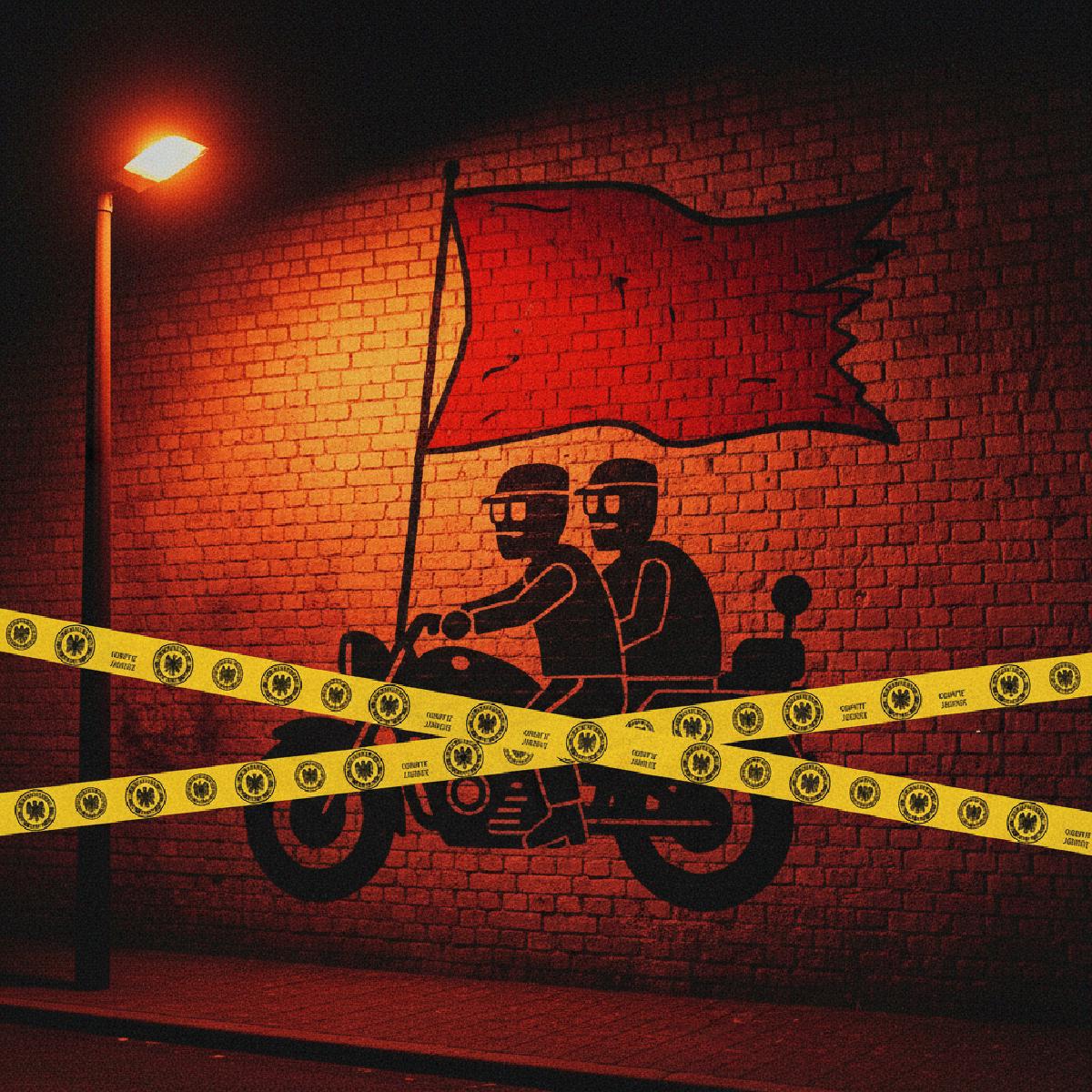
The image shows Police Chief Inspector Ringo S. and AfD party chairman Tino Chrupalla on a police motorcycle. At the rear: a German imperial war flag (Reichskriegsflagge). Chrupalla extends his left arm in a Hitler salute. The caption: “Sure thing, Tino! Nazis always get file access from me!”
That is satire. Exaggeration, confrontation, pointed provocation — the classical tools of political caricature.
Why Ringo S.? In September 2025, the officer confiscated the ZPS bus “Adenauer SRP+”. He stands accused of having passed internal police data to far-right extremists [2]. ZPS turned that accusation into an image — and placed it directly in front of his station.
Eight months later: five search warrants.
Section 86a: What the Law Says — and What It Doesn’t#
Section 86a prohibits the public display of symbols belonging to unconstitutional organizations, including the imperial war flag. Maximum sentence: three years.
The provision contains no explicit satire exception. However, Germany’s Federal Constitutional Court has consistently held: the substantive scope of Article 5(3) of the Basic Law — guaranteeing freedom of art — is broad. Satire that exaggerates falls within it, even if it uses symbols that would be criminal outside an artistic context. A contextually unambiguous critical deployment of a symbol cannot be blanket-prohibited without violating artistic freedom [3].
The ZPS poster does not use the war flag affirmatively. It shows a police-AfD duo carrying it — as accusation, not endorsement. Anyone who sees the image understands: this is not promotion of the Reichskriegsflagge. It is a charge.
The Chemnitz prosecutor’s office must have read the image differently. Or decided to read it differently.
What Happened to Stefan Pelzer#
ZPS member Stefan Pelzer was among those targeted. His computer was seized.
Officers also sought to take his fingerprints and photographs (erkennungsdienstliche Behandlung). There was no court order permitting this. Pelzer’s lawyer stopped the measure as unlawful [4].
This is not a footnote. When officers attempt measures during a search for which no judicial authorization exists — and a lawyer has to intervene to stop it — that is a finding about the quality of the investigation.
Article 5(3) Basic Law: No Reservations#
The German constitution leaves no ambiguity here:
Article 5(3) GG: “Arts and sciences, research and teaching shall be free.”
Freedom of art is guaranteed without any statutory reservation — there is no clause allowing legislative restriction. The only constitutionally immanent limit is the protection of other fundamental rights, primarily human dignity (Article 1(1) GG).
This means: Section 86a must be construed in light of Article 5(3). Where a criminal provision reaches political caricature, it collides with an unconditionally guaranteed right. Courts are required — and have consistently done so — to take the satirical context into account.
The Chemnitz district court signed five search warrants. It either did not engage with this context or found it outweighed. Which of those applies would be a question the public deserves an answer to.
The Elephant in the Room#
Section 86a is a sharp instrument. It needs to be — against genuine propagation of Nazi symbols. It is also an instrument that can be deployed selectively.
An artist who uses an imperial war flag as an accusatory device in a political caricature targeting a documented police-AfD connection: five searches, Chemnitz, 6 a.m.
The officer the accusation is directed at — who allegedly passed internal police data to far-right extremists: no comparable investigative pressure on the record.
ZPS is not a transparent organization — we have documented its structural opacity in detail. That remains a legitimate, entirely separate question. Both can be true simultaneously: ZPS is structurally opaque — and the raid of June 25, 2026 is a prosecution of satire.
Using one to neutralize the other does a favor to the Chemnitz prosecutor’s office. It hasn’t earned one.
Sources#
[1] ZPS: Statement on Bluesky, June 25, 2026
[2] Zeit Online, June 25, 2026: Searches at the Centre for Political Beauty
[3] BVerfGE 75, 369 (1 BvR 313/85) — “Anachronistischer Zug”: On the broad substantive scope of Article 5(3) GG in political satire
[4] taz, June 25, 2026: ZPS Raid: Five Searches Over Caricature
[5] Der Tagesspiegel, June 25, 2026
[6] Die Welt, June 25, 2026
[7] BZ Berlin, June 25, 2026