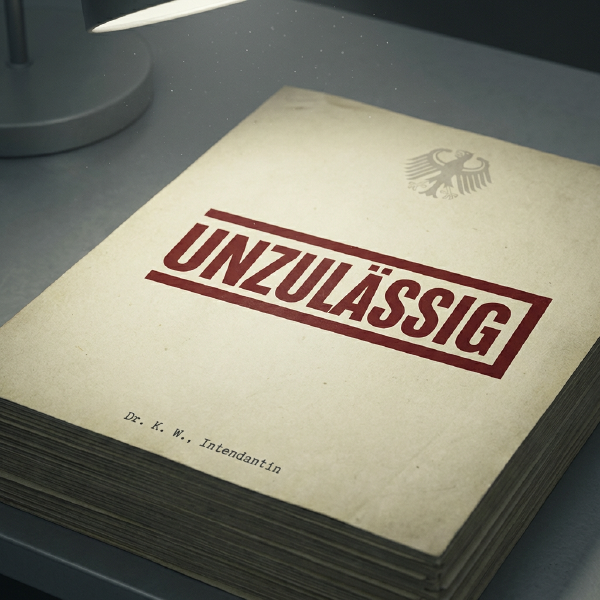
On 25 February 2026, the VII Civil Senate of Germany’s Federal Court of Justice (Bundesgerichtshof, BGH), presided by Judge Pamp, with judges Halfmeier, Graßnack, Borris and Dr Hannamann, issued a decision that, in the broadcasters whose entire funding mechanics it directly affects, has to this day never been reported. Case number: VII ZB 29/24. Matter: enforcement by Bavarian Broadcasting (Bayerischer Rundfunk, BR) against an individual fee debtor in Allgäu over unpaid broadcasting fees. Outcome: the enforcement is declared inadmissible, the creditor — the BR — bears the costs. Both lower courts, the local court of Kaufbeuren and the 4th Civil Chamber of the regional court of Kempten, had ruled the opposite way. The Federal Court overturned them both.
It is spring 2026, and the pattern is repeating itself. A new SARS-CoV-2 variant informally named “Cicada” (BA.3.2) is now detected in at least 31 U.S. states[1]. China and Hong Kong are simultaneously reporting their sharpest case rise “in at least a year”, driven by NB.1.8.1[2]. The WHO notes that “limited surveillance data” are increasingly hampering vaccination strategies worldwide[3].
The previous parts of this series described historical patterns: methodological weaknesses, late discovery of contaminations, liability exemptions. Part 5 shows that these patterns with the mRNA vaccine are not the exception but the rule.
Your browser cannot play this video. Download video.
Originalvideo: Marc Friedrich auf YouTube
Who Is Speaking Here? # Prof. Dr. Sucharit Bhakdi — immunologist, former head of the Institute for Medical Microbiology in Mainz, one of Germany’s most cited physicians. Since 2020, a critic of Covid vaccination policy.
Pia Aksoy lost her hearing. After an AstraZeneca vaccination in March 2021, experts diagnosed a likely irreversible unilateral hearing loss. The occupational insurance recognized the vaccine injury. But the courts? Two instances dismissed her lawsuit. She had to go all the way to Germany’s Federal Court of Justice (BGH).