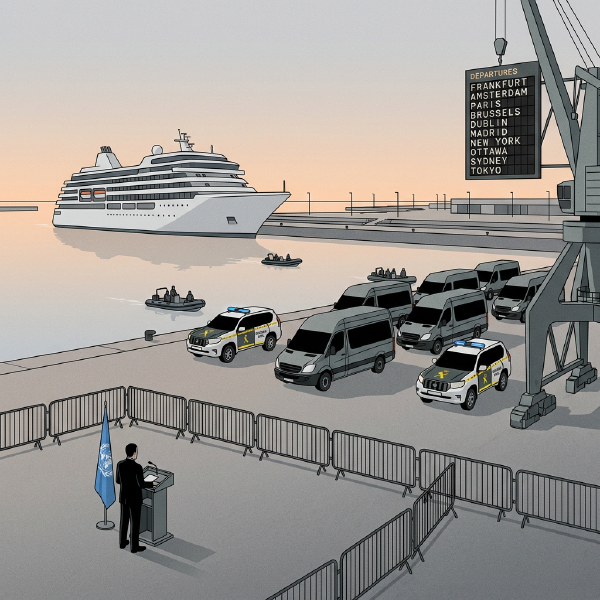
The evacuation of the MV Hondius activated the full institutional state-of-emergency apparatus — for an outbreak in which no one had symptoms on arrival. WHO risk rating: low. A lesson in institutional disproportionality.
At the very moment scientists and oversight bodies are systematically dismantling the Corona era, a new fear wave appears — and hijacks the space. A mechanism worth knowing.
On 18 May 2026, the 79th World Health Assembly (WHA79) opens in Geneva. On the agenda: the PABS annex to the WHO Pandemic Agreement — the mechanism that is supposed to determine what countries receive in return for sharing pathogen data that enables vaccine and drug development.
Since the beginning of her second term as President of the European Commission, public criticism and internal complaints about Ursula von der Leyen’s leadership style have been mounting. These accusations do not come from the margins — they come from former and current senior EU officials.
Some information is so precise, so perfectly timed, that you’d rather not think about it. This is one of those pieces.
October 2019. 27 EU member states. Greece.
While in New York City the famous Event 201 is running — a Gates Foundation pandemic simulation with a coronavirus scenario — a second exercise takes place in parallel, almost unnoticed by the public. Organizer: the European Centre for Disease Prevention and Control (ECDC). Participants: all 27 EU member states.
Von der Leyen’s SMS Affair: Facts and Consequences # Introduction # The controversy surrounding SMS communication between EU Commission President Ursula von der Leyen and Pfizer CEO Albert Bourla has raised fundamental questions about transparency in European institutions. In spring 2021, when the EU Commission concluded a contract for 1.8 billion vaccine doses with Pfizer, the New York Times reported on personal text messages between the two. What followed was an institutional failure in documentation and transparency.