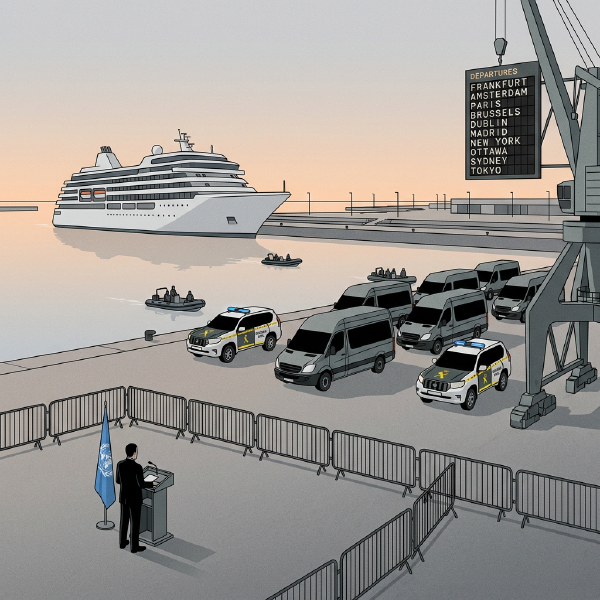
The evacuation of the MV Hondius activated the full institutional state-of-emergency apparatus — for an outbreak in which no one had symptoms on arrival. WHO risk rating: low. A lesson in institutional disproportionality.
At the very moment scientists and oversight bodies are systematically dismantling the Corona era, a new fear wave appears — and hijacks the space. A mechanism worth knowing.
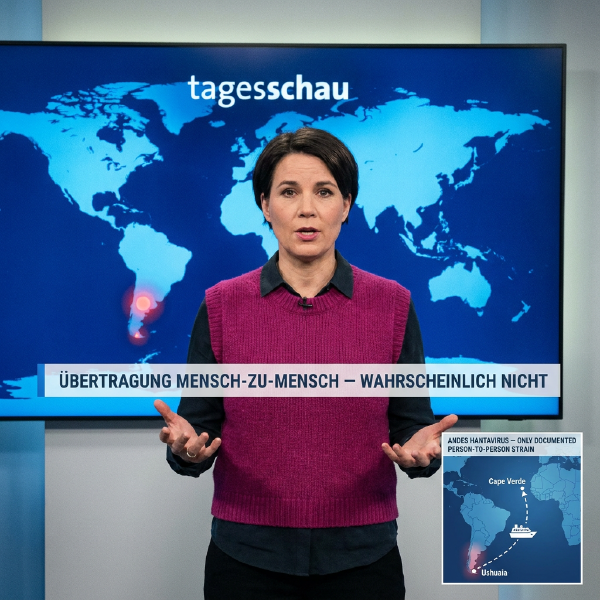
On 4 May 2026 — the same day the WHO officially confirms the hantavirus outbreak aboard the MV Hondius — Germany’s tagesschau airs a 99-second explanatory clip in its vertical social-media format. A young presenter stands before a glowing blue world-map backdrop with the tagesschau wordmark above her. Cut in: a statement by Stefan Schmiedel — “Infektiologe und Tropenmediziner” (infectious disease specialist and tropical medicine physician), identified in the lower third without further context. In substance, he is the leading Hamburg-UKE voice on imported tropical disease.
Institutions train for outbreaks. They build networks. They model scenarios. They use AI for this.
We read the patterns. We use AI for this.
The tools are symmetrical. This is not a claim about intent. It is an observation about structure — and about who gets counted in that structure.
On May 4, 2026, the WHO confirms: three people have died following a virus outbreak aboard the MV Hondius. The ship — a polar expedition vessel operated by Dutch company Oceanwide Expeditions — was en route from Ushuaia, Argentina, to Cape Verde. Laboratory confirmed: Andes hantavirus.