A new case report in Medical Research Archives describes vaccine-derived spike mRNA in exosomes after 1,284 days, spike protein in plasma after 1,173 days, and plasmid-DNA elements in skin tissue after 1,364 days in a 55-year-old man after three Pfizer-BioNTech doses. It proves no frequency. But it refutes the absolute claim that these components are biologically relevant only for a short time.
Advocate General Athanasios Rantos has recommended that the ECJ reject the EU Commission’s appeals in the dispute over disclosure of Pfizer vaccine contracts. A second consecutive legal defeat is now in sight — and the text messages are gone anyway.
On 5 May 2026, BioNTech announces: up to 1,860 jobs cut — 22 percent of its workforce. The plants in Idar-Oberstein and Marburg close by end of 2027. The CureVac sites too. COVID vaccine production transfers entirely to Pfizer.
The previous parts of this series described historical patterns: methodological weaknesses, late discovery of contaminations, liability exemptions. Part 5 shows that these patterns with the mRNA vaccine are not the exception but the rule.
There is a question that is rarely asked, but that puts the entire debate in a different light:
Why do vaccine manufacturers need statutory liability protection if their product is safe?
Your browser cannot play this video. Download video.
Originalvideo: Marc Friedrich auf YouTube
Who Is Speaking Here? # Prof. Dr. Sucharit Bhakdi — immunologist, former head of the Institute for Medical Microbiology in Mainz, one of Germany’s most cited physicians. Since 2020, a critic of Covid vaccination policy.
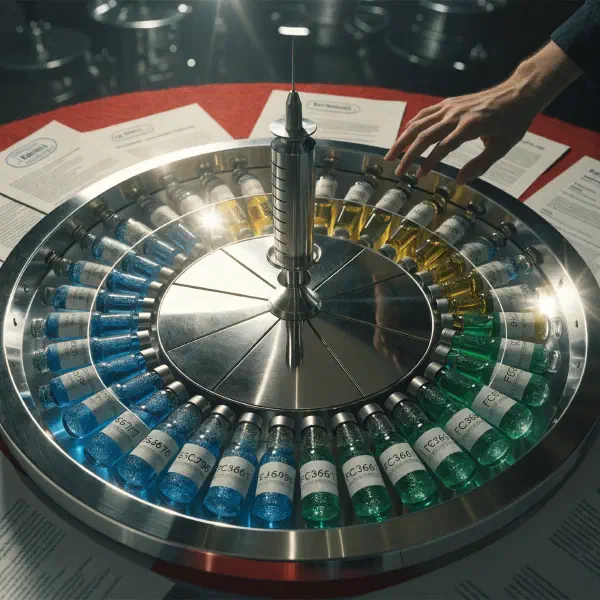
The Danish data shows what should never have happened: Identical product, completely different outcomes. Some batches cause illness. Some do — nothing at all. # In December 2025, Hamburg mathematics professor Hans-Juergen Bandelt published the first part of a three-part analysis on tkp.at. His starting point: the Danish study by Schmeling and Manniche, peer-reviewed and published in the European Journal of Clinical Investigation in 2023 [1]. His finding: More than 30% of BioNTech batches were practically ineffective — and the PEI knew it [2][3][4].
On March 19, 2026, something happened in the Bundestag that the media would rather downplay as a “heated exchange.” In truth, it was an indictment. # The Bundestag’s Corona Enquete Commission convened on Thursday under the title “Healthcare System Performance, Vaccination Strategy, and Research.” What was planned as a sober review turned into a tribunal over the federal government’s vaccination policy. So uncomfortable that audience members were expelled from the chamber — not because they were disruptive, but because they applauded [1][2].
The ruling of the General Court of the European Union (EuG) of May 14, 2025 (case number T-36/23) marks a decisive blow against the EU Commission in the so-called “Pfizergate”. The case concerns the Commission’s refusal to disclose text messages (SMS) between EU Commission President Ursula von der Leyen and Pfizer CEO Albert Bourla. The plaintiff, the New York Times (represented by journalist Matina Stevis-Gridneff), was vindicated: The Commission must re-examine the request and release the messages – if they exist. The ruling underscores the transparency obligation of EU institutions and sharply criticizes the Commission for inadequate documentation of digital communication.
On July 10, 2025, a crucial vote took place in the European Parliament in Strasbourg, where a motion of no confidence against EU Commission President Ursula von der Leyen was discussed. This motion, filed by 77 parliamentarians, including 15 German AfD members and politicians from the Rassemblement National (RN) party led by Marine Le Pen, was an expression of growing dissatisfaction with von der Leyen’s leadership during the Corona pandemic.
Since the beginning of the COVID-19 pandemic, we have witnessed an unprecedented global response that has had profound impacts on our society, our healthcare systems, and our daily lives. While many of us thought the worst storm had passed, more and more questions and concerns are emerging about the safety and long-term effects of COVID-19 vaccines. In this article, we take a detailed look at current revelations and studies that provide alarming insights into the potential risks and side effects of these vaccines.
Published September 18, 2025 | Source: Prof. Klaus Steger
In a groundbreaking revelation, official Pfizer approval documents have confirmed what was long dismissed as “conspiracy theory”: The COVID-19 vaccine Comirnaty actually contains SV40 promoter-enhancer sequences and residual DNA packaged together with modRNA in lipid nanoparticles. This disclosure raises fundamental questions about the safety and transparency of a vaccine administered to millions worldwide.