124 yes votes, zero no votes, historic. And not a single country has ratified since May 2025 — not because of resistance, but because the treaty text itself contains a prerequisite that remains unfulfilled. Why the ratification clock has never started.
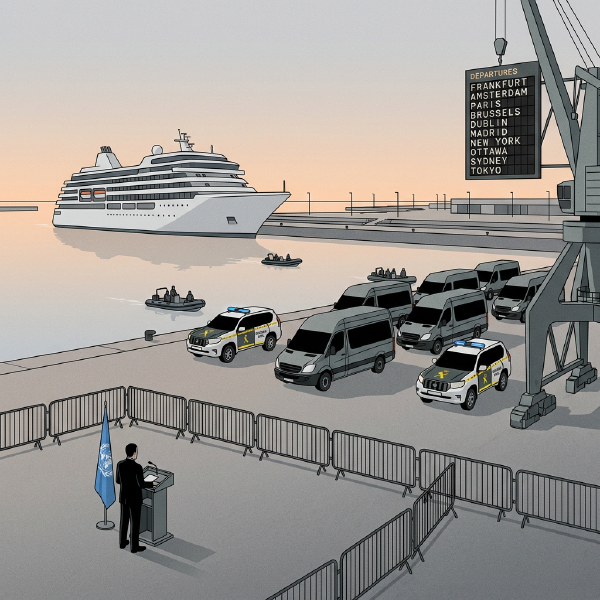
The evacuation of the MV Hondius activated the full institutional state-of-emergency apparatus — for an outbreak in which no one had symptoms on arrival. WHO risk rating: low. A lesson in institutional disproportionality.
At the very moment scientists and oversight bodies are systematically dismantling the Corona era, a new fear wave appears — and hijacks the space. A mechanism worth knowing.
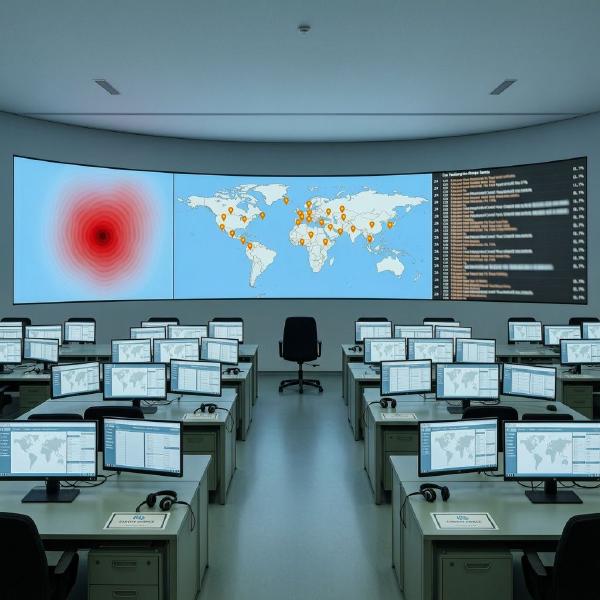
Institutions train for outbreaks. They build networks. They model scenarios. They use AI for this.
We read the patterns. We use AI for this.
The tools are symmetrical. This is not a claim about intent. It is an observation about structure — and about who gets counted in that structure.
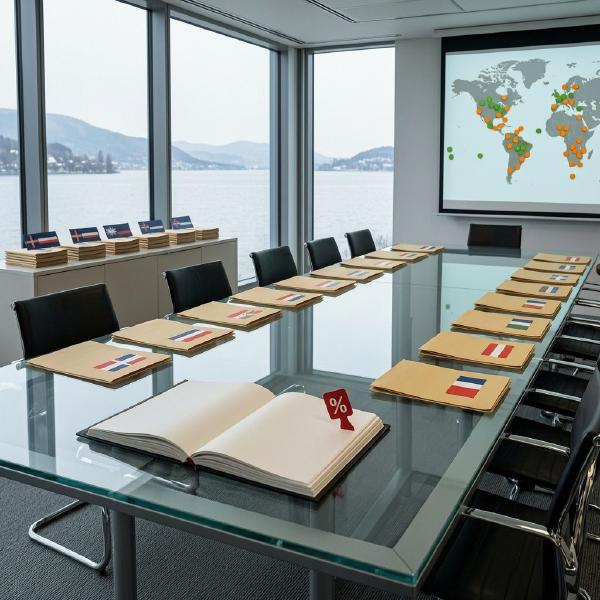
On 18 May 2026, the 79th World Health Assembly (WHA79) opens in Geneva. On the agenda: the PABS annex to the WHO Pandemic Agreement — the mechanism that is supposed to determine what countries receive in return for sharing pathogen data that enables vaccine and drug development.
On 22–23 April 2026, the WHO conducted Exercise Polaris II: a two-day pandemic simulation involving 26 countries, 600 health experts, and more than 25 partner organisations. The scenario: a fictional new bacterial strain spreading across 27 countries. Ten days later, the WHO confirmed the first hantavirus cluster aboard the MV Hondius.
On May 4, 2026, the WHO confirms: three people have died following a virus outbreak aboard the MV Hondius. The ship — a polar expedition vessel operated by Dutch company Oceanwide Expeditions — was en route from Ushuaia, Argentina, to Cape Verde. Laboratory confirmed: Andes hantavirus.
On 14 January 2005, in a conference room in Washington, ten former or sitting heads of government from North America and Europe — together with a former WHO Director-General and an array of foreign-policy advisers — gathered around a table and played out a coordinated smallpox attack on six major cities simultaneously: Istanbul, Rotterdam, Warsaw, Frankfurt, New York City, Los Angeles. Within four and a half hours of exercise time the reported case count climbed from 51 to 3,320. The exercise was called Atlantic Storm.
It is spring 2026, and the pattern is repeating itself. A new SARS-CoV-2 variant informally named “Cicada” (BA.3.2) is now detected in at least 31 U.S. states[1]. China and Hong Kong are simultaneously reporting their sharpest case rise “in at least a year”, driven by NB.1.8.1[2]. The WHO notes that “limited surveillance data” are increasingly hampering vaccination strategies worldwide[3].
124 States Said Yes. The US Said No. And Germany Is Paying the Bill. # In May 2025, 124 WHO member states adopted an international pandemic agreement in Geneva — the most far-reaching health accord since the International Health Regulations of 2005. Eleven states abstained, including Italy, Poland, Israel, Russia, and Iran. No state voted against it [1][2].
73 instances of plagiarism in her dissertation, declared 2G exclusion ethically acceptable, pocketed the Federal Cross of Merit — and now she advises the WHO on genome editing.
Alena Buyx has had a remarkable career. In a functioning democracy, that career would have ended long ago. In Germany, you get the Federal Cross of Merit for it.
Everyone is staring at the wrong thing.
Since the Epstein files dropped, public attention has locked onto the obvious — prominent names, sexual misconduct, a convicted pedophile with impossible connections. That story is real and it matters. But Prof. Roland Wiesendanger, physicist and nanoscientist at the University of Hamburg, spent his time in the documents looking somewhere else. And what he found is arguably bigger.