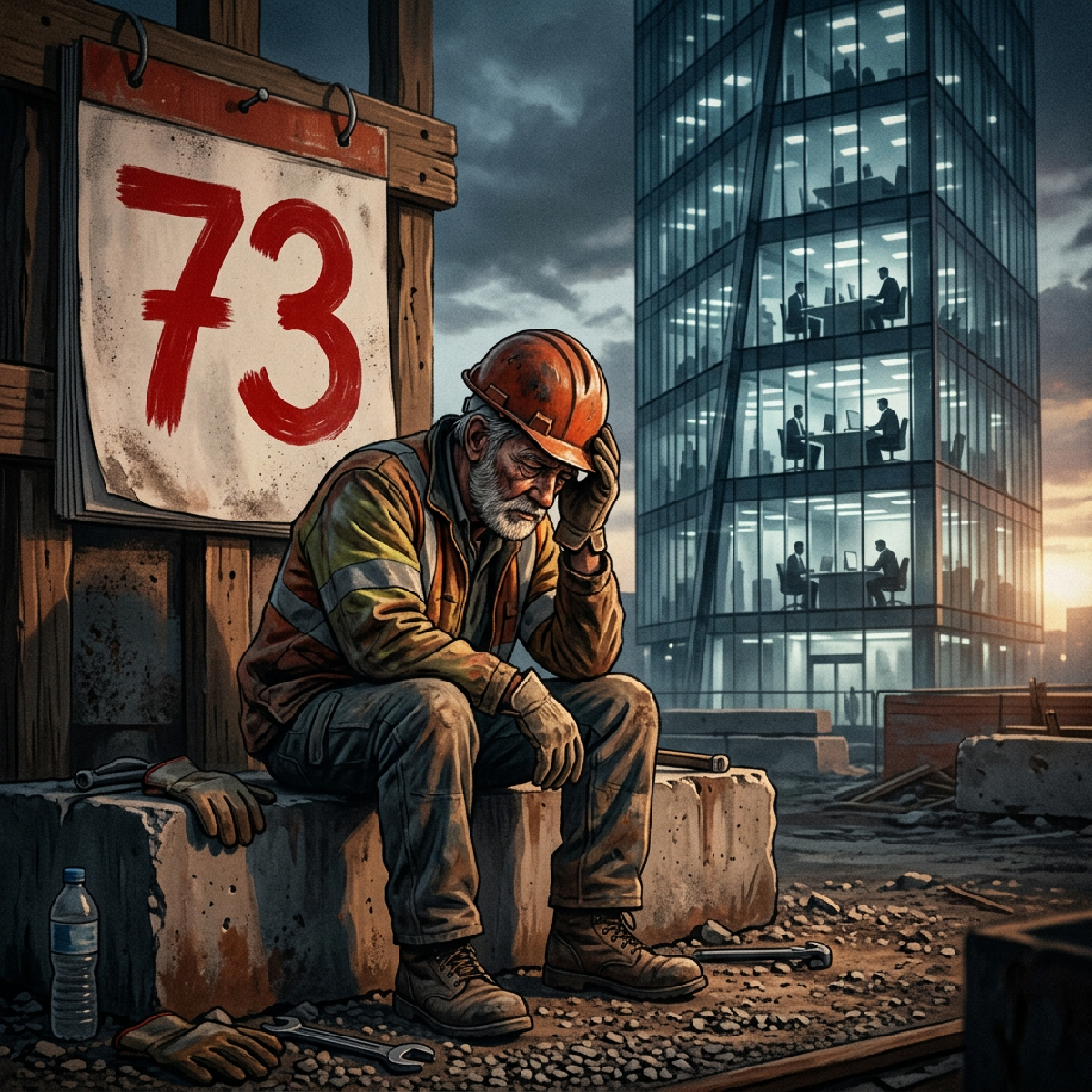
Retirement at 73. The idea is in the air, once again, as if it were the most natural thing in the world. For decades, the pension system was never fundamentally reformed. Now that the consequences of this inaction are becoming visible, the answer is once again: work longer.
For management consultants, lawyers, and bureaucrats, it may be an abstract number. For a roofer at 58, it’s a different question entirely.
Who Is Supposed to Work Longer #
Retirement at 73 doesn’t mean the same thing for everyone.
A 55-year-old roofer has spent a good 30 years on rooftops. Knees, back, shoulders — the body is the tool, and tools wear out. A care worker has accumulated night shifts, lifting duties, emotional exhaustion. A warehouse worker, a bricklayer, a retail worker — they’re all supposed to hold out until 73.
On paper, retirement at 73 is a number. In reality, for a significant portion of the workforce, it is a demand that borders on the impossible.
Whoever raises the retirement age without differentiating between occupational groups pretends that physical labor and desk work are the same thing. They are not.
How It Came to This #
The German pension system is a pay-as-you-go model: today’s workers finance today’s retirees. It works as long as the ratio holds. It no longer holds.
Demographic change, declining birth rates, rising life expectancy — this has been known for decades. The political responses were: gradually raise the retirement age, gradually lower the pension level, postpone reforms.
A capital-funded supplementary system? Discussed, never implemented. Immigration as a demographic solution? Millions came — but the share in regular, insured employment fell far short of expectations. The contribution side wasn’t substantially strengthened; the expenditure side grew.
The result: retirement at 73 as the ultima ratio of a policy that never touched the actual levers.
The Denmark Comparison #
Proponents point to Denmark, which successfully operates a flexible system with a higher retirement age. The comparison isn’t wrong — but it’s incomplete.
Denmark has a three-pillar system: state basic pension, occupational pension, private savings. It has one of Europe’s strongest worker protection frameworks. It has provisions enabling early exit for physically demanding occupations. And it has invested more in health, education, and labor market integration for decades.
Denmark is not Germany minus ten years of retirement age. It is a different system altogether.
Whoever imports only the retirement age without the flanking structures exports the burden onto those least able to bear it.
What Was Missing — and Still Is #
A serious pension reform would address several things simultaneously:
Differentiation by occupation. Those who do physical work need different rules than those who don’t. That’s not a privilege — it’s realism.
Capital funding. A sovereign citizen fund modeled on Sweden, decoupling parts of pension financing from the demographic ratio. Demanded for years, never seriously implemented.
Labor market integration. Whoever promotes immigration as a demographic solution must deliver the qualification and integration structures that turn arrivals into contributors. That hasn’t happened.
Honesty about the pension level. The pension level has been declining for years. Whoever conceals that and instead raises the entry age doesn’t solve the problem — they shift it onto those affected.
Conclusion #
Retirement at 73 is not the end of a debate. It is the symptom of a policy that managed structural problems for decades instead of solving them.
For workers in physically demanding jobs, it is more than a number. It is the prospect of working until exhaustion — while those who decide on the retirement age are rarely those whose bodies are at stake.
This is not individual failure. It is the result of decades of political convenience — at the expense of those who can least afford it.