The “Best” AI Models in the World: A Reality Check #
Everyone talks about the AI revolution. Superintelligence around the corner. AGI any day now. But what do the actual benchmarks say when we look at standardized testing across 171+ different tasks?
The numbers are sobering:
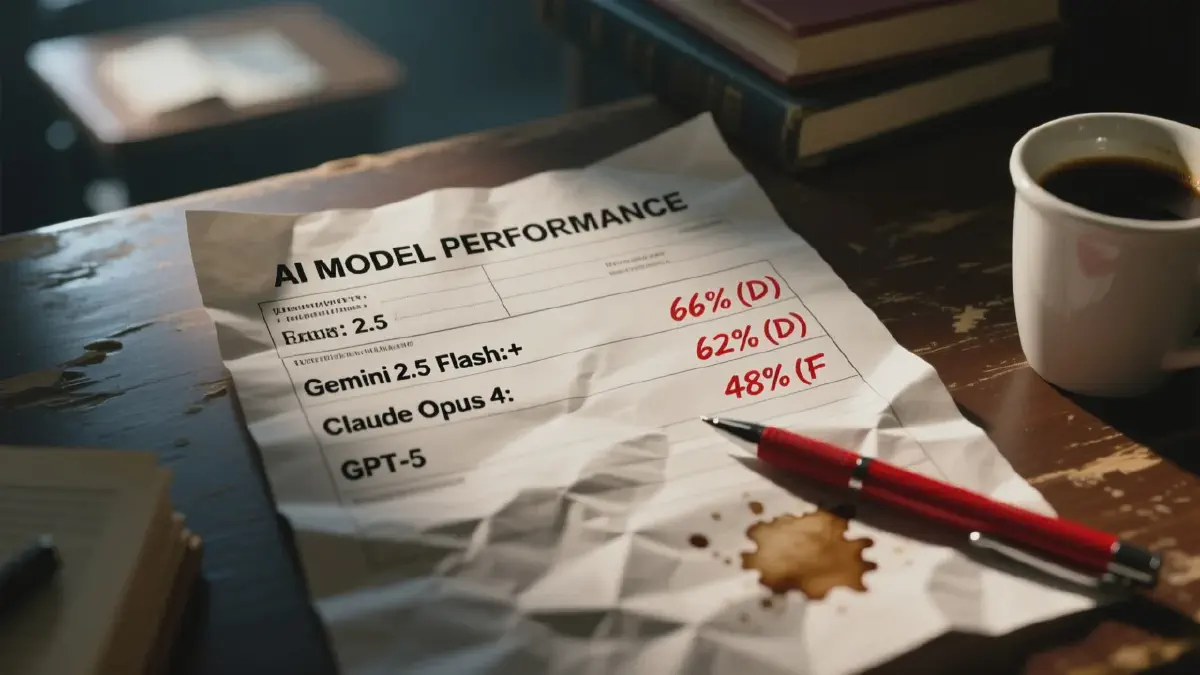
| Model | Overall Score | Tasks Failed | Grade Equivalent |
|---|---|---|---|
| Gemini 2.5 Flash | 66% | 1 in 3 | D+ |
| Claude Opus 4 | 62% | ~2 in 5 | D |
| GPT-5 | 48% | 1 in 2 | F (Fail) |
Let that sink in. These aren’t cherry-picked failure cases — these are aggregate scores across coding, reasoning, specification compliance, and stability tests.
The Math Nobody Talks About #
Gemini 2.5 Flash — the current leader — fails at 33% of tasks. In an academic setting, this is a D+ student. Not failing, but far from reliable.
GPT-5 — OpenAI’s flagship — performs at coin-flip level (48%). This is below most schools’ passing threshold. Yet this is the model powering enterprise applications, coding assistants, and automated decision-making systems worldwide.
What These Scores Actually Measure #
The AI Stupid Meter evaluates models across seven critical axes:
- Correctness — Does it produce the right answer?
- Specification compliance — Does it follow instructions precisely?
- Code quality — Is generated code maintainable and efficient?
- Efficiency — Resource usage and speed
- Stability — Consistent performance across similar tasks
- Refusal rates — How often it declines valid requests
- Recovery ability — Can it fix its own mistakes?
A 66% score doesn’t mean “gets 66% of questions right” — it means “performs adequately across 66% of our comprehensive evaluation criteria.”
The C-Student Running Your Business: Real-World Impact #
Think about what these failure rates mean in production:
For Developers #
- Your AI code completion suggests 3 solutions → 1 is subtly wrong and introduces a bug
- That “intelligent” refactoring? 50/50 shot it breaks something
- Documentation generation? Every third docstring contains hallucinated parameters
For Business Operations #
- Customer support chatbot with 1,000 daily queries → 330 frustrated customers getting wrong answers
- Automated data extraction from invoices → 340 invoices/day need manual review
- AI-powered email triage → Half your important emails might get misclassified
The Hidden Cost #
Each failure isn’t just an error — it’s:
- Time spent debugging AI-generated mistakes
- Reputation damage from wrong customer-facing answers
- Decision risk when leadership acts on flawed analysis
We’re not in the age of artificial intelligence. We’re in the age of artificial confidence — systems that sound authoritative while being fundamentally unreliable.
Why This Matters: Beyond the Hype Cycle #
The AI marketing machine shows demos. Benchmarks show reality. Understanding this gap is crucial for:
1. Setting Realistic Expectations #
A 66% score means you must build:
- Human-in-the-loop review systems
- Automated validation layers
- Fallback mechanisms for critical paths
2. Model Selection Strategy #
Don’t just pick the “best” model. Pick the right model for your use case:
- High-stakes decisions? Use multiple models and consensus voting
- Creative tasks? 66% might be acceptable
- Safety-critical? Current AI isn’t ready without extensive guardrails
3. Cost-Benefit Analysis #
If your AI fails 33% of the time, but fixing those failures costs 2x the AI savings, you’re losing money.
4. The Benchmark Gaming Problem #
Models are increasingly optimized for specific benchmarks, not general reliability. A high score on a public benchmark doesn’t guarantee good performance on your specific tasks.
Track It Yourself: Live Performance Monitoring #
We’ve integrated real-time AI performance monitoring directly into the Eliza on Steroids platform. This isn’t static data — it updates every 4 hours with fresh benchmarks.
Check Live AI Performance Stats →
See which models are actually performing today, which ones are degrading, and make informed decisions about which AI to trust.
The Bottom Line #
AI models are powerful tools, but they’re not oracles. A 66% benchmark score is a reminder that human oversight isn’t optional — it’s essential.
The revolution is real, but it’s a C-student revolution. Plan accordingly.
Data sourced from AI Stupid Meter — independent, real-time AI model benchmarking across 171+ tests and 16+ models. Methodology: 7-axis evaluation, updated every 4 hours.