Cem Özdemir wears a UN SDG pin on his lapel. A small badge symbolizing the 17 Sustainable Development Goals of the United Nations. For most, a detail. For those who look closer: a signal.
Özdemir is a WEF Young Global Leader, class of 2002. That’s not a footnote — it’s listed on weforum.org, publicly accessible, no secret.
The real question begins when you look at who else is on that list.
The Program #
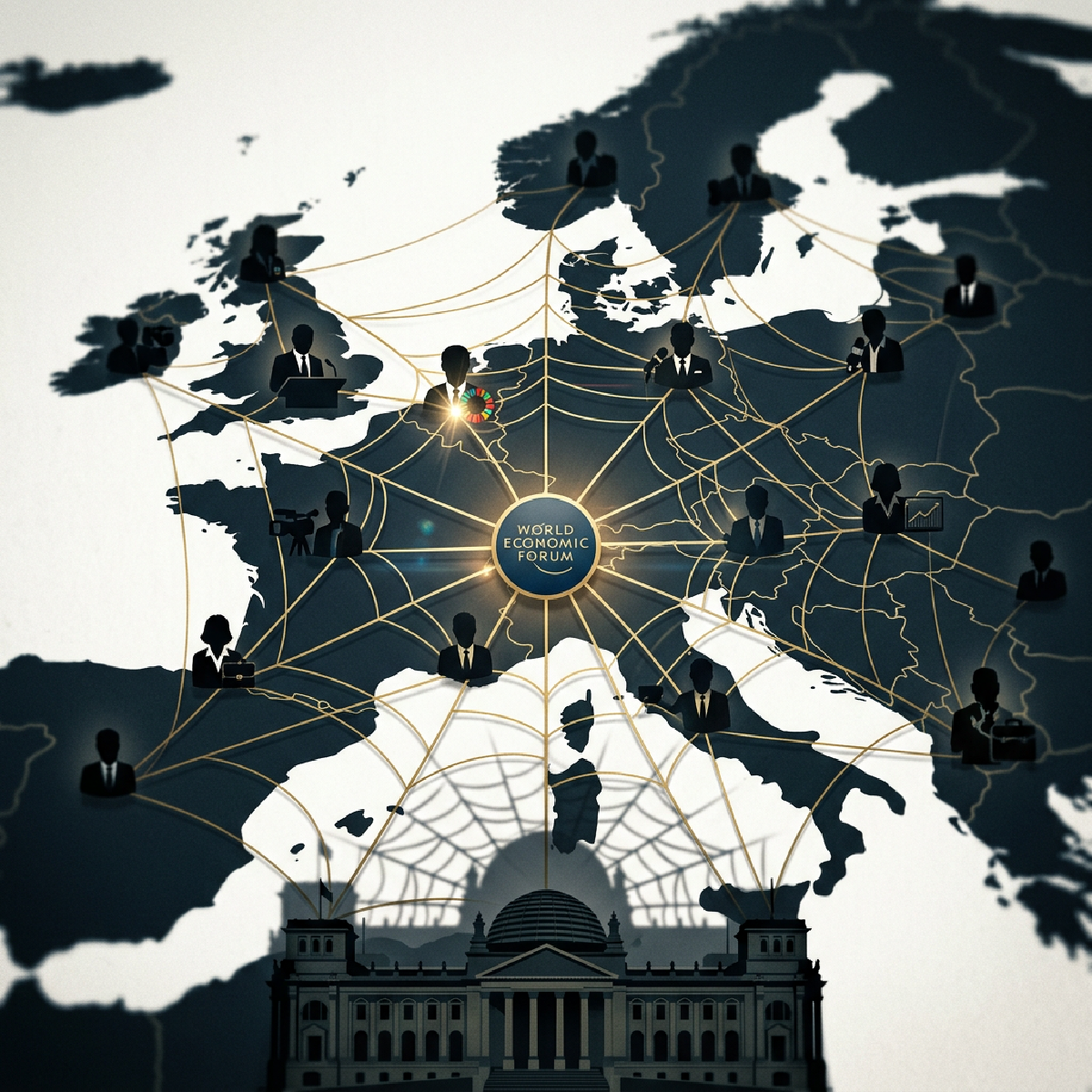
The Young Global Leaders (YGL) program of the World Economic Forum was initiated by Klaus Schwab and officially founded in 2004. Each year, young leaders from politics, business, science, and media are selected — people who, in the WEF’s assessment, will “influence global decision-making processes.”
Over 1,400 members and alumni from over 120 countries. No elected body. No democratic mandate. A private network operated by a foundation based in Geneva.
The German List #
What stands out when compiling the German YGL alumni is not any single name but the density:
CDU/CSU: Angela Merkel, Armin Laschet, Markus Söder, Jens Spahn, Julia Klöckner, Thomas de Maizière, Karl-Theodor zu Guttenberg, Volker Bouffier, Monika Grütters, Philipp Amthor
SPD: Olaf Scholz, Frank-Walter Steinmeier, Wolfgang Schäuble, Hubertus Heil, Ingrid Matthäus-Maier
Greens: Annalena Baerbock, Robert Habeck, Cem Özdemir, Omid Nouripour, Winfried Kretschmann
FDP: Silvana Koch-Mehrin, Katja Suding
Others: Jens Weidmann (Bundesbank), Wolfgang Ischinger (Munich Security Conference), Claus Kleber (ZDF journalist), Sandra Maischberger (ARD journalist), Cardinal Reinhard Marx, Nico Rosberg
This is not one name. It is the map of German decision-makers over the last two decades — across all parties, through media, church, finance, and security policy.
What the Program Does — and What It Doesn’t #
The WEF describes the YGL program as a network that promotes “innovative, collaborative, and inclusive leadership.” In concrete terms: joint seminars, exchange programs, access to Davos, a global network among like-minded peers.
This is not a conspiracy. It is a network. Networks work this way: you get to know each other, share language and concepts, build trust, open doors.
The question is not whether this is evil. The question is: who decides who enters this network — and who doesn’t?
The answer: Klaus Schwab and his institute. A private actor with no democratic legitimacy, no accountability to the public, no voter mandate.
The Özdemir Moment #
Özdemir became a YGL in 2002 — at the time just a member of parliament, not a prominent figure. He was selected before he became a minister.
This is the pattern running through the list: the WEF selects early. Not by election result, not by democratic legitimacy — but by potential, by worldview compatibility, by network fit.
Those who pass through this needle’s eye have doors open to them that remain closed to others. Those who don’t pass — or who decline the program — likewise.
The Question Nobody Asks #
If virtually the entire German leadership class of the past 20 years has passed through the same private network — what does that mean for the diversity of perspectives represented in German governments?
What does it mean when Merkel and Baerbock, Scholz and Spahn, Habeck and Söder all attended the same seminars, learned the same concepts, cultivated the same networks — before they entered democratic office?
This doesn’t preclude genuine political competition. But it includes a shared baseline consensus — a shared language, a shared worldview, a shared conception of which questions are legitimate and which are not.
And it perhaps explains why certain topics were never seriously discussed across party lines.
What Transparency Would Look Like #
Democracy functions through transparency. Voters should know who their representatives are, what interests they serve, which networks they belong to.
The WEF network is no secret — the list is public. But it is rarely discussed. Journalists who ask about it encounter disinterest or deflection. Özdemir did not substantively respond to a parliamentary question about his YGL membership on abgeordnetenwatch.de.
That is his right. But it is also a signal: whoever doesn’t want to talk about this network has a reason for it.
Conclusion #
A UN SDG pin on the lapel of a German minister is not a state affair. But it is a symbol — of a political class that cultivates its loyalties and networks beyond the German voter.
The WEF is not a shadow government. But it is a selector. It co-determines who makes a career in Germany — and it does so without democratic mandate, without voter authorization, without accountability.
The question everyone should ask: if the people who govern Germany were selected through the same private network — does the voter still truly have a choice?
Sources: