When The Telegraph revealed in February 2026 that a German businesswoman had called Jeffrey Epstein “Baby” and “Mr Wonderful” — the latter while he was in prison — Nicole Junkermann resigned from the board of a royal charity within days.
Noelia Castillo Ramos didn’t want to die because she was sick.
She wanted to die because no one was there.
At 13, after her parents separated, she was placed in state care. While in a foster family, she was raped in her sleep by her ex-boyfriend. In 2022, she was gang raped by three men. Later that year, she attempted suicide with medication. When that failed, she jumped from a fifth-floor window. The fall left her paraplegic, in permanent pain.
Nikola Brindley had been a dental nurse for over a decade. She knew vaccines. When she was asked to take AstraZeneca’s COVID jab in July 2021, she agreed without hesitation. Within hours, she was in A&E. Multiple organ systems began to fail. “I collapsed on the doorway and pretty much lost the ability to walk,” she recalls. Today, she uses a wheelchair.
Before discussing side effects, efficacy rates, or mandates — a foundational question must be asked:
Was the central assumption that vaccination protects ever empirically established?
This isn’t a question from fringe corners of the internet. It’s a methodological question raised by physicians and researchers in peer-reviewed literature — people who have been vaccinating for decades.
Pia Aksoy lost her hearing. After an AstraZeneca vaccination in March 2021, experts diagnosed a likely irreversible unilateral hearing loss. The occupational insurance recognized the vaccine injury. But the courts? Two instances dismissed her lawsuit. She had to go all the way to Germany’s Federal Court of Justice (BGH).
No monitoring, no data, no consequences — but the vaccines were of course “safe and effective.”
It is one of the biggest scandals in Germany’s postwar history — and hardly anyone is talking about it. BioNTech, the Mainz-based company celebrated as the hero of the pandemic, positioned itself legally so that it is formally not even a vaccine manufacturer. And the authority responsible for monitoring vaccine safety — the Paul Ehrlich Institute (PEI) — failed to evaluate the legally mandated data for years.
On April 15, 2023, Isar 2 went offline. The nuclear power plant in Essenbach, one of the most modern and efficient in Europe, reliably produced electricity — without CO₂, without shortages, without significant incidents. It could have run for decades more.
Retirement at 73. The idea is in the air, once again, as if it were the most natural thing in the world. For decades, the pension system was never fundamentally reformed. Now that the consequences of this inaction are becoming visible, the answer is once again: work longer.
In late January 2026, the German Bundestag debated weather manipulation. The AfD had introduced a motion (Drucksache 21/3832) calling on the federal government to investigate the risks of geoengineering and weather modification.
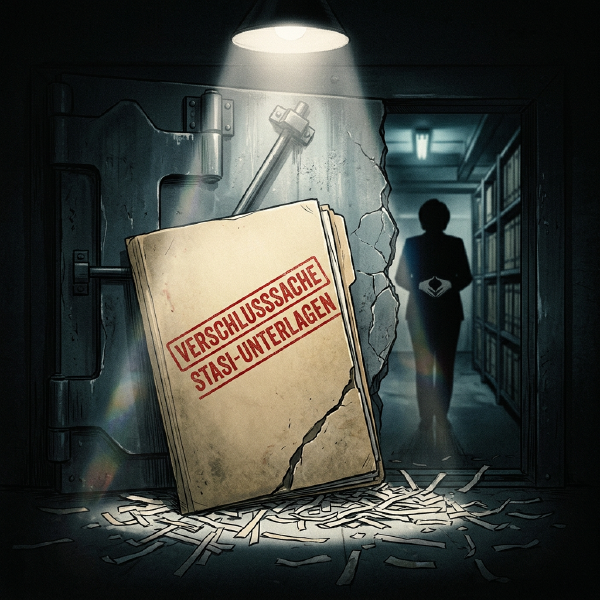
On March 13, 2026, the First Chamber of the Berlin Administrative Court delivered a ruling that barely made headlines. Presiding Judge Jens Tegtmeier stated clearly: Marcel Luthe, former FDP member of parliament and plaintiff, had “no legal claim to the release” of possible Stasi files on Angela Merkel under the Stasi Records Act.
Cem Özdemir wears a UN SDG pin on his lapel. A small badge symbolizing the 17 Sustainable Development Goals of the United Nations. For most, a detail. For those who look closer: a signal.
March 14, 2020 — the day a government agency lied to its citizens and was never held accountable.
Exactly six years ago today, Germany’s Federal Ministry of Health (BMG) published a tweet that would go down in history — though not in the way the ministry had intended.