There are moments on the internet where you sit in front of your screen, stare at what you’ve just watched, and genuinely ask yourself: Did someone actually make this? And then you realize: Yes. Yes, they did. And it’s the best thing you’ll see all week.
The Stasi, the Ministry for State Security of the GDR, was a symbol of total surveillance and oppression. With a vast network of official and unofficial collaborators, it infiltrated the most intimate areas of citizens’ lives. But what was once considered the epitome of a surveillance state now seems almost primitive compared to what Big Tech and artificial intelligence (AI) have made possible.
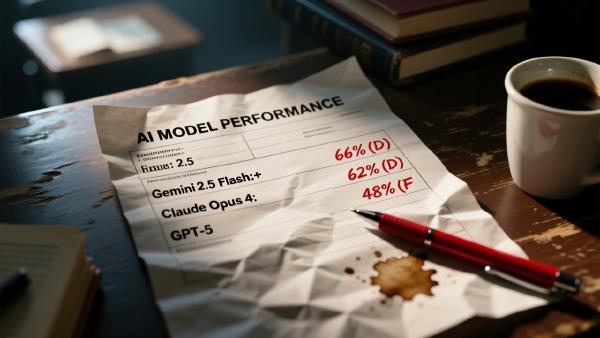
The “Best” AI Models in the World: A Reality Check # Everyone talks about the AI revolution. Superintelligence around the corner. AGI any day now. But what do the actual benchmarks say when we look at standardized testing across 171+ different tasks?
Awake? Or Just Telegram-Addicted?
Every day the same theater:
“I’m awake!” → shares 47 WEF articles per day → writes under every post “They’re still sleeping!” → sits in five Telegram groups where exactly the same thing is posted
There are two dominant narratives about Large Language Models:
Narrative 1: “AI is magic and will replace us all!” → Exaggerated, creates hype and fear
Narrative 2: “AI is dumb and useless!” → Ignorant, misses real value
The Setup: From Frustration to AI Psychology Experiment # What started as a simple product complaint quickly evolved into one of the most fascinating AI interaction experiments I’ve conducted. The journey revealed fundamental limitations in how current AI models communicate - even when they’re aware of those limitations.
Introduction: # The introduction of “Chat Control” represents a dangerous development for our digital freedom and privacy. Under the guise of “security,” our personal messages and communications are being monitored and analyzed. This measure not only threatens our privacy but also the integrity of our entire digital communication. It’s time to stand up against this surveillance and defend our rights.
In the last months, sightings of alleged Russian drones over Denmark, Norway, Sweden, Romania, and Germany have increased. What do these sightings have in common? First, not a single one of these drones was intercepted, shot down, or forced to land through electronic interference. Second, no one knows where these drones came from and where they disappeared to. There are no radar plots, no verifiable flight paths, although in all cases it concerns critical civilian, military, or dual-use infrastructure, namely in one of the most densely guarded airspaces in the world. These drones simply disappeared, and I have no further comment on that.
While the tech world debates EchoLeak and data exfiltration in Microsoft 365 Copilot, there’s another issue that frustrates content creators daily: Copilot simply changes your texts – unsolicited and at its own discretion. What was meant to be a helpful assistant turns into an overeager editor that overwrites your writing style, your statements, and your authenticity.
Operation Lockstep: A Comprehensive Critical Analysis of Global Health and Security Initiatives
In a world constantly confronted with challenges, the concept of Operation Lockstep remains a central theme that significantly shapes how nations approach global health and security. Sketched by the Rockefeller Foundation, this concept envisions a future where heightened government control and surveillance follow global health crises. While official narratives emphasize the necessity of such measures to better prepare the world for future threats, there is growing skepticism about who truly holds the reins.
In the rapidly evolving landscape of AI-driven tools, Microsoft’s Copilot has established itself as a key player by integrating generative AI into Microsoft 365 applications to boost productivity and efficiency. However, recent vulnerabilities have exposed significant security risks and raise critical questions about the tool’s reliability and the potential for data breaches. This post examines the EchoLeak vulnerability, its implications, and the broader context of AI security in enterprise environments.
The Charlie Kirk case has impressively demonstrated how AI tools can create false narratives in real-time and spread them at breakneck speed, often bypassing traditional news processes. This has led to considerable confusion and a lack of clarity about the actual events.