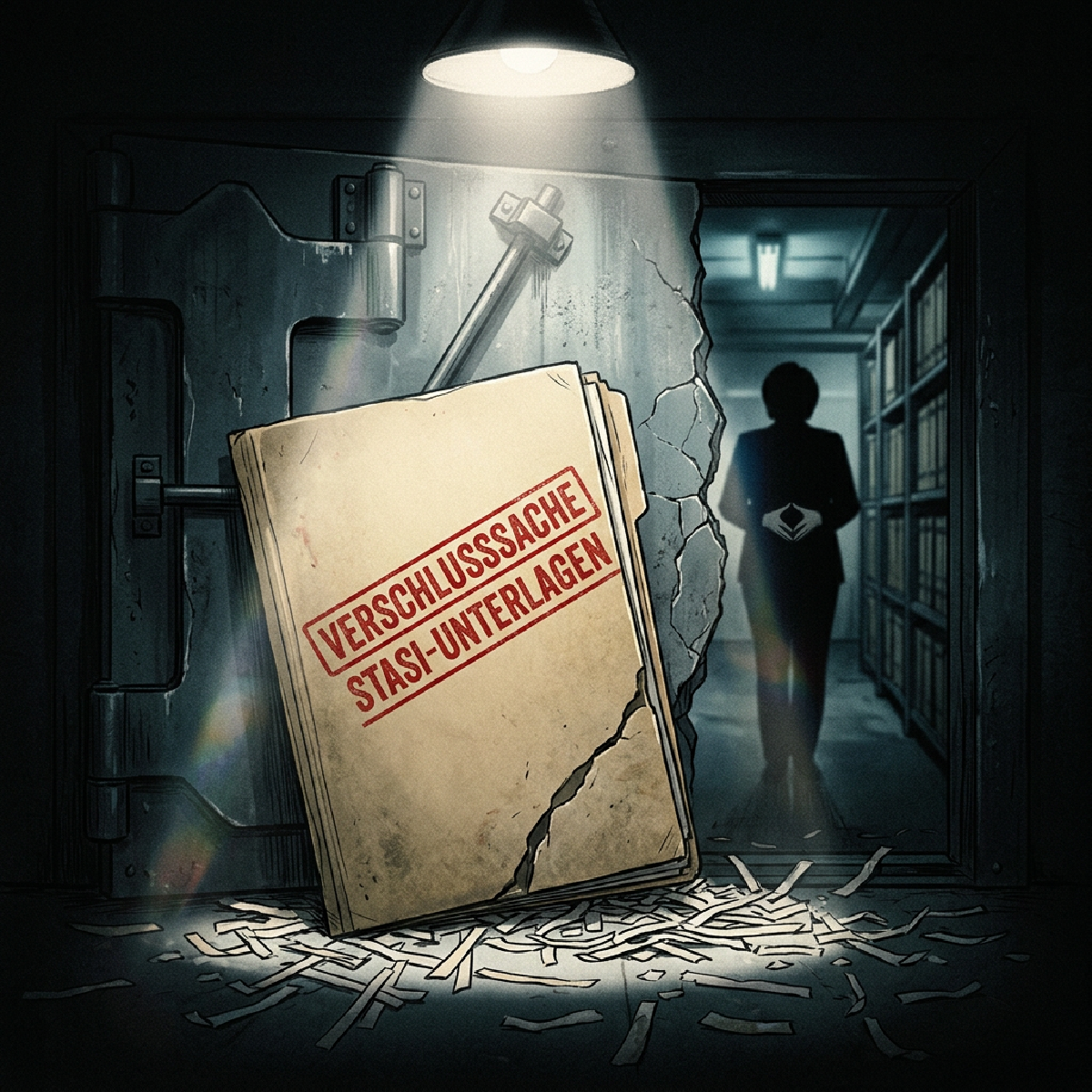
On March 13, 2026, the First Chamber of the Berlin Administrative Court delivered a ruling that barely made headlines. Presiding Judge Jens Tegtmeier stated clearly: Marcel Luthe, former FDP member of parliament and plaintiff, had “no legal claim to the release” of possible Stasi files on Angela Merkel under the Stasi Records Act.
The file remains sealed. The Federal Archive keeps it. The public learns nothing.
Angela Merkel was Chancellor for 16 years. The most powerful politician in Europe. And about her possible connections to the GDR’s State Security Service, the public is officially not permitted to know.
What We Know — and What Merkel Herself Says #
Angela Merkel grew up in the GDR, studied physics at the University of Leipzig, then worked at the Central Institute for Physical Chemistry (ZiPC) of the Academy of Sciences — an institute with over 600 employees.
What her function was there from 1981 onward remains disputed to this day.
Two former FDJ first secretaries of the institute, Gunter Walther and Hans-Jörg Osten, independently and on the record stated: Merkel was FDJ Secretary for Agitation and Propaganda. This is not a footnote — Agitprop was the FDJ’s political propaganda department, responsible for ideological conformity.
Merkel herself describes this role in her autobiography as “cultural affairs officer.” A choice of words that biographers and historians have repeatedly questioned.
Die Welt summarized it in 2013: Merkel was “system-conforming” — as a member of the Soviet-influenced scientific elite of the SED state.
What we don’t know: whether a Stasi file exists beyond this. And if so — what it contains.
The Trail of “IM Erika” #
Historian Hubertus Knabe, former director of the Berlin-Hohenschönhausen Memorial, researched possible Stasi connections to Merkel for years. He found traces of an unofficial collaborator with the code name “IM Erika.”
Whether “IM Erika” is Angela Merkel has not been proven. Knabe himself formulates carefully. The source material is fragmentary — which is unsurprising given the mass destruction of files by the Stasi in its final hours.
What Knabe documents: the search for these traces encounters institutional resistance.
The Legal Paradox #
The Stasi Records Act makes an important distinction: files on perpetrators — meaning Stasi employees and informants — can under certain circumstances be made accessible to the public. Files on victims — meaning people about whom the Stasi collected information — are subject to the personal data protection of those concerned.
The Federal Archive classifies Merkel’s possible file as a non-perpetrator file. This triggers personal data protection — and without Merkel’s consent, the file stays closed.
This raises a fundamental question: Was the Stasi Records Act designed for private individuals — or for someone who governed Germany for 16 years?
Luthe argued in court that the file was of public interest. The most powerful politician in Europe, shaped by the GDR, with a politically active FDJ past according to witnesses — the public interest should outweigh personal protection.
The court disagreed. The Stasi Records Act leaves no room for this balancing, according to the ruling.
The Comparison That Matters #
Hundreds of thousands of GDR citizens reviewed their Stasi files after 1990. For many, it was a traumatic experience — they learned who had spied on them. Neighbors. Friends. Spouses.
Some informants were exposed, lost jobs, reputation, social networks. This was politically intended: accountability meant consequences.
For the woman who governed Germany for 16 years and during that time made decisions on intelligence laws, surveillance architecture, and international security policy — for her, personal data protection applies.
This is not a criticism of the legal system. It is a question to the legal system: who was it made for?
What the Dismissal of the Lawsuit Means #
The ruling is not the end. Luthe can appeal to the next instance. Whether he will is unclear.
But the ruling sends a signal: institutions protect the archive — not historical truth.
This need not be malicious intent. It may be simple legal mechanics: the law works as it works, and nobody has the competence or political will to interpret it differently.
But the result is the same: one of the most consequential politicians in German postwar history leaves the stage with a blank spot in her biography — officially sanctioned, judicially confirmed.
The Real Question #
This is not about whether Angela Merkel was a Stasi informant. That has not been proven. There may not even be a perpetrator file. The file that exists may be irrelevant to the historical assessment of her chancellorship.
The real question is a different one: is the public that she governed for 16 years allowed to know?
In a democracy that takes accountability seriously, the answer should be clear. March 13, 2026 showed that it is not.
Sources:
- Euronews DE: Stasi Allegations — Court Rules Files Classified — Mar 13, 2026
- Tagesspiegel: Merkel’s Stasi File Remains Sealed — Mar 13, 2026
- Welt: Court Dismisses Lawsuit — Mar 13, 2026
- Berliner Zeitung: What’s in Merkel’s Stasi File?
- Hubertus Knabe: On the Trail of IM Erika — 2025
- Welt: GDR Biography — The Early Years of Angela Merkel (2013)
- ntv: “Nothing Concealed — Not Everything Told” (2013)