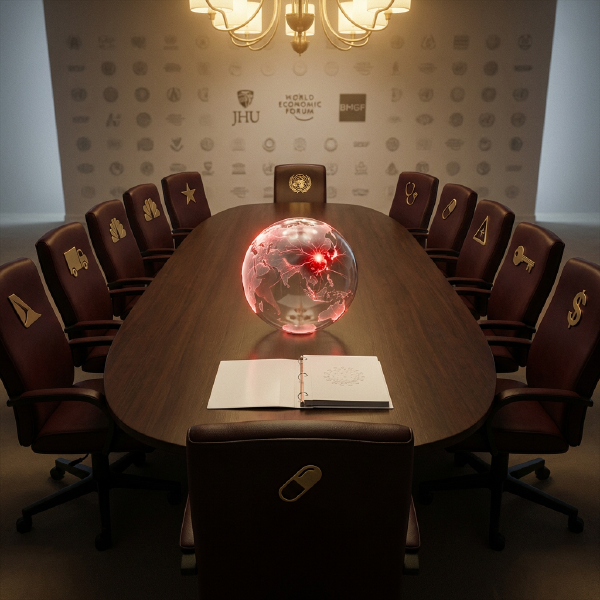
On 18 October 2019, in a conference hall at the Pierre Hotel on Fifth Avenue in New York, fifteen people gathered around an oval table. The seating chart, viewed from a distance, looks like a list of the world industries that would become central to a pandemic response. Four hours later, the fictional crisis cell had played out a coronavirus outbreak that, over eighteen months, produced 65 million dead and disrupted supply chains, the travel industry, vaccine procurement, and crisis communications across the entire globe.
On 15 May 2018, in the conference hall of the Mandarin Oriental Hotel in Washington, ten former or sitting US senior politicians and senior public-health officials gathered. 150 invited guests watched. A live stream ran simultaneously on Facebook. The exercise was called Clade X, lasted a single day and ended with a fictional outcome of 900 million dead worldwide over eighteen months. Convener: Johns Hopkins Center for Health Security.
In October 2017 — two years and three months before the first documented COVID case in Wuhan — the Johns Hopkins Center for Health Security published an 89-page document: “The SPARS Pandemic, 2025–2028: A Futuristic Scenario for Public Health Risk Communicators.” It was not a tabletop, not an NSC script like Dark Winter, not a transatlantic political format like Atlantic Storm. It was training material for press offices, PR professionals, risk communicators and agency spokespersons — a pre-written scenario meant to be read, not played.
From 22 to 23 June 2001 — three months before 9/11, five months before the anthrax letters — thirteen former senior US officials sat at an oval table in a briefing room at Andrews Air Force Base near Washington and played thirteen days of a smallpox outbreak in thirteen hours. The exercise was called Dark Winter.