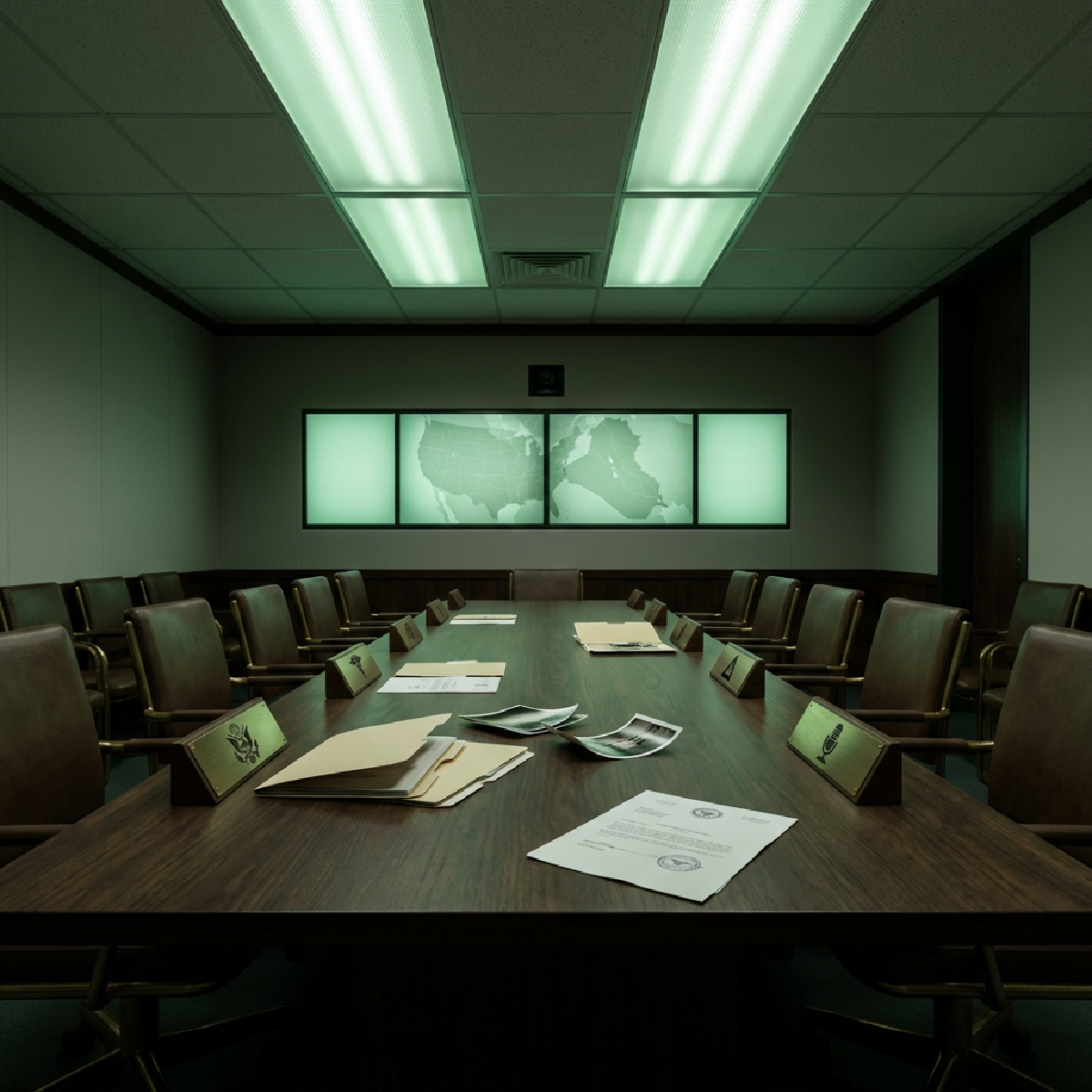
From 22 to 23 June 2001 — three months before 9/11, five months before the anthrax letters — thirteen former senior US officials sat at an oval table in a briefing room at Andrews Air Force Base near Washington and played thirteen days of a smallpox outbreak in thirteen hours. The exercise was called Dark Winter.
It was not a covert operation. The exercise documents, the after-action report, the player list, the post-exercise press briefing — all public. The notice appeared on the Johns Hopkins and CSIS websites. The exercise had a peculiarity that distinguished it from later tabletops (SPARS 2017, Clade X 2018, Event 201 2019): it was pre-9/11. It was conceived before the political shock that would reshape two decades of American bio- and security policy. What is structurally interesting about Dark Winter is not the scenario. It is the player list — and what those players became afterwards.
The Exercise#
Four institutions co-hosted Dark Winter: the Johns Hopkins Center for Civilian Biodefense Strategies (CCBS), the Center for Strategic and International Studies (CSIS), the ANSER Institute for Homeland Security (Analytic Services Inc., a DoD contractor), and the Oklahoma City National Memorial Institute for the Prevention of Terrorism (MIPT, founded after the 1995 OKC bombing). The four people who wrote the script and ran the exercise:
- Tara O’Toole (JHU CCBS)
- Tom Inglesby (JHU CCBS)
- Randy Larsen (ANSER)
- Mark DeMier (ANSER)
The scenario: three US cities (Oklahoma City, Philadelphia, Atlanta) are attacked simultaneously by aerosolised smallpox. Three successive National Security Council sessions over fourteen days. The players: former senior officials playing their old roles or taking new ones. The result at the end of the thirteen-hour run: three million infected, one million dead, no end in sight.
The five core findings published from the exercise read:
- Bioterrorism is a national security threat.
- Existing structures are inadequate for biodefense.
- There is no surge capacity in healthcare, public health, pharmaceutical or vaccine industries. More vaccine stockpile, more pharma contracts, more pre-positioning are required.
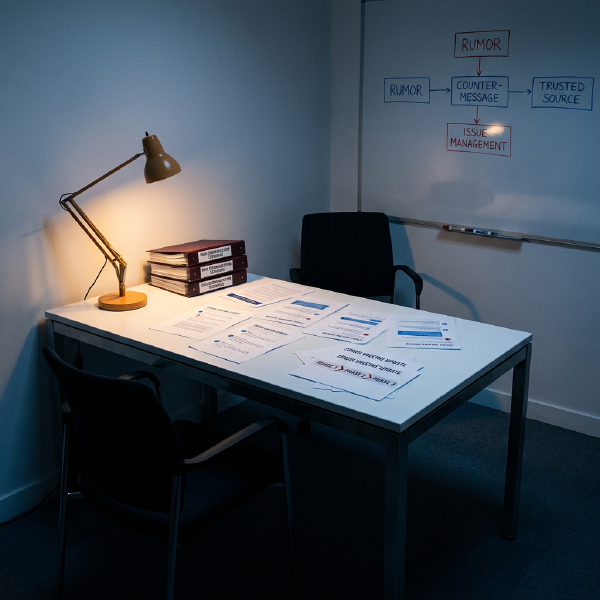
- Media management is “a major immediate challenge for all levels of government.” Crisis communication must be pre-rehearsed.
- Containing contagious bioweapons raises “ethical, political, cultural, operational and legal challenges” — emergency executive powers must be considered.
These five findings are not wrong. They are unambiguous: everything the exercise recommended pointed toward institutional apparatus expansion — vaccine stockpiling, pharma procurement pipelines, crisis communications, emergency executive powers. What the findings did not call for: more paediatrics capacity, school-based public health, social-consequences research, constitutional proportionality review. What the exercise produced was the blueprint of a bioterror industry. In October 2001 the anthrax letters arrived; in October 2002 the Homeland Security Act; in 2003 the Project BioShield Act with USD 5.6 billion in stockpiling budget; in 2004 the cabinet-level Committee on Biodefense.
The Player List#
| Dark Winter role | Player (with then-current standing) |
|---|---|
| President | Sam Nunn (former US Senator) |
| National Security Advisor | David Gergen (former Reagan/Clinton adviser) |
| CIA Director | R. James Woolsey (former DCI) |
| Secretary of Defense | John P. White (former Deputy SecDef) |
| Joint Chiefs Chairman | General John Tilelli (Ret.) |
| HHS Secretary | Margaret Hamburg (former Asst Sec HHS) |
| Secretary of State | Frank Wisner (former Ambassador) |
| Attorney General | George Terwilliger (former DAG) |
| FEMA Director | Jerome Hauer (former NYC OEM Director) |
| FBI Director | William Sessions (former FBI Director) |
| Governor of Oklahoma | Frank Keating (sitting Governor) |
Plus four real reporters playing themselves:
- Jim Miklaszewski (NBC News)
- Mary Walsh (CBS News)
- Sian Edwards (BBC)
- Judith Miller (The New York Times)
The bolded names are the ones a structural reading of the exercise has to follow.
The Career Pipeline#
What happened after Dark Winter is the actual information.
Tara O’Toole, one of the four exercise designers, founded the UPMC Center for Biosecurity in Pittsburgh the following year (2003) and served as its CEO and Director. In 2009 President Obama appointed her Under Secretary for Science and Technology at the Department of Homeland Security — that is, exactly the apparatus whose necessity Dark Winter’s third finding (surge capacity, stockpiling, pharma pipelines) had defined. In that position until 2013, she oversaw the DHS R&D portfolio, including biodefense programs. Since 2014 she has been Senior Fellow and Executive Vice President at In-Q-Tel — the 1999-founded CIA investment arm for technology and biotech holdings.
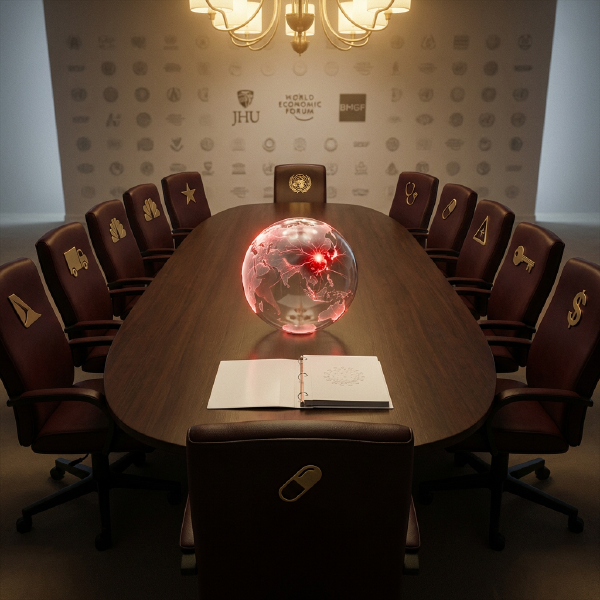
Tom Inglesby, the second JHU designer, stayed at Johns Hopkins. The CCBS was restructured: first into the UPMC Center for Biosecurity (and later moved back to JHU), then in 2013 renamed the Johns Hopkins Center for Health Security. Inglesby has led it since the migration and still does. In October 2019 the centre he runs was the co-host of Event 201 — the coronavirus pandemic tabletop with the World Economic Forum and the Bill & Melinda Gates Foundation, eighteen weeks before the first documented COVID case in Wuhan. Eighteen years after Dark Winter, the same designer sat at the table of the same exercise format with the same findings pattern.
Margaret Hamburg, in Dark Winter the HHS Secretary, was appointed by Obama in 2009 to be FDA Commissioner. She led the agency until 2015 — and with it the approval architecture for precisely the pharma pipeline structures whose necessity Dark Winter’s third finding had announced in 2001.
Jerome Hauer, in Dark Winter the FEMA Director, became, after 9/11, Director of the Office of Public Health Emergency Preparedness at HHS and was central to the anthrax response and the build-out of the Strategic National Stockpile.
R. James Woolsey — the Dark Winter DCI — became, in the years that followed, an actively public voice of the Iraq-hawk lobby; he signed Project for the New American Century letters and served on the board of the Committee for the Liberation of Iraq, which provided publicistic cover for the 2002 invasion push.
Four out of thirteen players, in the twelve years that followed, built out the very structures whose absence their own exercise had diagnosed. At least one further (Woolsey) became a public voice of the foreign policy that linked the bioterror narrative to the Iraq-WMD narrative. The exercise was not, for its designers, a learning format; it was a career grant. Those who rehearsed the smallpox built the apparatus afterwards.
The Reporter#
The personnel item that closes the loop is Judith Miller. On 22 June 2001 she was at Dark Winter as a New York Times reporter, playing herself — the reporter who covers a smallpox crisis that justifies emergency executive powers, that prepares the population for compulsory vaccination measures.
Fourteen months later, on 8 September 2002, the front page of the New York Times carried Miller’s joint article with Michael Gordon on the “aluminium tubes” — the central public justification for the US administration’s claim that Iraq was building nuclear weapons. The source for the story: Ahmed Chalabi’s Iraqi National Congress, mediated through Pentagon insiders. Miller wrote to her Times Baghdad bureau chief John Burns: “Chalabi has provided most of the front page exclusives on WMD to our paper.” The New York Times publicly retracted its WMD coverage in 2004, calling its reporting “not as rigorous as it should have been.” By then the Iraq War had already happened.
The function-inversion is plain. Miller had trained, fourteen months earlier, in a bioterror exercise — how a reporter handles anonymous government briefings during an existential crisis, how she processes fragments of unconfirmed intelligence under time pressure into a coherent threat narrative that justifies executive measures. That is exactly what she did in 2002. The substrate had changed (smallpox → nuclear weapons, bioterror → conventional war), the behavioural schema was the same. An exercise that had identified media management as “the immediate challenge” had trained a reporter whose reporting would, a few months later, legitimate a war.
That is not a conspiracy claim. It is a documented transition between two substrates inside fourteen months, with the same reporter, the same methodology (anonymous Pentagon/CIA sources, highly staged front-page stories, no open source-vetting), the same outcome (policy informed, population prepared).
What Dark Winter Actually Was#
A reader who opens the Dark Winter after-action report today finds no secret-plan document. Finds no “rigged game.” Finds, instead, the script of an industry being born, organised under the academic mantle of an exercise.
The five findings describe precisely which apparatuses would be built up, in the following twelve years, with double-digit billion-dollar budgets: the Strategic National Stockpile, BARDA, Project BioShield, the Bio-Defense Industrial Complex, the DHS Science & Technology Directorate, the Cabinet Committee on Biodefense, the CDC Office of Public Health Preparedness. The exercise designers became direct contractors to and appointees of these structures. The exercise players became heads of the very agencies whose construction the exercise had recommended. The exercise reporter trained a reporting schema that, fourteen months later, would legitimate a war.
An exercise describes which apparatus is missing. The people who design the exercise identify the gap. The people who play in the exercise learn the structures the apparatus would need. When the exercise then becomes a wave of policy, the designers are first in line to be appointed as agency heads, because they know the structures most precisely. The exercise is then not preparation for the apparatus; it is casting call for the apparatus.
That is the structural mechanism that became visible for the first time at Dark Winter and that continued through Atlantic Storm 2005, SPARS 2017, Clade X 2018 and Event 201 2019. In each of these exercises the designers were embedded in contractor structures that subsequently implemented the policy. At Event 201 the same Tom Inglesby who had co-designed Dark Winter ran the JHU side. Eighteen years, the same designer, the same format, the same career pipeline.
Closing#
Dark Winter was not the rehearsal for a secret pandemic. It was the rehearsal for an industry. Four designers, thirteen players, four reporters — and in the years that followed, two decades of biodefense policy in which the exercise participants occupied senior positions and the exercise recommendations turned into laws, agencies and billion-dollar contracts.
Whoever reads the exercise as “proof of a rigged game” misunderstands the mechanism. No game was needed. What was needed was that the same thirteen people who had completed the exercise should, twelve years later, lead the agencies and award the contracts to the institutes in which they themselves sat. The exercise has not, in this sense, repeated itself between 2001 and 2020. It has — with different pathogens, in larger halls, with more prominent guests — continued.
The chain of public tabletops from Dark Winter (2001) through Atlantic Storm (2005), Clade X (2018), Event 201 (2019) to the COVID response structures is not a plan. It is an institutional career pipeline. Accountability begins by laying the player lists side by side.
Sources#
- Johns Hopkins Center for Health Security — Dark Winter Overview — official exercise page (Inglesby still leads the Center)
- Wikipedia — Operation Dark Winter — player list, findings, designers
- Wikipedia — Tara O’Toole — career timeline DOE → JHU → UPMC → DHS → In-Q-Tel
- Office of Justice Programs — Dark Winter: Bioterrorism Exercise Andrews Air Force Base — DOJ abstract of the exercise report
- Pitt Med — Lessons from a Dark Winter — UPMC / Pittsburgh perspective (O’Toole’s center)
- SourceWatch — Dark Winter — critical breakdown of the participants
- In-Q-Tel — Wikipedia — CIA investment arm (O’Toole’s current role)
- Wikipedia — Judith Miller — NYT career, aluminium-tubes story 2002, NYT 2004 retraction
- PBS Frontline — The Press’ Reporting on WMD — documentation of NYT’s WMD coverage
- FAIR — 20 Years Later, NYT Still Can’t Face Its Iraq War Shame — accountability gap on the Iraq coverage
- Project BioShield Act of 2004 — Public Law 108-276 — USD 5.6 billion stockpiling act, direct policy output of the 2001-2003 bioterror wave
Cross-references on related actors:
- Leopoldina 7th Statement — Advisory Closed Circuit — the German variant of the same mechanism in 2020
- The COVID Years — What Remains When the State of Exception Ends — the consequences side: vaccine injuries, the Pfizer-SMS scandal, accountability gap
- Buyx, the Ethics Council, the Plagiarism File and the WHO Genome Committee — German player in the same career-pipeline architecture