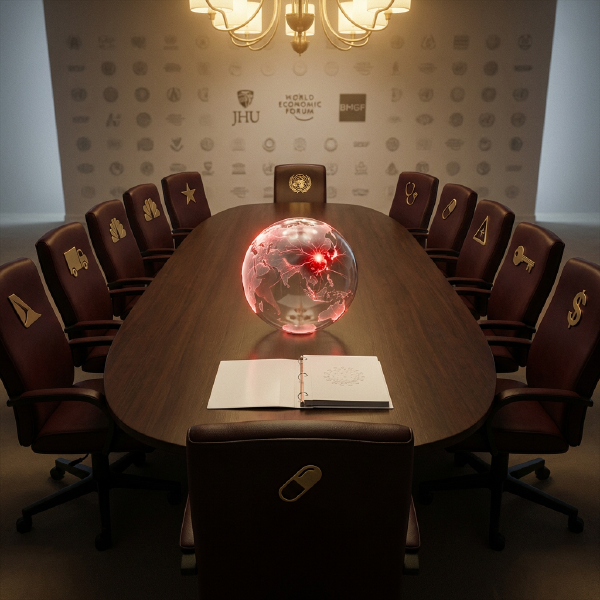
In October 2017 — two years and three months before the first documented COVID case in Wuhan — the Johns Hopkins Center for Health Security published an 89-page document: “The SPARS Pandemic, 2025–2028: A Futuristic Scenario for Public Health Risk Communicators.” It was not a tabletop, not an NSC script like Dark Winter, not a transatlantic political format like Atlantic Storm. It was training material for press offices, PR professionals, risk communicators and agency spokespersons — a pre-written scenario meant to be read, not played.
The fictional substrate: a novel coronavirus, SPARS, surfaces in a US city in 2025 and spreads over three years across all US states and 40+ countries. An existing medical countermeasure (“MCM”) is used for treatment; a new vaccine is in development. The Public Readiness and Emergency Preparedness Act (PREP Act, US 2005) is activated to indemnify vaccine manufacturers against liability. That is the back-story.
What the document delivers is the actual information: ready-made fictional skeptical-citizen tweets, fictional news stories about vaccine side effects, fictional agency press releases, fictional talk-show excerpts, fictional counter-misinformation playbooks. Whoever read SPARS came away with a library of response building blocks for every constellation a real coronavirus pandemic might communicatively present: vaccine hesitancy, manufacturer liability, side-effect clusters, ethno-cultural distrust, influencer backlash, “natural immunity” discourse, paediatric vaccination recommendations.
Three years later COVID arrived. And the library SPARS had built for a fictional coronavirus was operational.
Who Wrote It#
The author list:
- Monica Schoch-Spana (Senior Associate, Johns Hopkins Center for Health Security) — lead author, anthropologist working on pandemic-trust research
- Emily K. Brunson (Associate Professor, Texas State University)
- Tara Kirk Sell (Senior Associate, JHU CHS)
- Gigi Kwik Gronvall (Senior Associate, JHU CHS) — biosecurity researcher, later involved in lab-leak discussion circles
- Matthew P. Shearer (Senior Analyst, JHU CHS)
- Sanjana Ravi (Senior Analyst, JHU CHS)
- Hannah Chandler (MPH Candidate, Columbia University)
Six of the seven authors worked at the Johns Hopkins Center for Health Security. Director of the Center for Health Security at the time of publication: Tom Inglesby — the same Inglesby who in 2001 had been co-designer of Dark Winter, who in 2005 had been co-designer of Atlantic Storm, and who in October 2019, two years after SPARS was published, would run the JHU side of Event 201. Eighteen years, three tabletops, one communications script — the same director.
What SPARS Methodologically Was Not#
In conspiracy-clickbait listings SPARS regularly appears as “proof” of a planned pandemic — alongside Dark Winter, Atlantic Storm, Clade X and Event 201. The classification is methodologically wrong. SPARS was not a tabletop in the sense of the four other exercises. There was no player list, no NSC sitting, no heads of government, no live briefing format. It was a reading material: an 89-page PDF you work through, from which training exercises for PR teams are derived, used as a “self-guided exercise.”
This differentiation matters because it sharpens the mechanism. Tabletops train actors — officials, politicians, journalists — for decision sequences under time pressure. Communications scenarios like SPARS train craft — word components, talking points, response templates. The first produces a career pipeline (Dark Winter → DHS, FDA, BARDA); the second produces a language-regulation library.
What is structurally interesting about SPARS is not its mis-classification as a “tabletop” but the fact that the language-regulation library anticipates, three years before COVID, precisely the communications architecture that was rolled out from March 2020 onwards.
What’s in the Script — and What It Became in 2020#
The SPARS document is structured into three phases: early response, mass vaccination campaign, post-vaccine harms. Each phase delivers exercise tasks for PR teams. Six of the central exercise axes:
1. Manufacturer indemnity via PREP Act SPARS script: The HHS Secretary activates the PREP Act to indemnify SPARS-vaccine manufacturers against damages liability. PR exercise: how do you communicate the indemnity to the population without triggering a loss of trust? — Reality 2020: HHS Secretary Alex Azar activated the PREP Act on 17 March 2020 (PREP Act Declaration for “Medical Countermeasures against COVID-19”); manufacturer liability was lifted. Identical schema, identical legal pathway, written into a script three years before its real application.
2. Counter-misinformation as an operational field SPARS script: An influencer spreads vaccine skepticism on social media; agencies must respond without producing a Streisand effect. The fictional response templates suggest: no direct confrontation, instead mobilise “trusted messengers”, “pre-bunk” the expected arguments, work with platforms on ranking adjustments. — Reality 2020-2022: Trusted News Initiative (BBC, Reuters, Microsoft, Facebook, Google, Twitter, AP, AFP, Washington Post, etc.), CDC coordination with tech platforms, Stanford Internet Observatory / Election Integrity Partnership / Virality Project, EU Digital Services Act, EU Code of Practice on Disinformation. The SPARS lexicon — “pre-bunk”, “trusted messenger”, “inauthentic coordination” — became the operative vocabulary of the entire platform-pandemic policy in 2020-2022.
3. Skepticism among ethnic / cultural minorities SPARS script: A fictional African-American community activist voices skepticism about vaccination on the basis of historical experience (Tuskegee). PR exercise: culturally sensitive communication without paternalism. — Reality 2020-2021: CDC equity-outreach programs, race-specific vaccine campaigns, Spike Lee spots, Democratic outreach structures.
4. Side-effect clusters and “rumour control” SPARS script: A cluster of unusual side effects appears before agencies have data adequate to interpret. Exercise: how to delay disclosure without losing trust? — Reality 2021: AstraZeneca/CVST clusters, myocarditis clusters in young men, FDA “safety pause”, communication-containment strategies.
5. “Natural immunity” as a discourse risk SPARS script: Influencers who were themselves infected and reject vaccination for themselves create a class schema “naturally immune” vs. “vaccinated”. PR exercise: how is natural immunity not played off against vaccination recommendations? — Reality 2021-2022: CDC recommendations remained for a long time at “vaccinate even after infection”, despite mounting evidence for post-infection immunity. The discourse climate around “natural immunity” was actively damped.
6. “Trusted source” as an operational category SPARS script demands of PR teams that they identify and mobilise “trusted sources” early — persons with high credibility within their respective target audiences. — Reality 2020-2022: the architecture of “Trusted News”, “Trusted Flaggers” (DSA), CDC “Trusted Voices”, WHO “Vaccine Champions” programmes.
Six exercise axes from the October-2017 script — six operational structures of the COVID communications architecture 2020-2022. That is not coincidental overlap; it is tool training with subsequent application. Whoever had worked through SPARS in 2017 had the templates ready in 2020.
The Recurring Question: Why Not “Rigged Game”?#
The clickbait reading goes: SPARS “predicted” COVID, therefore COVID was staged. The reading is wrong because it misses the mechanism. SPARS did not predict COVID; it chose coronavirus as the pathogen class for a PR-training script because at that time coronaviruses were taken seriously as pandemic candidates in public-health discourse (SARS 2003, MERS 2012). The pathogen choice was professional situation analysis.
What SPARS did is something else, more substantive: it pre-shaped, in detail, the communicative response architecture to a coronavirus outbreak — word components, escalation steps, platform-cooperation models, “trusted source” mobilisation, “pre-bunk” templates. The PR profession, agency press offices, tech platforms — all those who had read SPARS or comparable materials — were communicatively rehearsed for a coronavirus crisis before the crisis occurred.
That is the function-inversion that distinguishes the SPARS mechanism from a tabletop. A tabletop trains actors; SPARS a library. A library is not “activated”, it is retrieved. Whoever in 2020 was a PR officer at the CDC, the RKI, the EU Commission communications team, the Trusted News Initiative or a major tech-platform Trust-and-Safety unit had SPARS-like materials in the drawer. They only had to open them.
Who Read SPARS Where#
The Center for Health Security distributed SPARS actively. NACCHO (National Association of County and City Health Officials) linked it in their training resources. Public-health schools used it as teaching material. The “self-guided exercise” format envisages that agency press offices work through it as a team, formulate fictional responses to the fictional tweets, and so build up a rehearsed response library.
Whoever did so was, structurally, the personnel that later carried real COVID communications. The SPARS exercise was onboarding material for the next generation of risk-communication professionals.
A second distribution channel: the WHO and its risk-communications programmes. Schoch-Spana, the SPARS lead author, is a regular adviser to WHO Crisis Communications Frameworks. The SPARS methodology flows directly into the international risk-communications standards of the WHO. Whoever in 2020-2022 worked as a national WHO liaison in pandemic PR worked in a framework SPARS had helped shape.
The Bridge to the Series#
The SPARS mechanism closes the series of three earlier structural analyses.
| Exercise | Year | Format | Trains | Policy outcome |
|---|---|---|---|---|
| Dark Winter | 2001 | Tabletop, officials | Career pipeline (DHS, FDA, BARDA) | Project BioShield 2003 |
| Atlantic Storm | 2005 | Tabletop, heads of government | Mandate architecture (WHO IHR) | IHR 2005 (May 2005) |
| SPARS | 2017 | Communications scenario, PR pros | Language-regulation library | Counter-misinformation architecture 2020-2022 |
| Event 201 | 2019 | Tabletop, pharma + politics + media | Final pre-synchronisation | COVID response architecture 2020 |
In this sequence SPARS is the exercise that explicitly trains the communicative defence of the policy architecture that Dark Winter and Atlantic Storm had established as institutional format. Executive class (DW), political class (AS), communicative class (SPARS), and finally the pharma-industry synchronisation (Event 201) — four exercise formats, four different class trainings, one line. Inglesby led the JHU center that co-organised three of these four formats.
Closing#
SPARS was no rigged game and no act of prophecy. SPARS was training material — and the question that matters structurally is not whether the material existed (it is public, it has been documented since 2017, it is on the JHU website), but who read it and where what was read flowed into operational architectures.
The answer is observable in concrete structures: the Trusted News Initiative was founded in March 2020, weeks before the WHO pandemic declaration. The EU Code of Practice on Disinformation was published in October 2018, one year after SPARS. CDC coordination with platforms was systematically built out from 2020. The Stanford Internet Observatory / Virality Project produced “counter-misinformation” reports that structurally followed the SPARS script. The EU DSA’s “trusted flagger” architecture (in force 2024) takes the SPARS “trusted messenger” concept and gives it legal codification.
That is no conspiracy. It is a language-regulation library that between 2017 and 2024 was translated into institutional structures, by a research center that since 2001 has been central as designer of the tabletop line. Whoever read the script knew in 2020 what to do — not because a pandemic had been planned, but because the communicative architecture of a pandemic had been rehearsed before the pandemic came. The response was choreographed; the talking points were print-ready; the platform cooperations were drafted. Whoever in 2020 stepped unprepared into a global risk-communications architecture was not where SPARS and its sister materials had been read.
That is the mechanism. It is not secret. It is described in the SPARS document’s own foreword: “prospective scenarios allow readers the opportunity to rehearse responses while also weighing the implications of their actions.” What was rehearsed was not whether the architecture would arrive but what it would look like when it did. In 2020 it arrived. It looked the way it had been rehearsed.
Sources#
- Johns Hopkins Center for Health Security — SPARS Pandemic Press Release (October 2017) — official publication notice, identifies authors and funders
- Internet Archive — The SPARS Pandemic 2025-2028, A Futuristic Scenario for Public Health Risk Communication (PDF, 89 pages) — full text of the script
- Johns Hopkins University — Pure Publication Listing, “The SPARS Pandemic 2025–2028: A Futuristic Scenario to Facilitate Medical Countermeasure Communication” — academic citation, author affiliations
- NACCHO — Exercise Resources Released for Pandemic Medical Countermeasure Risk Communications — distribution to County/City Health Officials
- HHS PREP Act Declaration for COVID-19, 17 March 2020 (Federal Register) — activation of the PREP Act for COVID
- PREP Act of 2005, Public Law 109-148 — statutory basis for manufacturer-indemnity, fictionally activated in the SPARS script
- BBC — Trusted News Initiative founding (March 2020) — platform cooperation against “misinformation”
- European Commission — Code of Practice on Disinformation (2018) — EU precursor to the counter-misinformation architecture
- Stanford Internet Observatory — Virality Project Final Report — operational application of the “counter-misinformation” methodology in the COVID period
- EU Digital Services Act — Trusted Flagger mechanism, Article 22 (in force 2024) — legal codification of the “trusted messenger” architecture
Cross-references on related actors:
- Dark Winter, June 2001 — Those Who Rehearsed the Smallpox Built the Apparatus After — the officials’ variant of the mechanism
- Atlantic Storm, January 2005 — Politicians’ Tabletop and WHO Emergency Powers — the politicians’ variant
- Leopoldina 7th Statement — Advisory Closed Circuit — the German variant of the mechanism in 2020
- The COVID Years — What Remains When the State of Exception Ends — the consequences side: vaccine injuries, the Pfizer-SMS scandal, the accountability gap