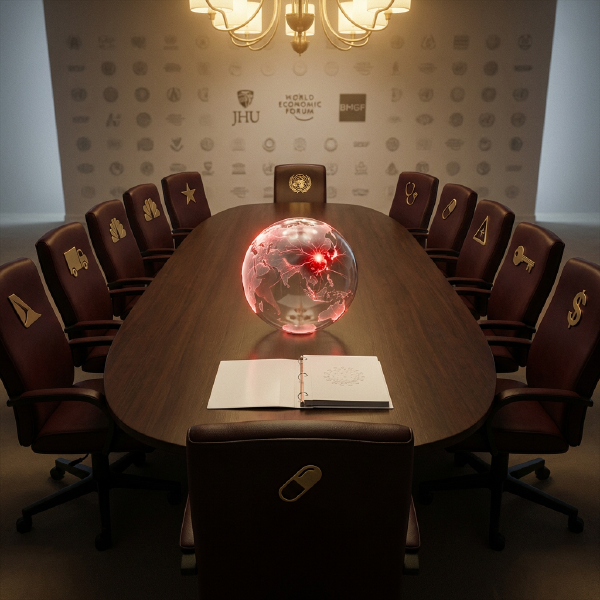
On 15 May 2018, in the conference hall of the Mandarin Oriental Hotel in Washington, ten former or sitting US senior politicians and senior public-health officials gathered. 150 invited guests watched. A live stream ran simultaneously on Facebook. The exercise was called Clade X, lasted a single day and ended with a fictional outcome of 900 million dead worldwide over eighteen months. Convener: Johns Hopkins Center for Health Security.
It was no covert tabletop. On the contrary — Clade X was the first exercise in the line explicitly designed for the public: live stream, press briefing, YouTube trailer, mainstream coverage in Reuters, ABC and Global Health Now. What is structurally striking about Clade X is not the scenario. It is a personnel item.
Tom Inglesby Plays National Security Advisor#
At Dark Winter in 2001, Tom Inglesby wrote the script. At Atlantic Storm in 2005, he wrote the script. At SPARS in 2017, his Center published the script. At Event 201 in October 2019 he would run the JHU side. At Clade X 2018 he sits — as Director of the same Center that convenes the exercise — at the table himself and plays the National Security Advisor.
This is not a marginal note. The designer of a tabletop steps into his exercise himself, in one of the three key roles of the fictional crisis cell. If the exercise produces recommendations, Inglesby is, by virtue of the dual role (designer + NSA player), their co-shaping actor. Whoever has read the mechanism of Dark Winter (“those who design become contractors”) and Atlantic Storm (“those who play become agency heads”) sees in Clade X the next escalation step: designer and actor in the same person, in the same exercise.
The Player List#
Known role assignments of the ten players:
| Clade X role | Player |
|---|---|
| National Security Advisor | Tom Inglesby (Director JHU CHS, designer of the exercise himself) |
| Senate Majority Leader | Tom Daschle (former Senator/SD, ex-Senate Majority Leader, later pharma lobbyist at DLA Piper) |
| Secretary of Defense | Jim Talent (former Senator/MO) |
| Attorney General | Jamie Gorelick (former Deputy AG under Clinton, 9/11 Commission, later WilmerHale partner for big-tech mandates) |
| HHS Secretary | Margaret Hamburg (former FDA Commissioner 2009-2015, previously a Dark Winter 2001 player) |
| CIA Director | Jeff Smith (former CIA General Counsel) |
| HHS adviser / CDC voice | Julie Gerberding (former CDC Director 2002-2009, subsequently Executive VP at Merck 2010-2016) |
| DHS voice | Tara O’Toole (Dark Winter 2001 designer, Atlantic Storm 2005 designer, former DHS Under Secretary, currently In-Q-Tel/CIA) |
| US Representative | Susan Brooks (R-IN, Chair of the House Energy & Commerce Subcommittee on Health) |
Plus two further players not captured by name in this overview.
What this list shows is no random casting. It is the condensed personnel pipeline of the tabletop line since 2001:
- Hamburg is at her third bioterror/pandemic tabletop (Dark Winter 2001 as HHS, Clade X 2018 as HHS, between them real FDA 2009-2015) — a 17-year exercise career
- O’Toole is at her third exercise format (Dark Winter 2001 designer, Atlantic Storm 2005 designer, Clade X 2018 player), with DHS Under Secretary in between
- Inglesby is the designer of ALL three previous formats (Dark Winter, Atlantic Storm, SPARS) and now plays himself — he is the constant across 17 years
- Gerberding brings the pharma-industry bridge explicitly into the room: ex-CDC, then Merck Executive VP for Patient Engagement, then Clade X. Whoever in 2018 was pharma industry had, via Gerberding, a seat at the pandemic-exercise table
- Daschle at the time of the exercise was a lobbyist at DLA Piper, one of the largest pharma/healthcare lobby firms in the United States
- Gorelick was an attorney at WilmerHale, whose mandates include Facebook, Google and other big-tech firms — the platforms that later became central as counter-misinformation hubs
Who Funded It#
The Clade X sponsor list, for the first time, leaves the classic JHU/CSIS/NTI/Sloan corridor and brings in a new funding source:
- Co-hosts: Program for Appropriate Technology in Health (PATH), Global Health Council, Nuclear Threat Initiative (NTI — Sam Nunn, the personnel bridge since Dark Winter)
- Funder: Open Philanthropy
Open Philanthropy is the effective-altruism foundation of Cari Tuna and Dustin Moskovitz — Moskovitz is co-founder of Facebook (#3 after Zuckerberg and Eduardo Saverin), one of the world’s wealthiest tech billionaires. Open Philanthropy has, in the late 2010s, channeled substantial funding into “pandemic preparedness” and “existential risk” research; the JHU Center for Health Security has been a recipient for years. With Open Philanthropy as funder of Clade X 2018, the exercise line for the first time pulls explicit tech-industry money into the funder list.
Eighteen months later, in October 2019, the next tech foundation took over this role: the Bill & Melinda Gates Foundation as co-host of Event 201, alongside JHU CHS and the WEF. The bridge from Open Philanthropy 2018 to Gates 2019 is no coincidence. It is the funder pipeline of the tabletop architecture in this phase, bringing the tech industry to the table.
The Scenario and the Discourse Asymmetry on Lab Leak#
The fictional Clade X scenario deserves careful attention. Pathogen: a genetically engineered Nipah-parainfluenza recombinant, as transmissible as parainfluenza, as lethal as Nipah. Release by a fictional cult “A Brighter Dawn” — scientists with rich background backers who want to reduce overpopulation. Lab-leak in the literal sense: the pathogen is synthesised in a private laboratory and deliberately released.
That is the structurally interesting layer. In May 2018, the lab-leak hypothesis is explicitly the exercise scenario at a JHU exercise with live-stream and a 150-person audience, staged as a realistic scenario in the US mainstream. Tom Inglesby, who led the exercise, was 21 months later, in February 2020, among those who in mainstream-media statements bracketed the COVID lab-leak hypothesis as “speculation” and effectively backed Daszak’s “we condemn conspiracy theories” Lancet letter (see The Web — Part 23).
This is no direct accusation. It is a discourse asymmetry: the same lab-leak hypothesis that in May 2018 serves as a legitimate exercise basis is, in February 2020 — when it could be applied to a real outbreak — declared a conspiracy theory. Whoever in May 2018 was play-acting the release of a Nipah hybrid from a private lab had, in 2020, the language-regulation library (see SPARS) at hand to file the parallel real-world question as “misinformation”. The asymmetry is not coincidence. It is tool.
What Clade X Produced as Recommendations#
The fictional exercise produced, in the published report Clade X: A Pandemic Exercise (Watson, Toner, Shearer, Rivers, Meyer, Hurtado, Gronvall, Adalja, Sell, Inglesby, Cicero, in Health Security 2019), seven central policy recommendations. Abbreviated:
- Better vaccine surge capacity (mRNA platforms named explicitly)
- Reformed crisis communications (refers to the SPARS methodology)
- WHO mandate expansion (ties into IHR 2005, the Atlantic Storm legacy)
- Pre-positioned medication stockpiles
- Transatlantic coordination frameworks
- Sustainable research funding for “dual-use research of concern” (DURC) — i.e. gain-of-function-adjacent research
- Better private-sector integration during a crisis (pharma + tech)
Six months later, in December 2018, the WHO IHR Review Committee was convened for a renewed revision of the International Health Regulations. Eighteen months later, Event 201 ran with explicitly named pharma/media/tech-industry participation. 19 months later, SARS-CoV-2 emerged in Wuhan. The follow-on architecture of the Clade X recommendations played out in the next two years in exactly that order.
The Live Stream as Pre-Conditioning#
What distinguishes Clade X from the three earlier exercises is the publicness. Dark Winter (2001) was documented but primarily an insider format. Atlantic Storm (2005) had a press briefing but no live streaming. Clade X 2018 was, from the outset, public spectacle — Facebook live stream, YouTube trailer, ABC News coverage, Reuters reports, Global Health Now feature.
This level of publicness is not additional to the exercise function but part of the exercise function. What is publicly played out conditions the audience. Whoever sees the live stream of real former senators discussing in an NSC sitting lockdown measures, international travel restrictions and emergency executive powers, has in 2018 in the living room the schema in front of them of what would in 2020 arrive as real policy. The pre-conditioning is no manipulation accusation — it is concept of the exercise. A public dress rehearsal is meant to condition the public.
Bridge to the Series#
The four tabletops/scripts 2001-2017-2018-2019 together form an escalation series in which each step pulls in another class and adds an element:
| Exercise | Format | Trains | Funder bridge | New element |
|---|---|---|---|---|
| Dark Winter (2001) | Tabletop, officials’ class | Career pipeline | Sloan, JHU CCBS | Exercise as casting call |
| Atlantic Storm (2005) | Tabletop, politicians’ class | Mandate architecture | + NTI (Nunn), GMF | Transatlantic + WHO IHR |
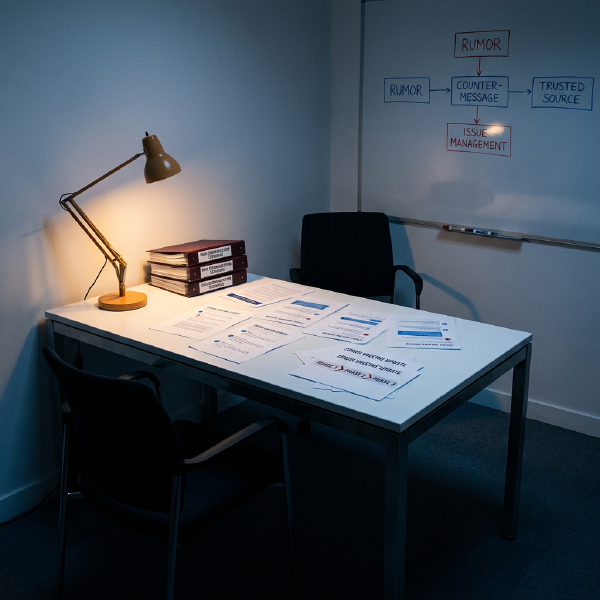
| SPARS (2017) | Communications script, PR class | Language-regulation library | JHU CHS internal | Counter-misinformation as tool |
| Clade X (2018) | Tabletop, NSC + pharma bridge | Designer-as-actor, live stream | + Open Philanthropy (Moskovitz/tech) | Public pre-conditioning + tech money |
| Event 201 (2019) | Tabletop, pharma + politics + media | Final pre-synchronisation | + Gates Foundation | Final tech integration |
Clade X is the exercise in which the architecture observes itself (designer as NSA), in which the public becomes spectator of the dress rehearsal, and in which tech money sits explicitly at the table for the first time. Without Clade X, Event 201 would not have been possible — Open Philanthropy 2018 paved the way for Gates 2019.
Closing#
Whoever reads Clade X as a “rigged game” misses the mechanism for the fourth time. Clade X was not a covert rehearsal of a planned pandemic. Clade X was an exercise that demonstrated openly what the tabletop line had been institutionally building since 2001: an apparatus whose designers are also its actors, whose funders also become its contractor platforms, whose players also become the subsequent agency heads and pharma lobbyists, and which understands its public reach as a part of the exercise itself.
The central personnel item is Tom Inglesby. In 2001 he wrote the script that Margaret Hamburg played as HHS. In 2005 he wrote the script that Tara O’Toole co-produced as designer. In 2017 his Center published the language-regulation library that became the operational architecture in 2020. In 2018 he sat at the table himself — as National Security Advisor in the exercise whose script he had had written. Eighteen months later he ran the JHU side of Event 201, the last exercise before COVID.
The seventeen-year line of a single director is the line of the tabletop architecture. To read this line as a “plan” misses the fact that no plan was needed. What was needed was a research center whose director had held the same function since 2001, whose funders migrated from Sloan Foundation to tech-billionaire foundations, and whose player lists were drawn from the same personnel pipeline.
The list of the Clade X players is the list of the persons who knew how the exercise would run because their fellow players had written it.
Sources#
- Johns Hopkins Center for Health Security — Clade X Tabletop Exercise (official page) — exercise description, results report, player linkage
- JHU CHS Press Release — Players for Clade X named (16 April 2018) — full player list with role assignments
- Wikipedia — Clade X — overview, funder Open Philanthropy, co-hosts PATH/GHC/NTI
- Watson C, Toner E, Shearer MP, Rivers C, Meyer D, Hurtado JD, Watson M, Gronvall G, Adalja AA, Sell TK, Inglesby TV, Cicero A. “Clade X: A Pandemic Exercise.” Health Security 2019;17(5):410-417 — peer-reviewed exercise report with recommendations
- JHU Pure Publication Listing — Clade X — academic citation
- PreventionWeb — Clade X Exercise: Improving policy to prepare for severe pandemics — UNDRR distribution of recommendations
- ABC News — Online videos “predicted” details of deadly outbreak — mainstream coverage of the Clade X / COVID parallel
- Homeland Preparedness News — Clade X: Simulated pandemic to put political leaders, public on notice — exercise coverage 2018
- Open Philanthropy — Pandemic Preparedness Grant Listings — funding architecture, JHU CHS as recipient
- Center for Health Security — Sitemap of the Clade X microsite (materials)
Cross-references on related actors:
- Dark Winter, June 2001 — Those Who Rehearsed the Smallpox Built the Apparatus After — Inglesby + O’Toole as designers; Hamburg as player
- Atlantic Storm, January 2005 — Politicians’ Tabletop and WHO Emergency Powers — Inglesby + O’Toole as designers; NTI/Nunn as funder bridge
- SPARS 2017 — Coronavirus Communications Script — JHU CHS under Inglesby; language-regulation library for the lab-leak discourse
- Leopoldina 7th Statement — Advisory Closed Circuit — the German variant of the designer-as-actor mechanism in 2020
- The Web — Part 23: Drosten, Daszak and the Lancet Letter — the lab-leak discourse inversion in 2020