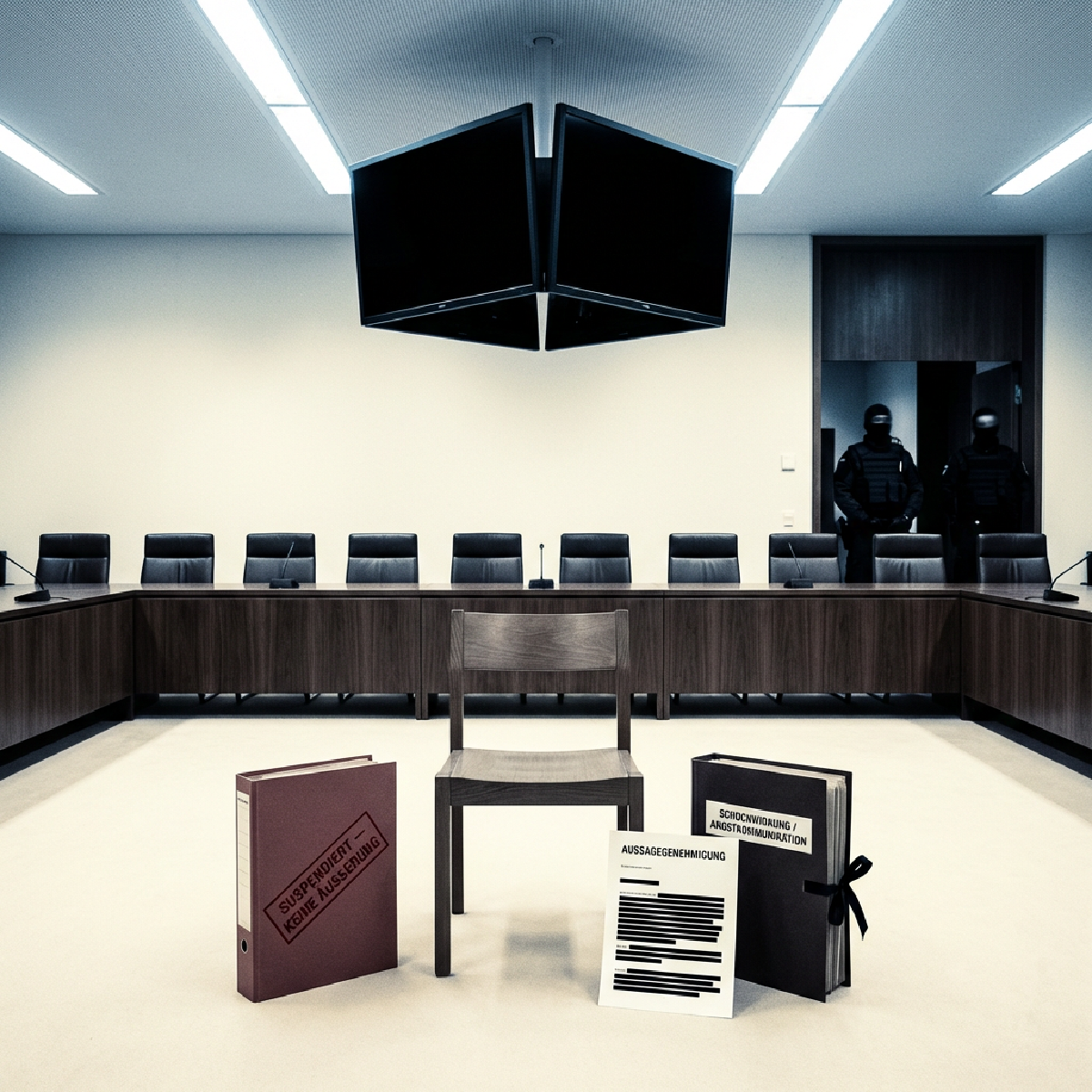
In spring 2020 the German Federal Ministry of the Interior produced two documents which together document the German application of the tabletop language-regulation architecture. Six years later the two papers meet again — as witness and as questioned, in the great hearing room of the German Bundestag, in the framework of the federal inquiry commission “Aufarbeitung der COVID-19-Pandemie.” What happens there is not accountability. It is a second application of the same mechanism.
The Two Papers#
The Kerber shock paper (March 2020): Between 19 and 22 March 2020, the then-BMI State Secretary Markus Kerber convened an informal group of academics — economists, sociologists, China researchers — and had an internal strategy paper drafted with the title “How We Get COVID-19 Under Control.” One of the central group members was Otto Kölbl, a 52-year-old German-studies doctoral student at the University of Lausanne, who wrote the passages on “shock effect” and “fear communication.” The paper recommended explicitly the staging of dying scenarios (“children will kill their parents” through inadequate hygiene; “suffocate at home in agony” because hospitals are overwhelmed) — as deliberately deployed population-conditioning instruments. Welt am Sonntag published the paper on 30 March 2020. It became the strategic foundation of federal communications in the early months of the pandemic.
The Kohn memorandum (May 2020): Stephan Kohn, senior administrative officer at the BMI with twenty years of experience in crisis management and protection of critical infrastructure (Department KM4), produced on 8 May 2020 an 83-page evaluation report (full version 192 pages) titled “Corona Crisis 2020 from the Perspective of Critical Infrastructure Protection.” His finding: no systematic risk analysis had taken place; the RKI risk classification rested on no empirical indicators; the harm caused by measures was potentially greater than the harm caused by the pathogen; mortality in 2020 was at normal levels until autumn; 400,000 short-time workers came out of medical practices and clinics while politicians spoke of “excess mortality.” Kohn sent the report by email to his department head, the BMI crisis cell, the Federal Chancellery, and all German state governments. The email was leaked and published by Tichys Einblick.
In May 2020 Kohn was suspended. In March 2022 the Berlin Administrative Court ordered his dismissal from service — the highest possible disciplinary penalty for a civil servant on lifetime tenure, including loss of pension. The judgment text attributed to him a “deceitful character” — without that character ever having been examined. The question whether the imminent-danger situation on which Kohn had relied for direct distribution had really existed was never adjudicated.
Both papers came from the same ministry, the same weeks, the same crisis-management apparatus. One became policy. The other was sanctioned. The differential was not professional but strategic.
Holtherm: The Militarisation of 19 January 2020#
Three days before Germany registered its first PCR coronavirus case — and while there was not yet a single positive test in all of Europe — on Sunday 19 January 2020, at 22:15, immediately after the Tatort detective broadcast, then-Federal Health Minister Jens Spahn sent an SMS to the Bundeswehr Surgeon General Hans-Ulrich Holtherm: “Dear Dr. Holtherm, I would like to get to know you. You have some competencies that are very important to me. Please call me. Jens Spahn.” Holtherm had taken command of the Bundeswehr Hospital Ulm on 15 January — four days earlier.
On 1 March 2020 Holtherm became head of the newly created Department 6 of the Federal Health Ministry: “Health Protection, Health Security, Sustainability.” He simultaneously took the lead of the BMG Corona Crisis Cell and, jointly with the Public Security Department head of the BMI, the leadership of the “Joint Crisis Staff BMI-BMG COVID-19.” In this position he became the supervisory authority over the Robert Koch Institute.
From the 2024-released RKI crisis-cell minutes (released by court order via the Multipolar lawsuit), it emerges that the RKI considered, at several points, legal action against subject-matter-irrelevant directives from the BMG — and then concluded that such action would be hopeless. Whoever supplied the situation assessment (RKI) received directives from a department under military leadership, which itself stood under the political mandate of a minister who had recruited the Bundeswehr general without normal service-route procedure, by Sunday-evening SMS. That is the German militarisation inversion: not the military supporting civilian health authorities, but the military leading them.
The expert witness Tom Lausen put this question before the inquiry to the present Bundeswehr General Hoffmann; the answer was evasive (“identification of a personnel measure that could be active in supporting the crisis”). The structural question — why before the first European PCR case, why by SMS after Tatort, why a NATO general as direct supervisor of the RKI — remained unanswered in the session. Lausen noted that parallel militarisation steps occurred simultaneously in Spain, Italy and other states — that is, not coincidence but shared understanding (see Atlantic Storm 2005: WHO IHR 2005 as the institutional framework for exactly this coordination architecture).
The Hearing: Questioning at the Table#
Stefan Homburg’s questioning of Kohn (as AfD-faction expert witness) led step by step to the structural thesis of the Kohn memorandum: “The data and facts that were available then and that are available today indicate no exceptionally dangerous pandemic.” The dangerousness of a pandemic, he argued, is measured by harm — and a population-relevant harm can be assessed only after it has occurred. “In this pandemic, measures were imposed before any harm had occurred.”
On Homburg’s follow-up question on the shock paper:
“At the BMI an external group of a German-studies doctoral student, a sociologist and so on was commissioned to write a so-called shock paper, intended to scare the population, to suggest an emergency. Were you aware of it?”
Kohn’s reply: “I learned of it. To anyone approaching the matter without preconception it should be clear that when a crisis or war breaks out — a difficult problematic affair causing great harm — a government would normally try to calm, to ramp down, to reassure. Light entertainment might appear on television — and not panic-mongering.”
That is the central finding of the Kohn memorandum, now repeated in a session of the German Bundestag: what was sold in spring 2020 as crisis communication was functionally the opposite of what a government in a real crisis would do. It was panic-induction as strategy, not reassurance as duty.
The Inquiry Majority Gives Its Answer#
The reaction to Kohn’s statements demonstrated the second application of the shock-paper mechanism at parliamentary level.
The chair of the Inquiry Commission is Franziska Hoppermann (CDU, Hamburg) — the member who on 1 December 2021 publicly wrote: “The #Impfpflicht [mandatory vaccination] must now be prepared.” The commission assessing whether pandemic policy was proportionate is led by someone who was among the publicly declared advocates of the most contested measure of that pandemic policy. That is not neutrality. That is institutional continuity.
The personal sanction: CDU member Axel Müller of Ravensburg asked the witness, in the middle of substantive questioning:
“You experienced a hard fate, I am well aware of that. A great injustice was done to you in your childhood and youth, because something was covered up. […] When one has once experienced that something was covered up, does it trigger something? Has it triggered anything in you? And if so, in what form, in connection with this crisis?”
Stephan Kohn was as a child a victim of the Ahrensburg abuse scandal — one of the most serious documented cases of sexual abuse in an Evangelical Lutheran parish of the Federal Republic. Müller’s question instrumentalised that biography as rhetorical device: implicitly suggesting that Kohn’s professional critique of the measures was the consequence of trauma rather than rational proportionality assessment. It is the ad-hominem variant of the counter-misinformation doctrine: not refute the argument, but delegitimise the arguer.
The AfD’s commission Obmann, Kay-Uwe Ziegler, raised a procedural motion (“What is this supposed to be in this connection?”). The chair interpreted it as a request to return to substantive questioning, but gave Müller a further 33 seconds — and Müller repeated the same question in a slightly different wrapping. Member Dr. Baum responded later openly: “Frau Wittmann, your dismissive personal remarks I find an impertinence, and they should actually have been formally rebuked.”
The data lockout: Expert witness Homburg reported that he had moved in the inquiry commission to formally request the RKI and the Paul Ehrlich Institute to deliver the safe-track data and the statutory health-insurance billing data — which these federal institutes have refused to release in pending lawsuits for years. The argument: the Bundestag is the highest constitutional organ; if it asks two subordinate federal institutes to deliver, those cannot refuse. The majority of the inquiry commission (CDU/CSU, SPD, Greens, Left) voted the motion down. Verbatim: “You don’t want to see this data.”
The graph ban: Homburg moved that, in expert-witness questioning, graphs (e.g. mortality statistics) be permitted — comparable with the standard of any eighth-grade classroom with a digital whiteboard. For eight weeks it was asserted that this was “legally not possible” because of copyright (the Robert Koch Institute would supposedly sue the Bundestag for showing RKI graphs). After this argument was acknowledged as unsustainable, the commission majority resolved in a non-public sitting: graphs may not be shown in expert-witness questioning. The session minutes containing the resolution’s reasoning may not, by majority vote, be released.
In an accountability commission whose mandate is the assessment of pandemic policy, the majority blocks access to the data of the federal institutes on whose basis the pandemic policy was justified — and simultaneously blocks the visual presentation of the publicly available mortality statistics. That is not accountability. It is the parliamentary application of the SPARS counter-misinformation doctrine: the information that might disturb the narrative is blocked at procedural level, not refuted.
Dettmar: The Judicial Sanction Layer#
The structural sanction against deviating positions reaches into the judiciary. Christian Dettmar, family-court judge at the Local Court Weimar, issued an order in April 2021 to suspend the mask requirement for school students at two schools — on the basis of a child-welfare assessment. He was sentenced in 2023 by the Federal Court of Justice to two years’ suspended imprisonment for perverting the course of justice — and dismissed from judicial service.
Dettmar and Kohn are the two German exemplary cases of structural sanction against professionals whose internal-professional assessment ran against the political line — Kohn from the ministry, Dettmar from the judiciary. The message to all other career civil servants and judges is unambiguous: whoever professionally challenges the basis of the measures risks not only career but pension and criminal record.
Against this backdrop, Kohn’s testimony before the inquiry has an additional layer. Asked whether judges had been “afraid” of him, he replied: “Of course. Today all sorts of people are afraid, and not only of this disease but of institutional consequences if they do not speak up.”
The Security-Force Staging#
The session itself was characterised by staging elements meant to frame the testimony. In the room sat four representatives of the federal government — at a purely parliamentary procedure. Armed protective forces in vests were present, which has previously occurred only in extreme cases (e.g. at Drosten hearings). Above all, the BMI had unsolicited sent Kohn an authorisation to testify in which it was explicitly listed what he was not allowed to testify about. The authorisation was functionally a pre-censorship of the witness.
That is not accountability. That is the staging of accountability-refusal as parliamentary procedure. Whoever was in the session could read that the majority was not attempting to achieve professional clarification but rather to intimidate the witness, to truncate his statements, and to delegitimise his person.
Bridge to the Series: The Accountability-Refusal Architecture#
The five preceding structural analyses in the series (Dark Winter, Atlantic Storm, SPARS, Clade X, Event 201, plus the Leopoldina 7th statement as the German application) documented the build-up of a pandemic-response architecture across two decades. The Kohn case documents the accountability-refusal architecture that emerged after the pandemic as a second application of the same mechanism.
SPARS 2017 had supplied as script: pre-bunking, trusted messenger, counter-misinformation, ad hominem rather than substantive argument. The shock paper 2020 had supplied the German application of that methodology: fear communication, dying scenarios as population-conditioning. The 2026 inquiry majority supplies the parliamentary extension: data lockout at the procedural level, graph ban, personal delegitimisation of the witness. In all three stages the mechanism is identical — the information that might disturb the narrative is not refuted but structurally blocked.
The Kohn memorandum and the Kerber shock paper were not two random documents. They were the two poles of the same political architecture: one pole (shock paper) supplied the language-regulation library for population-conditioning; the other pole (Kohn memorandum) supplied the professional proportionality assessment. One became policy. The other was sanctioned. Six years later the inquiry delivers the second answer: accountability conducted by the same majority that produced the policy is accountability-prevention.
Closing#
What took place in the inquiry commission’s hearing room in spring 2026 is not pandemic accountability. It is a second activation of the SPARS counter-misinformation script at parliamentary level. Stephan Kohn sits in 2026 before a majority that in 2020 made the shock paper its policy basis and sanctioned his professional memorandum. Six years later that same majority blocks the data of the federal institutes, blocks the visual presentation of the mortality statistics, lets one of its members confront the witness with his abuse-victim childhood — and adopts all of this in non-public sittings with sealed minutes.
That is an accountability format whose function is not the accountability but the prevention of the accountability under the cloak of the accountability. It is the function-inversion at a format that without inversion would be one of the most important parliamentary accountability instruments of the Federal Republic.
Stephan Kohn said at the close of his statement: “I believe, when one has once experienced injustice, or heavy blows of fate, and had to defend a reasonable position against resistance, then one is a bit robust and resilient against demands to fit oneself streamlined somewhere, no matter whether it is right or wrong.”
That is the simplest description of the function of a career civil servant. It is at the same time the simplest description of what the majority of the inquiry commission is currently not honouring. Whoever does not fit oneself streamlined is sanctioned. Whoever is sanctioned is, in the accountability hearing, confronted with their abuse-victim childhood. Whoever asks that is a member of the governing faction.
Accountability does not begin in the inquiry. It begins with reading the two papers of 2020 — and the list of those who made one of them policy and de-mandated the other.
Sources#
- Wikipedia (German) — Stephan Kohn — biography, BMI position KM4, 83-page report 8 May 2020, May 2020 suspension, Berlin Administrative Court dismissal March 2022
- Cicero — Leaked paper from the BMI (May 2020) — full-text source of the Kohn memorandum, publication context
- Achgut — Panic as ordered: a new look at the Kohn affair — analytical framing
- tichyseinblick — CDU attacks the man who warned — coverage of the Müller sanction in the inquiry session
- reitschuster — CDU member abuses the abuse — critical analysis of the personal attack
- Wikipedia (German) — Strategy paper of the Federal Interior Ministry on the Corona Pandemic — the Kerber shock paper of 22 March 2020, with Otto-Kölbl authorship of the “shock effect” passages
- taz — Strategy paper of the Interior Ministry: shock effect desired — coverage of the shock paper
- GPPi — “Achieving the desired shock effect” — analysis of the shock-effect rhetoric
- Bundestag Drucksache 19/20301 (2020) — parliamentary inquiry on the BMI shock paper
- Wikipedia (German) — Hans-Ulrich Holtherm — Surgeon-General biography, 19 January 2020 Spahn SMS, BMG Department 6 appointment 1 March 2020
- aerzteblatt — Hans-Ulrich Holtherm: New at the BMG — official appointment coverage
- kma-online — Bundeswehr General Holtherm takes new BMG department — context of the Spahn SMS
- Multipolar — RKI Crisis-Cell Minutes (released by court order 2024) — RKI-internal references to subject-matter-irrelevant directives + considered legal action
- BGH judgment in the Christian Dettmar case (2023) — Weimar family-court judge, mask requirement suspension order, conviction for perverting the course of justice, dismissal from service
Cross-references on related actors:
- Leopoldina 7th Statement — Advisory Closed Circuit — the German academic variant of the mechanism, December 2020
- SPARS 2017 — Coronavirus Communications Script — the training material whose language-regulation library Kerber translated into German in 2020
- Atlantic Storm, January 2005 — Politicians’ Tabletop and WHO Emergency Powers — the mandate architecture which Holtherm delivered in 2020 as German application
- Event 201, October 2019 — The Final Synchronisation — the international framework into which the German militarisation in 2020 stepped
- Dark Winter, June 2001 — Those Who Rehearsed the Smallpox Built the Apparatus After — the format in which the designer-to-actor logic began
- The Web — Part 14: Germany — The Web Comes Home — the German personnel pipeline