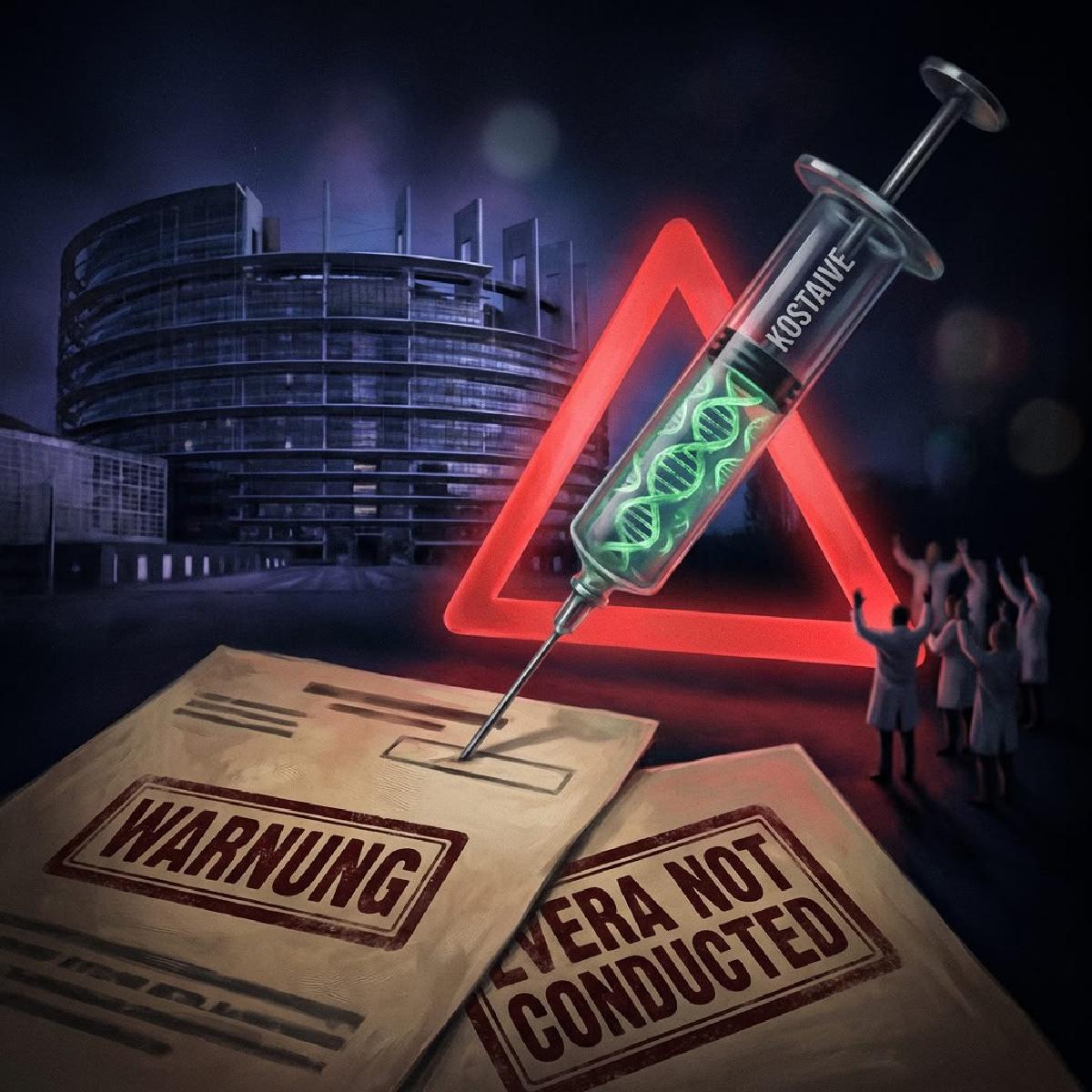
There is one critical difference between a conventional mRNA vaccine and what the EU approved in February 2025.
A conventional mRNA vaccine delivers a blueprint into the body. The body produces the protein, the immune response is triggered, the blueprint is degraded.
Kostaive® works differently. It does not only deliver a blueprint — it also delivers instructions for an enzyme (replicase) that produces additional copies of the mRNA inside the body. The process amplifies itself. Hence the name: self-amplifying mRNA, or sa-mRNA.
How long this production continues, where exactly in the body it occurs, and what quantities are generated — according to two official European biosafety authorities, this has not been sufficiently investigated to this day.
And yet the product has been approved in the EU since February 14, 2025.
What Is Kostaive? #
Manufacturer: Arcturus Therapeutics & CSL Seqirus
Active ingredient: Zapomeran (ARCT-154)
Technology: sa-mRNA, derived from the Venezuelan equine encephalitis virus (VEEV)
Target group: Adults 18 and older against COVID-19
EU approval: February 14, 2025 (EMA recommendation: December 12, 2024)
Already in use: Japan (first country worldwide)
The European Parliament took note: MEP Gerald Hauser (PfE) filed a priority written question in January 2025 — asking whether critical scientific voices from Japan had been included in the decision, how long-term safety had been assessed, and whether the Commission intended to approve the product despite international concerns.
The Commission’s answer: Yes.
The Open Letter: ZKBS and COGEM Warn #
The Zentrale Kommission für die Biologische Sicherheit (ZKBS) in Berlin and the Dutch Commissie Genetische Modificatie (COGEM) in The Hague are not activist organizations. They are official state expert bodies responsible for biological safety at the highest level.
Both jointly sent an open letter to the European Commission. The key points:
1. No Environmental Risk Assessment (ERA) conducted
Although Kostaive is derived from an animal virus (VEEV) and self-replicates inside the body, no Environmental Risk Assessment was conducted prior to approval in accordance with the applicable guideline EMEA/CHMP/BWP/473191/2006. For biologically active substances of this type, this is normally mandatory.
2. Virus-like vesicles (VLVs) — risk to third parties unknown
The sa-mRNA can generate so-called virus-like vesicles (VLVs) that can spread within the body. Whether transmission to third parties is possible is not known.
This means concretely: it is theoretically possible that someone vaccinated with Kostaive could pass on particles to people who have consciously decided against vaccination. This question remains scientifically open.
3. The EU responded — but concerns remain
The EU Commission replied to the letter. COGEM and ZKBS assessed the response as insufficient and followed up in January 2026: the central questions regarding safety for humans and the environment were still unresolved.
As of today: Kostaive is approved. The safety questions are open.
What Scientists Are Criticizing #
From scientific literature and expert statements:
- Prof. Dr. Yasufumi Murakami (emeritus professor, Tokyo University of Science) publicly warned of possible long-term risks of self-replicating mRNA technology
- Pharmaceutical Technology quotes researchers: experience with conventional mRNA vaccines is “maybe not translatable to the samRNA”
- Immunologist Jablonowski on Children’s Health Defense: chronic exposure to spike protein is “like being vaccinated every day for the rest of your life” — and when new variants emerge, another new product would be needed
- PubMed/PMC review (2025): Systematic analysis of sa-mRNA technology limitations — open questions about dosage, duration of protein production, and distribution within the body
The manufacturers themselves report in clinical trials: no myocarditis, no serious adverse events in short-term observation. But long-term data simply do not exist — the technology is too new.
Autumn 2026: Is Kostaive Coming to the Campaign? #
The Dutch Health Council has issued a new COVID vaccination recommendation for autumn 2026, based on mRNA vaccines. Kostaive stands as the first and only approved sa-mRNA product available.
Whether it will specifically be used has not been finally decided. But the infrastructure is in place. The product is approved. And the warning bodies are being ignored — exactly as in 2020.
The Pattern #
What is happening here is not an isolated case. It is a pattern:
- New technology is approved under time pressure
- Independent expert bodies warn in writing
- The warning is formally acknowledged and substantively ignored
- The product reaches the market
- Long-term consequences are “monitored retrospectively”
With the mRNA vaccines of 2021, we experienced exactly this. ZKBS and COGEM want to prevent it from happening again. The EU Commission is allowing it.
What Remains #
No one here is being asked to make a decision for or against vaccination. That is a personal decision.
But anyone who wants to make an informed decision should know:
- Kostaive is a new technology class, not a development of known vaccines
- Two independent official biosafety bodies warned in writing before approval
- The question of possible transmission to third parties is scientifically open
- Long-term effects are unknown — not because they have been studied and found safe, but because the time for that has not yet passed
This is in the documents. Not in Telegram channels.
Sources:
- ZKBS/COGEM Open Letter: zkbs-online.de
- EMA Kostaive: ema.europa.eu
- EU Commission Press Release: newsroom.csl.com
- Parliamentary Question EP P-000048/2025: europarl.europa.eu
- PubMed Review saRNA Limitations: pmc.ncbi.nlm.nih.gov
- Pharmaceutical Technology: pharmaceutical-technology.com