The Enquete Commission is running, the German Federal Court of Justice is overturning vaccine injury rulings, the Telegraph is reporting on vaccine injuries – but one question nobody asks: How many of the “Corona-positives” were actually infectious?
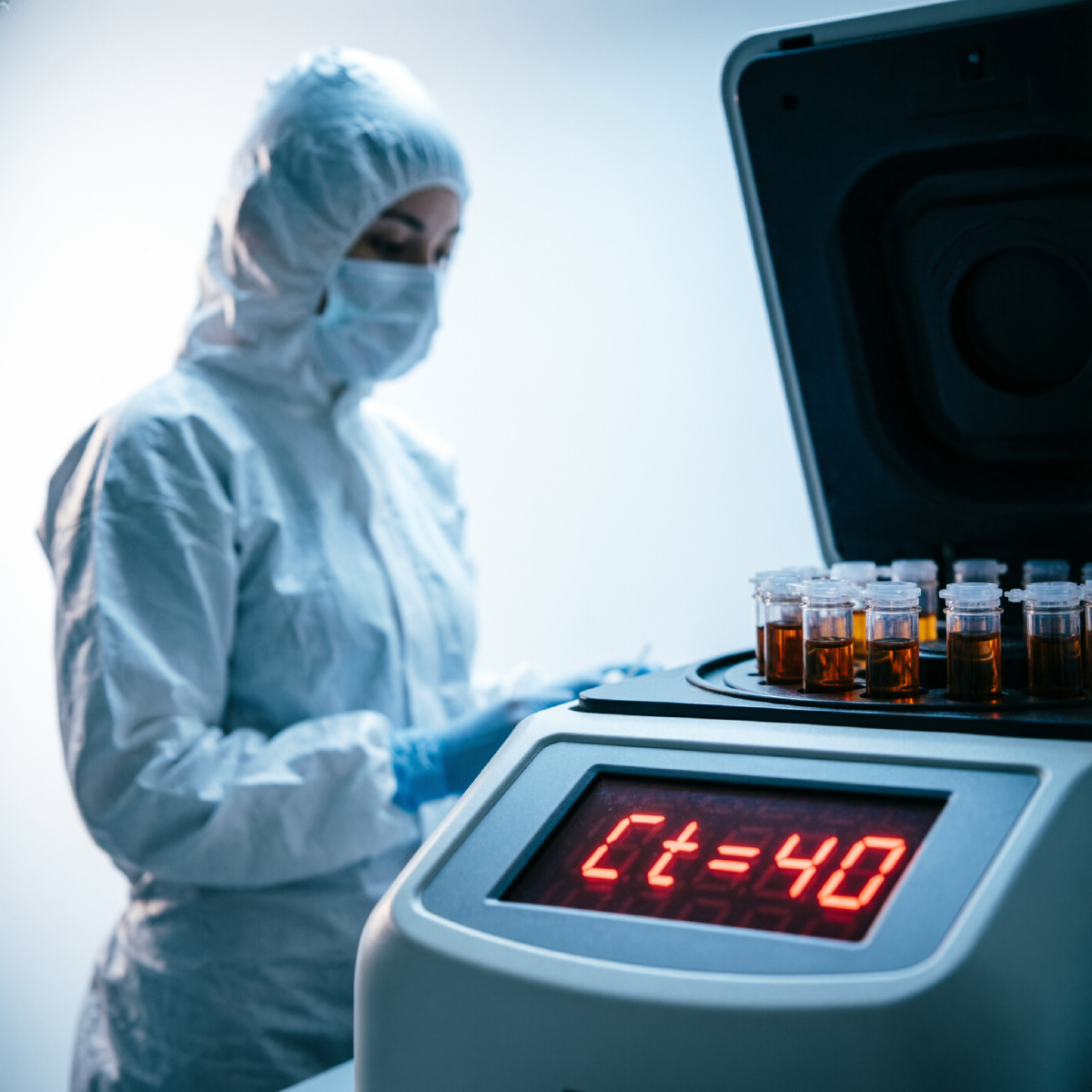
The answer has been in peer-reviewed studies since 2020: At Ct value 35 = 0% culturable [1]. The RKI itself set the threshold at Ct >30 [2]. But many labs ran PCR tests up to Ct=40 and higher [3].
This means: A large proportion of “positives” were not infectious – but still in quarantine, in intensive care, in lockdown statistics.
Even more explosive: Harvard epidemiologists said the same thing in 2020 [4][5]. The Charité assay produced positive results on pure water [6]. And the RKI protocols prove: Politics overruled science – internally documented [7][8][9].
Why do both sides (mainstream AND critics) conceal this core lie?
Drosten PCR Without Patient Isolate – The Birth of the Test#
On January 23, 2020, Christian Drosten published the PCR protocol in Eurosurveillance – 24 hours after submission [10]. Peer review normally takes weeks to months. Here: one day.
The timeline:
- January 21, 2020: Submitted
- January 22, 2020: Accepted
- January 23, 2020: Online
Conflict of interest: Drosten and co-author Chantal Reusken were themselves members of the Eurosurveillance Editorial Board [11]. Structural conflict of interest.
Basis of the test: Not a German patient isolate, but a GenBank sequence from China [10]. The virus had not yet been detected in Germany at that time.
Corman-Drosten Review (Borger et al., November 2020): An international consortium of scientists identified 10 major methodological flaws [6]:
- Primer design too unspecific (also detects other coronaviruses)
- No negative controls
- No standardized Ct value threshold
- Killer finding: The Charité assay produces positive results on pure water controls at Ct 36–38 [6]
With a test run up to Ct=40 and higher, this means: Every run near the cutoff threshold is forensically worthless.
Retraction demand – ignored to this day. Eurosurveillance asked for “further expert opinions” (Retraction Watch, December 2020) [11] – but the paper still stands.
Ct Value Manipulation – The Core Lie#
What is the Ct value?
- PCR amplifies genetic material in cycles
- The higher the Ct value, the less starting material was present
- Ct >30 = viral RNA in tiny amounts, often no longer infectious
The Science Was Clear#
Jaafar et al. 2020 (Clinical Infectious Diseases, peer-reviewed) [1]:
- At Ct=25: ~70% of samples culturable (infectious)
- At Ct=30: only 20% culturable
- At Ct≈35: 0% culturable (no infectious virus detectable)
RKI position (discharge criteria, March 2020) [2]:
- “At Ct values >30, loss of culturability can be assumed”
- The RKI knew: From Ct >30 = no longer infectious
But: Many labs ran PCR tests up to Ct=40 and higher [3]. The WHO warned (January 2021): “At low prevalence, the false-positive risk increases, interpret high Ct values carefully in context” [12] – but no specific Ct threshold.
Mainstream Scientists Said the Same#
It was no secret. Harvard epidemiologist Michael Mina publicly called for antigen tests instead of PCR mass testing in the New England Journal of Medicine (NEJM) in 2020, because PCR detects “viral debris” weeks after recovery as “positive” [5].
Tom & Mina (Clinical Infectious Diseases, 2020) [4]:
“At high Ct values, only ‘viral debris’ is detected, not infectious virus. PCR is too sensitive for public health purposes.”
Harvard, NEJM, same journal as Jaafar. When a Harvard epidemiologist writes the same thing in NEJM in 2020 as Jaafar, “Ct >30 = not infectious” is not a conspiracy argument, but consensus-overlooked-in-mainstream.
Consequence:
- A large proportion of “positives” (Ct >30) were not infectious
- But: Quarantine, contact tracing, lockdown statistics were based on all positives (including Ct=40)
Drosten 2014 vs. 2020 – Methodological Inconsistency#
2014 (MERS outbreak, Saudi Arabia): Drosten warned in Wirtschaftswoche [13][14]:
“In Jeddah, PCR mass testing was done – suddenly construction workers and chambermaids were positive who had hardly any symptoms. The WHO case definition (bilateral pneumonia) was bypassed – incidence shot up.”
Drosten saw 2014 PCR mass testing as incidence artifact risk.
2020 (SARS-CoV-2): Drosten developed the PCR test that was used worldwide for mass testing – without Ct value standardization.
Methodological inconsistency: The same person who warned against PCR mass testing in 2014 developed the test in 2020 that enabled exactly that.
Caveat: Correctiv and dpa fact-checkers argue MERS ≠ SARS-CoV-2 (different tropism, different lethality) [15]. But: The methodological criticism (PCR mass testing without symptom context) applies regardless of virus.
RKI Protocols Leak: Politics Overruled Science#
In March 2024, journalist Paul Schreyer (Multipolar) sued to release RKI crisis team protocols – with over 1,000 redactions [7]. In July 2024, Aya Velazquez published the unredacted protocols [8].
RKI confirmed authenticity, only objected to the transfer [9]. FragDenStaat reported a data breach [16].
Three Quotable Findings from the Leak#
1. Incidence threshold internally deemed “nonsensical” / “professionally rejected”
Spring 2020: The RKI internally rejected incidence thresholds as a scientific control variable – they became a political control variable anyway [7][8].
2. Spahn/Braun demanded scientific justifications from RKI for politically predetermined thresholds
The order was reversed: Politics decided first, RKI was supposed to deliver retroactively [7][8].
3. February 25, 2022: Lauterbach rejected risk downgrade
RKI wanted to reduce the risk assessment from “very high” to “high”. BMG (Lauterbach) rejected [7][8].
Lauterbach claimed publicly in March 2024: “There were no political directives.”
The protocol refutes this verbatim.
Conclusion: The Question Nobody Asks#
A significant number of reported positives did not contribute to the pandemic. This was known internally:
- RKI knew: Ct >30 = not infectious
- Harvard epidemiologists publicly called for: Antigen tests instead of PCR
- Charité assay was positive on water
- RKI protocols prove: Incidence was political directive, not science
The investigation must start with the question: Who politically decided to ignore this knowledge?
As long as “pandemic” is accepted as a premise, the investigation remains cosmetic.
Sources#
[1] Jaafar et al., “Correlation Between 3790 Quantitative Polymerase Chain Reaction–Positives Samples and Positive Cell Cultures”, Clinical Infectious Diseases, 2020. https://academic.oup.com/cid/article/72/11/e921/5912603
[2] RKI, “Discharge criteria from isolation”, March 2020. https://edoc.rki.de/bitstream/handle/176904/6867/20_0316_Entlasskriterien_A3_V11.pdf
[3] RKI, “Notes on testing patients for SARS-CoV-2”. https://www.rki.de/DE/Themen/Infektionskrankheiten/Infektionskrankheiten-A-Z/C/COVID-19/Diagnostik-Hinweise.html
[4] Tom & Mina, “To Interpret the SARS-CoV-2 Test, Consider the Cycle Threshold Value”, Clinical Infectious Diseases, 2020. https://pmc.ncbi.nlm.nih.gov/articles/PMC7314112/
[5] Mina, “Rethinking Covid-19 Test Sensitivity — A Strategy for Containment”, NEJM, 2020. https://pubmed.ncbi.nlm.nih.gov/32997903/
[6] Borger et al., “External peer review of the RTPCR test to detect SARS-CoV-2 reveals 10 major scientific flaws”, November 2020. https://zenodo.org/records/4433503
[7] Multipolar, “RKI protocols released by court order”, March 20, 2024. https://multipolar-magazin.de/artikel/rki-protokolle-2
[8] Wikipedia, “Protocols of the RKI Crisis Team”. https://de.wikipedia.org/wiki/Protokolle_des_RKI-Krisenstabs
[9] RKI, “Statement on the protocols of the COVID-19 crisis team”. https://www.rki.de/DE/Content/InfAZ/C/COVID-19-Pandemie/Stellungnahme_Protokolle.html
[10] Corman et al., “Detection of 2019 novel coronavirus (2019-nCoV) by real-time RT-PCR”, Eurosurveillance, January 23, 2020. https://www.eurosurveillance.org/content/10.2807/1560-7917.ES.2020.25.3.2000045
[11] Retraction Watch, “Public health journal seeking further expert advice on January paper about COVID-19 PCR testing”, December 7, 2020. https://retractionwatch.com/2020/12/07/public-health-journal-seeking-further-expert-advice-on-january-paper-about-covid-19-pcr-testing-by-high-profile-virologist/
[12] WHO, “Information Notice for IVD Users 2020/05”, January 20, 2021. https://www.who.int/news/item/20-01-2021-who-information-notice-for-ivd-users-2020-05
[13] Drosten, “The body is constantly attacked by viruses”, Wirtschaftswoche, May 16, 2014. https://www.wiwo.de/technologie/forschung/virologe-drosten-im-gespraech-2014-der-koerper-wirdstaendig-von-viren-angegriffen/9903228.html
[14] Drosten, “The WHO can only make recommendations”, Wirtschaftswoche, May 16, 2014. https://www.wiwo.de/technologie/forschung/virologe-drosten-im-gespraech-2014-die-who-kann-nur-empfehlungen-aussprechen/9903228-2.html
[15] Correctiv, “No, Christian Drosten did not say in 2014 that he considers PCR tests unsuitable”, November 23, 2020. https://correctiv.org/faktencheck/2020/11/23/nein-christian-drosten-hat-2014-nicht-gesagt-dass-er-pcr-tests-fuer-untauglich-halte/
[16] FragDenStaat, “Reporting a data breach: RKI leak from July 23, 2024”. https://fragdenstaat.de/en/request/meldung-einer-datenpanne-rki-leak-vom-23-07-2024/