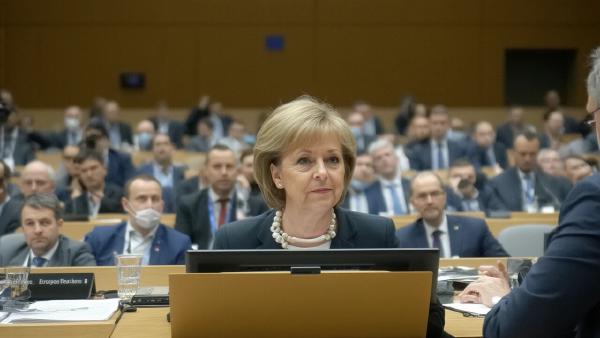
Reiner Haseloff, CDU, Minister-President of Saxony-Anhalt, in the state parliament, June 12 of last year. Emotional, combative, passionate:
“I was born in this state and I will die in this state and I will do everything to make sure they never come into government responsibility.”
The moderator summarizes: “our country, our democracy.”
One of Germany’s highest-ranking CDU politicians publicly declares: he will do everything to prevent a party from governing. A party polling above 30 percent in Saxony-Anhalt. Leading in surveys. Potentially providing the next Minister-President.
Let’s ask the obvious question: whose democracy is this, exactly?
What Democracy Means — and What It Doesn’t #
Democracy is not a matter of taste. It has a clear mechanism: the population votes. The majority governs. Minorities have rights, but no veto power over the will of the voters.
This is not complicated. It’s written not in any party manifesto, but in the fundamental structure of every democratic system in the world.
Whoever says “I will do everything to make sure this party never governs” — regardless of what voters decide — has not applied this basic principle. He has overridden it.
This is not a criticism of Haseloff as a person. It is a criticism of the logic he publicly and proudly presents.
The Firewall Concept and Its Consequences #
The “firewall” against the AfD is the declared concept of the established parties: no coalition, no cooperation, no toleration — regardless of the election result.
At first glance, it sounds like principled resolve. On second look, it’s something else: a preemptive decision to structurally exclude certain voters from government participation.
When over 30 percent of a state’s population votes for a party and that party is never allowed to govern — those 30 percent don’t have an equal democratic voice. They vote, but their vote doesn’t count.
That is not democracy. It is democracy theater with a guaranteed outcome.
The Contradiction in Person #
Haseloff is not a bad person. He’s a politician who believes he’s doing the right thing. And perhaps he’s convinced that the AfD is so dangerous that normal democratic mechanisms must be suspended.
But that’s exactly where the error lies.
When a political class determines which election results are valid and which are not — who still holds the power? Not the people. The class.
That is the model Haseloff represents when he says: “I will do everything to make sure they never come into government responsibility.” He’s not talking about courts. Not about laws. He’s talking about his political will to neutralize the election result.
What He Failed to Understand #
Whoever acts this way has failed to grasp something fundamental: exclusion does not produce consent. It produces radicalization.
When 30 percent of the population feel that their vote structurally doesn’t count — that no matter who they elect, the same people do the same thing — frustration grows. Not insight.
The AfD didn’t grow despite the firewall. It grew because of it. Because the firewall sends a signal: your vote doesn’t interest us. We decide anyway.
That is the opposite of democracy. And it is the best campaign aid one can give an opposition movement.
“Our” — the Decisive Word #
“Our democracy.” Not “the democracy.” Not “the system that protects everyone.” But: ours.
Whose? That of the CDU, SPD, Greens, FDP — the parties that have formed federal governments for decades and have decided who belongs and who doesn’t?
The word “our” reveals the actual conviction: democracy is for us. For those who play the game by our rules. Whoever wants different rules — whoever fundamentally questions the system — is not a legitimate participant. They’re a threat.
That is not a democratic self-understanding. It is an elitist one.
What Democratic Maturity Would Mean #
Democratic maturity would be: sit down, listen, ask. What do the 30 percent want? What drives them? What specific grievances do they name — migration, economy, energy costs, loss of trust in institutions — and which of those are legitimate?
Not every AfD answer is right. Many are not. But the questions they provide answers to are real. And they won’t disappear because the party that asks them is structurally kept out of government.
Haseloff fights a symptom. The cause doesn’t interest him — or he lacks the means to address it.
Conclusion #
“I will do everything to make sure they never come into government responsibility.”
That is not a democratic commitment. It is the announcement of overriding democratic mechanisms when the result doesn’t fit.
Whoever calls that “our democracy” has not understood what democracy is. Or he has understood it — and considers it too important to leave to the voters.
Both are a problem.
Source:
Opinion piece. Not an endorsement of the AfD — but of the fundamental principle that in a democracy, the people decide. Not those who consider themselves its guardians.