In the first part of this series, we showed what happened: an employee exposes internal misconduct, and instead of addressing the fake scandal, ZDF hunts down the messenger. Works council member Hubert Krech collected 600 likes with a tirade in which he labeled journalism as treason and called critical media war enemies.
This raises the real question: how does an institution that considers itself the moral authority of the German public reach this point?
The answer doesn’t lie in the AI scandal. That’s just the latest occasion. The answer lies in the structure that sustains this broadcaster — and makes every reform attempt structurally impossible.
The Election That Isn’t One #
Four days after the staff assembly, in the middle of the worst crisis of his tenure, ZDF was supposed to elect its director.
Originally seven candidates applied. The television council vetted them, filtered them out — and one single counter-candidate remained: TV journalist Florin Fifasihi. She withdrew three days after her nomination. Public pressure, they said. The search committee was unable to put forward a replacement.
Result: Norbert Himmler runs unopposed. He needs three-fifths of the votes, gets them in the third ballot even without opposition. It was the same in his first election — back then he prevailed over Tina Hassel.
Waldemar Hartmann, who knows ZDF from his time as a sports presenter, commented soberly: “That’s just an acclamation of Himmler.”
An election without alternative. For a broadcaster in existential crisis. The television council organizing this election looks on — and shrugs.
The Power Arithmetic Problem #
Here lies the core. Norbert Himmler is considered a conservative candidate — he was once assessed as CDU-aligned. Yet for years he has consistently defended Jan Böhmermann, Dunja Hayali, and Elmar Theveßen, even when the arguments against this defense had long become overwhelming.
This is not a contradiction. It is calculation.
ZDF’s television council is made up of representatives from social groups — churches, unions, parties, associations. The majority alignments within it lean left-liberal. Böhmermann, Hayali, Theveßen are sacred cows of this milieu. Attack them and you lose the majority that keeps you in office. Protect them and you secure your position.
Himmler protects them. Not because he’s convinced of their work. But because he knows: if he wants to keep his power, theirs must be preserved too. A system of mutual protection, financed by the license fee payer.
That’s why Schausten could publicly admit she recognized the “magnitude too late” — and still kept her job. Why Theveßen could say they had “nothing to reproach themselves for” — and no one objected. Why Hayali announced the segment, stayed silent, and was held accountable by no one. The system protects itself.
Three Scandals, One Pattern #
The AI scandal is not the first. Anyone familiar with ZDF’s recent crisis history recognizes the pattern:
Jan Böhmermann and the BSI Chief. Böhmermann used “ZDF Magazin Royale” to deliberately spread false information that significantly contributed to the dismissal of BSI President Arne Schönbohm. A journalistic intervention against a senior official, based on constructed connections. Consequences for Böhmermann: none. Himmler stood protectively in front of him.
Dunja Hayali and Charlie Kirk. Hours after the shooting of the UnitedHealthcare CEO, Hayali publicly described the deceased as “the devil incarnate.” No apology, no contextualization, no consequences. Himmler was silent.
Nicola Albrecht and the AI images. A segment with fabricated footage runs on the country’s most important news program. Albrecht is dismissed — the lowest person in the hierarchy who could be sacrificed. The executives remain. Himmler apologizes in three internal letters, but stays publicly tight-lipped.
Three scandals, three times the same pattern: someone at the lowest level bears the consequences. The people keeping the system running remain untouched.
The War Rhetoric and What It Reveals #
Works council member Krech’s intranet text was not a slip. It is the symptom of a self-image that fully exposed itself during this crisis.
Two statements from the crisis week document this self-image better than any analysis:
The first goes roughly: journalism is treason if the right outcome doesn’t result. Whoever makes misconduct public isn’t a journalist — they’re a saboteur.
The second: whoever disagrees has declared war on us. Critical media reporting on ZDF errors aren’t competition, aren’t a control mechanism — they are enemies.
This is not exaggerated. Krech said it explicitly: the whistleblower had delivered material “to portals that have declared war on us.” Having a source in ZDF parlance is equivalent to having “spat in colleagues’ faces.”
What this rhetoric produces is not trivial. Whoever believes they’re at war accepts different means. Clandestine operations, denunciation, public character assassination — methods that Böhmermann has perfected — are reinterpreted as self-defense in wartime. The system no longer merely protects itself passively. It begins to actively fight back.
The Political Protection Guarantee #
Why doesn’t politics intervene?
Because it doesn’t have to. Because it doesn’t want to.
Public broadcasting offers politicians something that cannot be bought on the free market: guaranteed reach without critical questions. Whoever goes to ZDF gets court reporting. The result is a silent pact: politics leaves the broadcaster alone, the broadcaster leaves politics alone.
The license fee is the guarantee of this pact. It makes the broadcaster independent of the market — but dependent on the political majorities in the television council. And these majority alignments decide who becomes director. The director decides whom to protect. Whom they protect decides which journalists tell which stories.
The circle closes.
What Remains #
The AI scandal has been addressed, the errors acknowledged, Nicola Albrecht is gone. ZDF has its director back. The 600 likes for Krech’s whistleblower attack are forgotten.
Until the next scandal.
Which is not unlikely. It is structurally predetermined.
An institution that defines error exposure as treason will not fix errors — it will learn to hide them better. An institution that understands critics as war enemies will not become more capable of dialogue — it will become more defensive. An institution that places power preservation above quality standards will not improve — it will become more sclerotic.
The whistleblower did not damage ZDF. He showed an institution as it really is.
That is the real scandal. Not the AI video. But that 600 people on the intranet applauded when someone was vilified for it.
Sources #
On the director election and crisis week:
- FAZ, February 2026 — Coverage of the staff assembly, reactions from employees, and Himmler’s re-election
- Spiegel, February 2026 — Documentation of the fake video affair and internal processes
- Nius — Publication of whistleblower recordings from the crisis meeting
On Böhmermann / BSI President Schönbohm:
- Spiegel, October 2022 — “How Böhmermann brought down Schönbohm”
- BMI press release, October 2022 — Schönbohm’s dismissal
On the Hayali-Charlie-Kirk statement:
- Screenshot and documentation via social media, December 2023
On the structure of the ZDF television council:
- ZDF charter and broadcasting state treaty (publicly available at zdf.de)
- Medienkorrespondenz, ongoing coverage of the composition of oversight bodies
Video background:
Discussion on Newslive, 07.03.2026:
Part 2 of a series on the ZDF AI scandal and its structural causes. Part 1: ZDF and the Whistleblower: When the Messenger Becomes the Enemy
Related Posts #
- ZDF and the Whistleblower: When the Messenger Becomes the Enemy — Part 1: The AI scandal and the hunt for the whistleblower
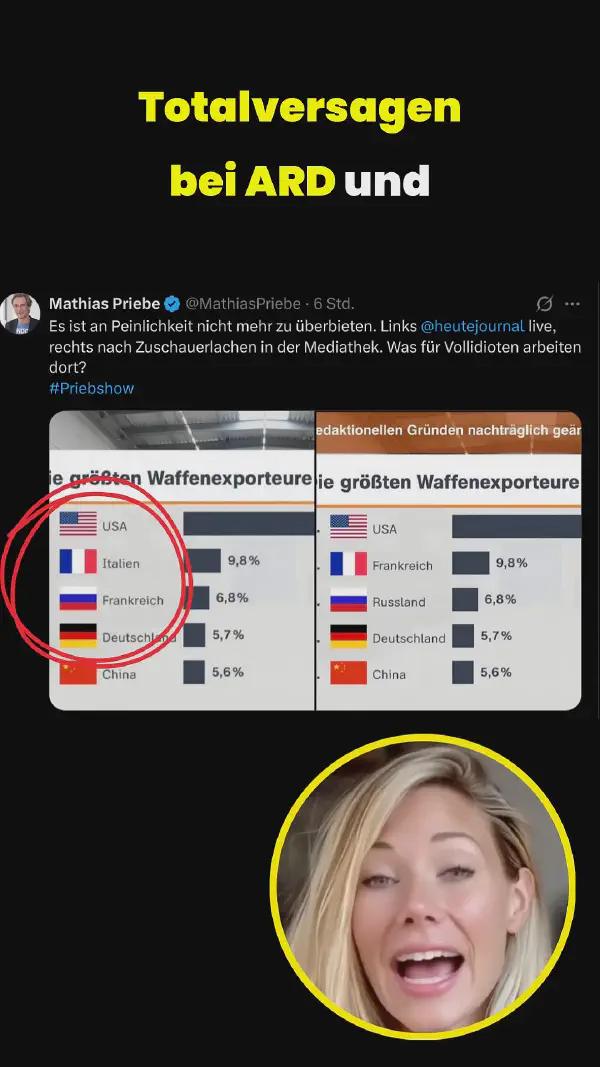
- Total Failure at ARD and ZDF: Wrong Flags, Wrong Graphics, Everything Wrong — Further quality failures in the same period
- The Director and the “Enemy”: How ZDF Betrays Its Own People — Katrin Seibold and Himmler’s re-election without a counter-candidate
- The Julia Ruhs Case: Systematic Discrediting or Legitimate Criticism? — The same pattern at NDR: whoever is inconvenient gets removed
- Analysis of the Latest Court Ruling on the Broadcasting Fee in Germany — Court questions the programming diversity of public broadcasting