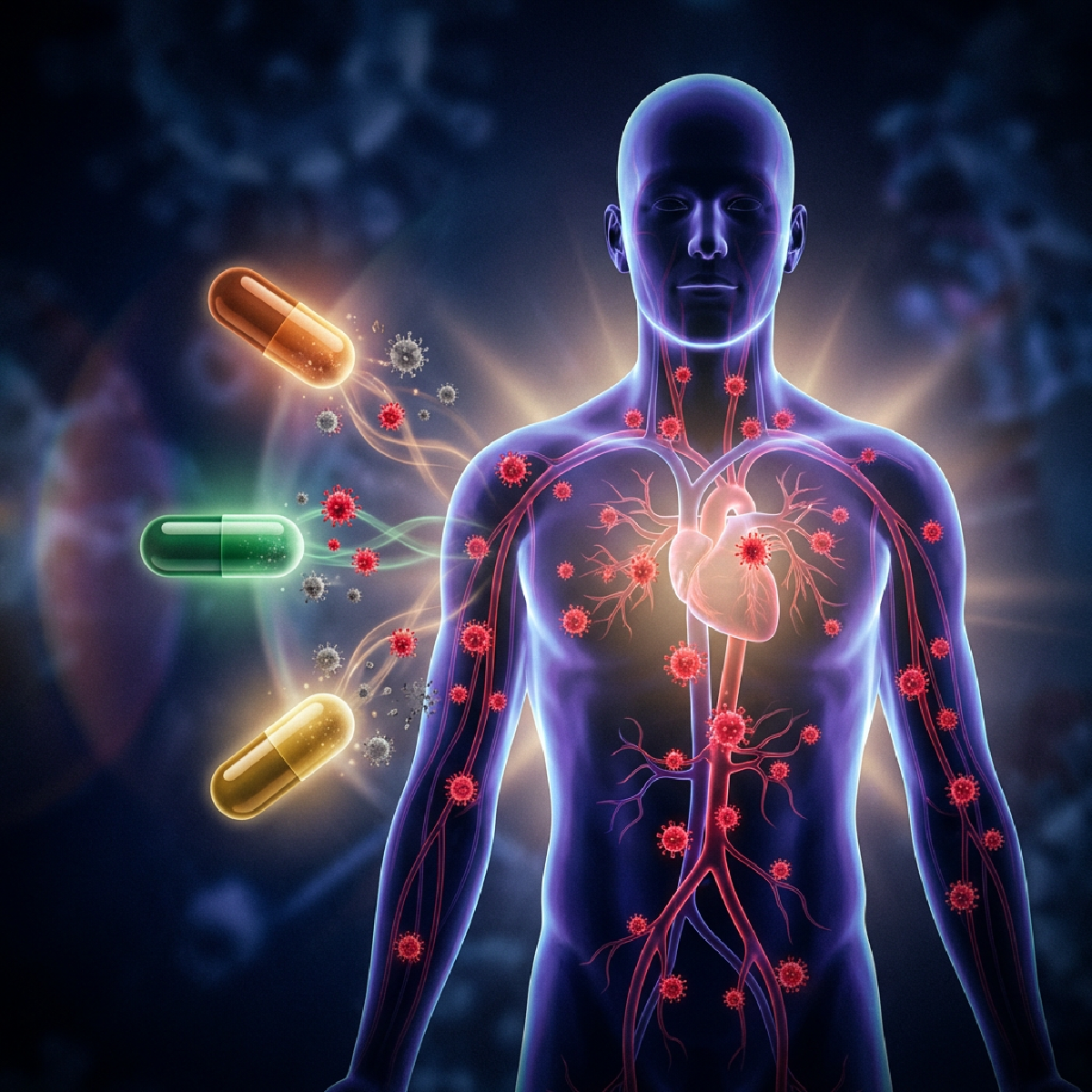
You got vaccinated. Or you had COVID. Maybe both. Since then, something’s off — fatigue, brain fog, heart palpitations, pain that wasn’t there before. Your doctor finds nothing. Google doesn’t help. The media tells you it’s in your head.
It’s not in your head.
The spike protein — whether from the virus or the vaccine — can lodge in the body and trigger inflammation, microclots, and autoimmune reactions. This isn’t conspiracy theory, it’s published science [1][2].
This article is for people starting from zero. No prior knowledge needed. Every recommendation is sourced — and where the evidence is thin, I say so openly.
What the Spike Protein Does in the Body #
The spike protein is the surface protein of SARS-CoV-2. During infection, the virus produces it. With an mRNA vaccine, your own cells produce it. In both cases, it can:
- Bind to ACE2 receptors — found on heart, lungs, brain, blood vessels, kidneys [2]
- Trigger inflammation — chronic micro-inflammation that doesn’t show on standard CRP tests
- Form microclots — tiny blood clots that deprive organs of supply [3]
- Misdirect the immune system — autoimmune reactions, mast cell activation
The question is not whether, but how long and how much spike protein circulates in your body. Studies have detected spike protein months after vaccination and infection [1].
The Base Protocol: 3 Substances Everyone Should Know #
This protocol is based on the McCullough Base Spike Detoxification (BSD) protocol [1] and the FLCCC I-RECOVER protocol [4]. Both were developed by physicians who have treated thousands of post-COVID and post-vaccination patients.
Honesty About the Evidence #
I’ll say it directly: there are currently no completed clinical trials (RCTs) testing this combination in humans [1]. What exists:
- In vitro studies (lab): nattokinase demonstrably degrades spike protein [5]
- Mechanistic plausibility: the mechanisms of action are well understood pharmacologically
- Clinical experience: thousands of physicians worldwide use this protocol and report improvements
- Individual substance evidence: each substance has its own body of research
Official medicine says: “Not proven.” That’s true — in the RCT sense. But “not proven” is not the same as “disproven.” And when official medicine offers you nothing but “you’ll have to live with it,” a plausible protocol with a good safety profile is better than nothing.
Tier 1: The Basics (suitable for everyone) #
These are the three substances you should start with. All are available without prescription, all have a good safety profile, all have been established in natural medicine for decades.
Nattokinase — 2,000 FU, twice daily (on empty stomach) #
What it is: An enzyme from fermented soybeans (natto), used for centuries in Japan.
What it does: Proteolytically degrades spike protein. Dissolves fibrin (i.e., microclots). The Tanikawa study (2022) demonstrated that nattokinase destroys spike protein in a dose- and time-dependent manner [5].
Evidence: In vitro study (cell culture) with clear results [5]. Fibrinolytic effect in humans well documented [6]. No clinical spike detox studies in humans completed.
What to watch:
- Take on empty stomach (30 min before eating)
- DO NOT combine with blood thinners (warfarin, apixaban, rivaroxaban) without medical supervision!
- Minimum 2,000 FU per capsule (Fibrinolytic Units)
Bromelain — 500 mg, 1-2x daily (on empty stomach) #
What it is: An enzyme from the pineapple plant.
What it does: Cleaves disulfide bonds in spike protein (prevents docking to ACE2). Anti-inflammatory. Stabilizes mast cells [7][8].
Evidence: Anti-inflammatory effect in humans documented in multiple studies. Spike-related effect: in vitro and mechanistically plausible [7].
What to watch:
- Take on empty stomach
- Same blood thinner warning as nattokinase
- Good alternative or addition: Serrapeptase (120,000 SPU)
Curcumin (liposomal!) — 500 mg, once daily (with food) #
What it is: The active compound in turmeric.
What it does: Inhibits inflammatory cascades (NF-κB, IL-6). Protects the liver. Supports breakdown of spike fragments [9].
Evidence: Curcumin is one of the most studied natural substances in existence. Anti-inflammatory effect in humans extensively documented [9]. A clinical study on curcumin + boswellia for Long COVID was in planning as of November 2023 [1].
What to watch:
- Only liposomal or with piperine (BioPerine)! Standard turmeric has under 5% bioavailability
- Take with food (fat-soluble)
Tier 2: Additions (add after 2-4 weeks) #
NAC (N-Acetylcysteine) — 600-1,200 mg/day #
Builds glutathione — your strongest endogenous antioxidant. Breaks down mucus. Supports liver detoxification. NAC is an approved pharmaceutical (ACC) and has been clinically used for decades.
Quercetin — 500 mg/day (with food) #
Acts as a zinc ionophore (shuttles zinc into cells). Inhibits histamine (important for mast cell activation). Anti-inflammatory. Best taken with zinc (25-50 mg) [10].
Vitamin D3 — 5,000-10,000 IU/day + K2 (MK7) 200 µg #
Immune modulation. Current study (March 2026, Mass General Brigham): Vitamin D3 reduced Long COVID risk in a clinical study with 1,747 participants [11]. Taking Vitamin D without K2 is risky (calcium deposits) — always combine.
Vitamin C — 1,000-2,000 mg/day #
Antioxidant. Supports immune system and collagen formation. Liposomal for better absorption.
Tier 3: Advanced (discuss with physician) #
These substances have stronger effects but also more interaction potential.
Ivermectin — 0.2-0.4 mg/kg, short course (5 days) #
Prescription required. Anti-spike effect shown in multiple studies. Short courses, not long-term. Doctor must prescribe.
Hydroxychloroquine — 200 mg/day #
Prescription required. Autoimmune medication in use for 70 years (lupus, rheumatoid arthritis). Off-label for post-COVID.
Methylene Blue — 0.1%, 1-2 drops #
Mitochondria booster. Neuroprotective. DO NOT combine with SSRI antidepressants (serotonin syndrome!).
Binders: The Forgotten Puzzle Piece #
When you break down spike protein, you need to get the fragments out. Otherwise they keep circulating. For that you need a binder:
- Bentonite — 1 tsp in water (inexpensive, effective)
- Zeolite (clinoptilolite) — 3 g/day
- Activated charcoal — 1-2 g
- Modified Citrus Pectin — 5 g
IMPORTANT: Always take binders 2-3 hours apart from all other supplements and medications! Otherwise they bind your supplements instead of the toxins.
Timing: Morning enzymes (nattokinase, bromelain) → wait 3 hours → binder → then other supplements.
Sweating Is Mandatory, Not Optional #
McCullough explicitly emphasizes in his protocol: spike protein and mRNA remnants are excreted through the skin [1]. Without regular sweating, any supplement protocol is incomplete.
- Infrared sauna: 3-4x/week, 30-45 minutes (ideal)
- Exercise: Daily moderate — walking, cycling, whatever works
- Hot bath: If no sauna available
- Cold water after heat: Stimulates microcirculation
Start slowly. If you have post-COVID, too much exertion can worsen symptoms (PEM/crash). Listen to your body.
Measure, Don’t Guess #
Want to know if it’s working? Then measure. Before starting and after 3 months:
| Lab Value | What It Shows |
|---|---|
| Anti-spike antibodies (BAU) | Spike burden |
| D-dimers | Microclots |
| CRP / IL-6 | Systemic inflammation |
| Troponin | Heart involvement |
| NT-proBNP | Cardiac stress |
| Ferritin | Iron metabolism / inflammation |
| Complete blood count | Overall picture |
| Vitamin D (25-OH) | Level (target: > 60 ng/mL) |
Most doctors will tell you it’s unnecessary. Say: “I’ll pay myself.” A complete panel costs approximately €150-250 as a self-pay patient. It’s one of the best investments in your health.
Daily Plan for Beginners #
Here’s what a typical day looks like:
Morning (fasting, 30 min before breakfast):
- Nattokinase 2,000 FU
- Bromelain 500 mg
- NAC 600 mg
Mid-morning (~3h after enzymes):
- Bentonite 1 tsp in large glass of water
Lunch (with food):
- Curcumin liposomal 500 mg
- Quercetin 500 mg + Zinc 25 mg
- Vitamin D3 5,000 IU + K2 200 µg
- Vitamin C 1,000 mg
Afternoon:
- Nattokinase 2,000 FU (2nd dose, fasting or 2h after eating)
Exercise/Sauna — sometime during the day, the point is to sweat.
Costs: What to Expect #
The base protocol (Tier 1 + 2) costs approximately €60-100 per month. That’s not luxury — it’s a conscious decision for your health. For comparison: a post-COVID rehabilitation costs insurance €5,000-8,000 and often has no measurable effect.
| Supplement | Monthly Cost (approx.) |
|---|---|
| Nattokinase | €15-25 |
| Bromelain | €10-15 |
| Curcumin liposomal | €15-25 |
| NAC | €8-12 |
| Quercetin + Zinc | €10-15 |
| Vitamin D3 + K2 | €5-10 |
| Vitamin C | €5-8 |
| Bentonite | €5-8 |
Interactions and Warnings #
🔴 Blood thinners (warfarin, apixaban, rivaroxaban, aspirin): Nattokinase and bromelain increase bleeding tendency. Only under medical supervision!
🔴 SSRI antidepressants (sertraline, citalopram, fluoxetine): Methylene blue is contraindicated — serotonin syndrome possible!
🔴 Thyroid medications (levothyroxine): Keep binders 4 hours apart.
🔴 Pregnancy/breastfeeding: No self-medication — ask your doctor.
🟡 Herxheimer reaction: It may get worse before it gets better in the first days. This is a sign that the body is mobilizing toxins. Increase binders, drink water, slow down.
What the Fact-Checkers Say — and What They Leave Out #
If you Google “nattokinase spike protein,” you’ll find fact-checks from AFP, Reuters and others labeling everything as “debunked” within seconds. Let’s look at what they say — and what they conceal.
“The study was only in vitro” #
Correct. Tanikawa et al. (2022) is a cell culture study [5]. But what’s concealed: in vitro is the first step in every drug development process. Aspirin, penicillin, every medication you know was once “only in vitro.” And there’s no study showing it doesn’t work in humans — nobody has paid for that study. A patent-free enzyme from soybeans is economically uninteresting for pharma.
“Spike protein is degraded within days” (CDC, Health Canada) #
This is what authorities have claimed since 2021. But:
- Röltgen et al. (2022, Cell): Spike protein detected in lymph nodes 60 days after vaccination [12]
- Brogna et al. (2023, Proteomics Clin Appl): Spike protein in blood up to 6 months after vaccination [13]
- Patterson et al. (2022): Spike protein in monocytes up to 15 months after infection [14]
The CDC statement is based on assumptions from the early phase — not on long-term measurements. It has been contradicted by at least three independent studies.
“Vaccines are safe and effective” #
Germany’s Federal Court of Justice ruled on March 9, 2026 (Case VI ZR 335/24): EU approval does not protect the manufacturer from liability. And the Paul Ehrlich Institute informed the Health Ministry on July 21, 2021, that it could not assess vaccine safety with German data — because §13 Para. 5 of the Infection Protection Act was never implemented [15]. “Safe” based on which data exactly?
“No need for detox” #
That’s easy to say when you have no therapy to offer. Official medicine currently has no causal treatment for post-COVID and post-vaccination patients. “You’ll have to live with it” is not therapy. A plausible protocol with a safety profile known for decades is better than nothing.
“5.5 billion vaccinated, 3 million deaths prevented” #
Model calculation by the Commonwealth Fund (2022). No measured data. No functioning safety monitoring. Tom Lausen demonstrated via Freedom of Information requests that the legally mandated data pathways for drug safety were never established [15].
When fact-checkers write “debunked,” they mean: “Not proven by RCTs.” That’s correct. But “not proven” is not “disproven.” And when the only alternative is doing nothing, an evidence-informed protocol with a good safety profile is the rational decision.
Conclusion #
This protocol is not a miracle cure. There are no guarantees. But it’s based on the best available knowledge from physicians who have been working on spike protein pathology since 2021 — while the rest of medicine is still debating whether the problem even exists.
Start with Tier 1. Measure your values. Sweat. Drink water. Give your body time.
And if someone tells you your symptoms are imaginary: they’re not. The science is on your side — even if politics won’t admit it yet.
Sources #
[1] McCullough PA et al. (2023): Clinical Approach to Post-acute Sequelae After COVID-19 Infection and Vaccination. Cureus. PMC10663976
[2] Yuki K et al. (2020): COVID-19 pathophysiology: A review. Clin Immunol. PMC7169933
[3] Pretorius E et al. (2021): Persistent clotting protein pathology in Long COVID/Post-Acute Sequelae of COVID-19. Cardiovasc Diabetol. PMC8389078
[4] FLCCC Alliance: I-RECOVER Post-Vaccine Treatment Protocol. imahealth.org
[5] Tanikawa T et al. (2022): Degradative Effect of Nattokinase on Spike Protein of SARS-CoV-2. Molecules. PMC9458005
[6] Weng Y et al. (2017): Nattokinase: An Oral Antithrombotic Agent. Clin Drug Investig. PMID: 28600386
[7] Rathnavelu V et al. (2016): Potential role of bromelain in clinical and therapeutic applications. Biomed Rep. PMC5028366
[8] Akhter J et al. (2020): The combination of bromelain and curcumin as an immune-boosting nutraceutical. Clin Exp Pharmacol Physiol. PMC7661945
[9] Hewlings SJ, Kalman DS (2017): Curcumin: A Review of Its Effects on Human Health. Foods. PMC5664031
[10] Dabbagh-Bazarbachi H et al. (2014): Zinc ionophore activity of quercetin and epigallocatechin-gallate. J Agric Food Chem. PMID: 25050823
[11] Mass General Brigham (March 2026): Vitamin D3 and Long COVID risk reduction. Clinical study with 1,747 participants. ScienceDaily
[12] Röltgen K et al. (2022): Immune imprinting, breadth of variant recognition, and germinal center response in human SARS-CoV-2 infection and vaccination. Cell. DOI: 10.1016/j.cell.2022.01.018
[13] Brogna C et al. (2023): Detection of recombinant Spike protein in the blood of individuals vaccinated against SARS-CoV-2. Proteomics Clin Appl. PMID: 37650258
[14] Patterson BK et al. (2022): Persistence of SARS CoV-2 S1 Protein in CD16+ Monocytes in Post-Acute Sequelae of COVID-19. Front Immunol. PMC8940706
[15] Lausen T: FragDenStaat request on data flows §13 Para. 5 IfSG. fragdenstaat.de
This article is not medical advice. It summarizes published research and clinical protocols. Always discuss medication changes with a physician — ideally one who takes post-COVID and vaccine injuries seriously.