Methodological note. This text is based on primary Bundestag documents (Drucksachen), the foundation register, the AAS website, and publicly available material on the founder’s Stasi-IM past. Where amounts are only secondary-sourced, this is marked. The foundation does work against right-wing extremism that addresses an unquestionable societal need. The point here is not to deny it its legitimacy — it is to show what the foundation systematically does not show when presenting itself as a “civil society” actor.
The Amadeu Antonio Foundation (AAS) is not a civil-society initiative. It is a node in a web of federal grants, politically aligned oversight, a founder with a documented Stasi-IM past, an active head of domestic intelligence on the supervisory board, and a revolving door leading directly from the funding ministry into the recipient foundation’s oversight body. The funding pillars are over 60 percent state-financed. The self-description as “civil-society-borne” does not match the numbers.
This text puts the pieces together.
1. The money pillars — €4M from federal sources alone in 2024#
In response to a written question from AfD MP Birgit Bessin, Parliamentary State Secretary Michael Brand replied on 4 November 2025 (Drucksache 21/2665, Question 109) [1]:
“The Amadeu Antonio Foundation received in fiscal year 2024 from the then-Federal Ministry of the Interior and Community €1,095,898.13, from the then-Federal Ministry of Education and Research €634,085.00, and from the then-Federal Ministry for Family Affairs €1,224,833.62 in financial grants. The Federal Government Commissioner for Migration, Refugees and Integration, who is also the Commissioner against Racism, supported the project work of the Amadeu Antonio Foundation in fiscal year 2024 to the amount of approximately €1,067,000.00.”
Total — from these four federal sources alone, in 2024 alone: €4,021,816.75.
| Source | Ministry | 2024 amount |
|---|---|---|
| BMI | Federal Ministry of Interior | €1,095,898.13 |
| BMBF | Federal Ministry of Education & Research | €634,085.00 |
| BMFSFJ | Federal Ministry for Family Affairs | €1,224,833.62 |
| Anti-Racism Commissioner (Alabali-Radovan) | Federal Government | ~€1,067,000.00 |
| Total federal 2024 | €4,021,816.75 |
State (Land), EU and municipal funding come on top — these were not asked in the Bessin question. Tichys Einblick estimates the 2024 total from federal plus state sources at roughly €7.35M [2] — a secondary figure, no primary Drucksachen-evidence.
Follow-up Drucksache 21/3498 by MPs Bessin et al. of 6 January 2026 [3] now asks for the complete breakdown since 2015 — federal, state, EU, categorised by personnel costs, advertising, events, material costs. The Federal Government’s reply was not yet available as of 23 April 2026.
The “Demokratie leben!” line#
From AfD inquiry Drucksache 20/5213 of 17 January 2023 [4]: AAS received from the BMFSFJ programme “Demokratie leben!” between 2020 and 2022 alone €1,239,884.30 (calculation by the questioners based on the public project database). “Demokratie leben!” has been for years the central federal funding line for anti-right work, and BMFSFJ is the AAS’s primary contact ministry.
The donation reality#
The AAS presents itself on its website as “borne by civil society”. The numbers from its own 2022 activity report tell a different story [5]:
- Annual budget 2022: €8,239,654
- Of which donations 2022: “well over €1.8M” (AAS own statement) — i.e. roughly 22 % of the annual budget
- Staff: 142
The Wikipedia analysis of 2023 annual financial statements shows the distribution even more clearly [6]:
- Total income 2023: €9.645M
- Of which state subsidies: €6.055M (= 62.8 %)
- Of which donations: €2.508M (= 26.0 %)
- Of which private foundations / institutions: €0.902M (= 9.4 %)
The arithmetic reality: The foundation is majority state-financed. The self-description as a “civil society” actor is linguistically not wrong (private legal entity), but economically misleading.
Private foundations and special relationships#
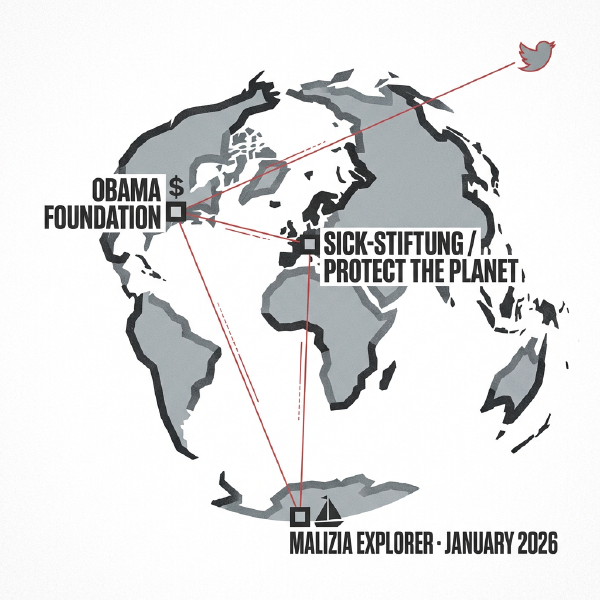
- Open Society Foundations (Soros): Joint initiative “Strengthening engagement! East Germany for democratic culture” 2020–2021, 8 funded projects per the AAS 2022 activity report [5]. Specific OSF grant amount directly to AAS: not primary-verified; secondary sources name roughly €500,000 for the joint initiative.
- Freudenberg Foundation: Supporter “since the foundation’s founding” (AAS partner page). 2022 activity report: co-financed “as part of an institutional grant”. Structurally deeply embedded — under AAS statute § 12(3), the Freudenberg Foundation is the dissolution beneficiary: should the AAS one day be dissolved, the assets flow to Freudenberg [7].
- Demokratie-Stiftung Campact: Listed in the 2024 lobby register as a “private donation” donor to AAS at €570,001–580,000 — at the same time recipient of joint campaign funds with AAS (e.g. state-election fund Saxony/Brandenburg/Thuringia 2019).
- gut.org gAG (Betterplace): €840,001–850,000 (lobby register 2024).
- Stern (magazine): “Over €1.3M since 2007” per the AAS partner list — a foundation-magazine direct-funding relationship that is unusual in German media space.
- Dreilinden gGmbH: funded the build-up of antifeminism monitoring (2022 activity report).
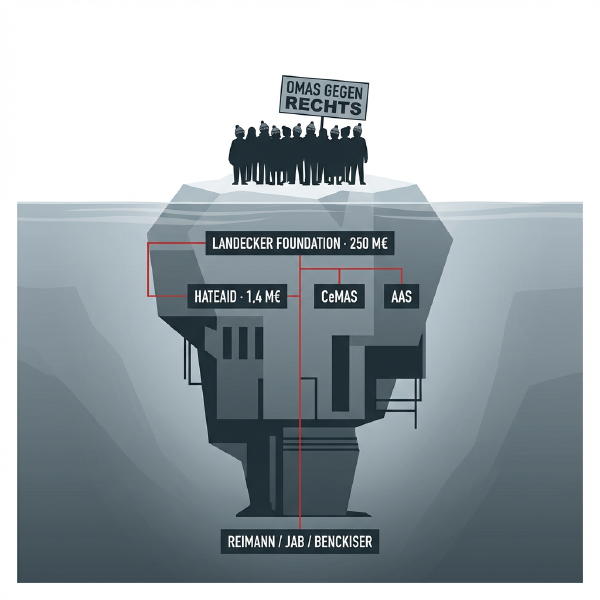
- Alfred-Landecker Foundation: IDZ project funding. Background that must not be glossed over here: the foundation was set up in June 2019 by the Reimann industrialist dynasty (JAB Holding — Coty, Krispy Kreme, Pret a Manger, Calgon, Persil) — immediately after the Bild am Sonntag exposé of March 2019, which showed that the firm’s patriarchs Albert Reimann Sr. and Jr. were NSDAP members and SS donors from 1931 onwards, and that female forced labourers in their Ludwigshafen plants were physically and sexually abused [14][15]. The foundation is named after Alfred Landecker, a Jewish business partner of the Reimanns who was murdered in the Holocaust. It is endowed with €25 million per year from Reimann assets and finances Holocaust education and “promoting democracy”. The structural displacement is striking: heirs of Nazi profiteers, via grants to the AAS-IDZ, today help define what counts as “right-wing” — and use the same money to buy themselves moral cleanliness against their own family past.
Platform cooperations#
- Facebook/Meta: since 2015 part of the “Task Force against Hate Content” of then-Federal Justice Minister Maas; from 2016 partner of the Facebook initiative “Online Civil Courage Initiative”. Specific compensation not public.
- AAS project “debate//de:hate”: consulting for platforms + hate-speech monitoring. Interface to HateAid (see below).
2. Anetta Kahane: IM “Victoria”#
The AAS founder and long-serving chair Anetta Kahane was demonstrably an Inoffizielle Mitarbeiterin (IM, “unofficial collaborator”) of the East German Ministry of State Security (Stasi). The files are publicly accessible at the Stasi Records Archive (formerly BStU, since 2021 part of the Federal Archives) [8].
Key facts of the IM activity (source: BStU files AIM 613/82, documented among others by Hubertus Knabe, former director of the Hohenschönhausen Memorial):
- Codename: “Victoria”
- Recruitment date: June 1974, Kahane was 19 years old
- Recruiting officer: Heinz Mölneck, Stasi District Office Frankfurt (Oder), Department II/3
- Recruitment basis: “on a political-ideological basis”, without coercion or compromising material (per Stasi expert Helmut Müller-Enbergs)
- Termination: March 1982 by Kahane herself
- File volume: approx. 800 pages, of which approx. 400 pages released by BStU for research
- Number of reports: over 70 meeting reports and written communications
- Report contents: diplomats from various nations (e.g. a three-page report on the Peruvian ambassador, September 1976), Chilean emigrants, West Berlin journalists, GDR citizens with “hostile attitudes”, private details from weddings and parties, information for potential further Stasi recruitments
Verbatim from the handwritten commitment statement [8]:
“I declare myself willing to cooperate voluntarily with the Ministry of State Security. I undertake to speak to no one about this connection. For security reasons I choose the codename Victoria.”
Material privileges: coffee, schnapps, cigarettes, cake at meetings; a gold pen as a gift; a 200-mark bonus. In 1978 confirmation as a “travel cadre” — which enabled her to work abroad as an interpreter.
Kahane’s own position#
Kahane denies that her reports caused harm. Her lawyer stated after a Focus report by Hubertus Knabe in December 2016 that she had “repeatedly pointed to the IM activity before 2002” [9]. In her own self-presentation she emphasises the “voluntariness” of the cooperation and partly portrays herself as a young idealist whose reports had no significant consequences.
Kahane has taken legal action against critical reporting on the IM activity — among others in 2017 before the Hamburg Regional Court (Az. 324 O 217/17). The AAS has presented the Müller-Enbergs report as an “independent expert opinion”, which is problematic insofar as the report was commissioned by Kahane herself and was provided with selective archive excerpts. The anonymisation requirements of the Federal Archives prevent independent verification of whether those reported on by Kahane subsequently suffered no disadvantage.
Current status#
Kahane resigned as chair of the board on 1 April 2022 after almost 25 years. She remains connected to the foundation “as founder and publicist”, without formal office [10]. The transition was communicated by the foundation as a “generational change”; in media perception it was also seen as a response to the ongoing debate about the IM past.
3. The supervisory board — who decides#
The supervisory board (Stiftungsrat) is the AAS’s top oversight body. Current members (per AAS website, 2026) [11]:
| Name | Main function | Notable |
|---|---|---|
| Christine Hohmann-Dennhardt | Chair; former Federal Constitutional Court justice, then Daimler AG | high-level legal-corporate connection |
| Beate Küpper | Deputy chair; professor of social work | academic representation |
| Ralf Kleindiek | Lawyer; State Secretary BMFSFJ 2014–2018 | revolving door: was in charge of the Demokratie-leben! programme that funds AAS |
| Stephan J. Kramer | President of the Thuringian State Office for the Protection of the Constitution since 2015 | active head of domestic intelligence on the oversight body of a state-financed foundation |
| Sergey Lagodinsky | Member of the European Parliament (Bündnis 90/Die Grünen) | active EU parliamentarian for one party on the board |
| Uta Leichsenring | former director of the Stasi Records Office Halle, former police director | GDR reckoning background |
| Sabine Leutheusser-Schnarrenberger | Lawyer; twice Federal Minister of Justice (FDP); Antisemitism Commissioner NRW 2018–2024 | cross-partisan embedding |
| Shahrzad Eden Osterer | journalist/presenter Bavarian Broadcasting | public-broadcasting representation |
| Patrice G. Poutrus | contemporary historian, migration research | academic embedding |
Two structurally explosive memberships#
Stephan J. Kramer has been since 2015 the President of the Thuringian State Office for the Protection of the Constitution (Verfassungsschutz Thüringen) — an active head of domestic intelligence sits on the oversight body of a foundation receiving millions in state funding, which itself runs hate-speech monitoring, an “Antifeminism Reporting Office” and Belltower.News as a watchdog magazine. This is not informal cooperation as in the Correctiv-BfV conference of 2023 — it is the personnel fusion of intelligence service and “civil society” in a single body. Kramer himself has rejected the accusation of institutional cooperation [12]; the structural fact remains.
Ralf Kleindiek was State Secretary in the Federal Family Ministry 2014–2018 — the exact period in which “Demokratie leben!” was built up and consolidated as the central funding instrument for anti-right work. He now sits on the supervisory board of the main recipient of that programme. This is the classic revolving door: from grantor into the recipient’s oversight body. A comparable constellation in the construction industry would not be compliance-permissible.
4. Operational subsidiary structures#
The AAS is not one foundation but a federation of initiatives and subsidiaries, each tapping its own funding streams:
- Belltower.News — the AAS online magazine (formerly “Netz gegen Nazis”, 2007–2014 in cooperation with Die Zeit Online). Reports as a “watchdog” on right-wing extremism, financed from the same pots as the parent foundation. Editorial lead Simone Rafael.
- debate//de:hate — consulting for platforms + hate-speech monitoring. Interface to Meta/Facebook and HateAid.
- Antifeminism Reporting Office — launched in 2023, joint project with federal funding (“Demokratie leben!”). 2023 controversy: reports also include statements that are not legally criminal — i.e. an opinion register in private hands with state co-financing.
- Institute for Democracy and Civil Society (IDZ) — AAS research institute in Jena, co-financed by the Federation, the State of Thuringia and the City of Jena.
- CURA — victims’ fund for those affected by right-wing violence. 271 cases handled in 2022 per the activity report.
- Good Gaming — Well Played Democracy — educational project for the gaming community. Came into a Bundestag inquiry in 2023 (Drucksache 20/5213) over a staff member with a documented Austrian regional-court ruling on left-wing extremism categorisation.
- Civic.net / civic.academy — education and networking platform.
Network nodes to other NGOs#
The AAS does not operate alone — it is part of a federation. Operational alliances include:
- HateAid (gGmbH) — the AAS was substantially involved in HateAid’s founding in 2018; HateAid CEO Anna-Lena von Hodenberg comes from the AAS environment. See HateAid-Campact pipeline.
- CeMAS — Center for Monitoring, Analysis and Strategy — closely interlinked research spin-off, CEO Josef Holnburger. Personnel overlaps.
- Correctiv — shared topic fields, shared funding lines (BKM, BMFSFJ). See Correctiv structural analysis.
- Neue Deutsche Medienmacher — similar BMFSFJ funding-line recipient, shared campaign logic.
- Society for Civil Rights (GFF) — strategic litigation, parallel funding landscape.
What emerges in sum is a well-rehearsed anti-right platform that operates in coordination and is at the same time multiply publicly funded — each organisation presents itself as independent, while the overall system moves in concert through campaign seasons.
5. The Drucksachen pattern: the Bundestag asks, the government dodges#
AAS funding is regularly the subject of parliamentary inquiries — almost exclusively from the AfD. A selection:
- Drucksache 20/5213 (17 Jan 2023): “Allegedly left-extreme staff member of the Amadeu Antonio Foundation” — questioners Schmidt, Reichardt, Ehrhorn, Janich (AfD). 22 questions on the Good Gaming staffer and on AAS funding 2020–2022. [4]
- Drucksache 21/2665, Written Question 109 (4 Nov 2025): Bessin (AfD) asks about federal grants in 2024. Brand reply: €4,021,816.75 from four federal sources (see Section 1). [1]
- Drucksache 21/2709 (11 Nov 2025): Motion of the AfD parliamentary group “End the state financing of the Amadeu Antonio Foundation from federal funds”. Demand to cut all federal funding from fiscal year 2026, independent audit and possibly clawback [13].
- Drucksache 21/3498 (6 Jan 2026): Bessin et al. (AfD) — “Financing of the Amadeu Antonio Foundation through federal funds”. Demands a complete breakdown since 2015 by federal/state/EU and by personnel costs/advertising/events/material costs. The Federal Government’s reply was not yet available as of 23 April 2026. [3]
What emerges is a familiar pattern: the only Bundestag faction systematically scrutinising these funding relationships is the AfD. The other factions (CDU/CSU, SPD, Greens, FDP, Left) do not ask. That does not change the substance — the numbers are the numbers regardless of who asks — but it makes parliamentary oversight of the civil-society funding landscape structurally asymmetric. Anyone unwilling to take a public position that overlaps with AfD inquiry material does not ask. That weakens the parliamentary oversight function across all factions.
6. Controversies — a short chronicle#
- 2017: Lawsuit against Hubertus Knabe’s IM reporting (LG Hamburg, Az. 324 O 217/17).
- 2021 scandal over reports to employers: allegations that AAS-related initiatives put critical voices under pressure by reporting them to their employers. Publicly discussed in Welt, NZZ, Cicero.
- Maaßen conflict: Hans-Georg Maaßen (former BfV president) as a prominent AAS critic — mutual legal disputes; the Cologne Administrative Court proceedings concern Maaßen’s classification by domestic intelligence, not a direct AAS lawsuit.
- Antifeminism Reporting Office controversy 2023: criticism from comment columns and the Linkspartei Bundestag faction over the recording of non-criminal statements.
- April 2026 — pornography controversy: discussion over content of an AAS-related publication; not deepened in this analysis.
- Apollo News leaflet controversy 2025: an AAS event was advertised with a Linkspartei leaflet that called for “stepping on the keys” of Apollo News and named the editorial address. A Belltower journalist took part in the panel discussion thus advertised. The AAS defended the wording as a “metaphor”. This episode is referenced in the preliminary remarks of Drucksache 21/3498 [3].
A complete controversies chronicle would be its own article. The point here: the AAS works in a highly politicised field in which its own methods regularly come under criticism — and in which the foundation itself takes legal action against critics.
7. The total picture — structural analysis#
What comes together is not a single scandal. It is a structural picture with five pillars:
The financial pillar: federal funding alone in 2024 of around €4M. Over 60 % of the annual budget state-financed. “Borne by civil society” is a self-description that does not match the cash-flow reality. Add private foundation money with a clearly progressive-activist orientation (OSF, Freudenberg, Stern direct-financing) and platform cooperations (Meta since 2015).
The personnel pillar: the supervisory board includes an active head of domestic intelligence (Kramer/Thuringia), a former funding state secretary (Kleindiek/BMFSFJ revolving door), and an active member of the European Parliament for Bündnis 90/Die Grünen (Lagodinsky). A plural, cross-partisan oversight exists formally with Leutheusser-Schnarrenberger (FDP) — but the overall profile is clearly progressive-state-aligned.
The historical pillar: the founder and long-time chair was for over eight years an IM of the Ministry of State Security — codename “Victoria”, over 70 reports, 800 pages of file. The structural question is not moral (people can change) — it is one of separation of powers: a foundation whose programme in part involves combating constitutionally hostile currents, accompanied on its supervisory body by domestic intelligence, was founded by a person who delivered reports for years to another domestic intelligence service. This symmetry calls for an explanation — one the AAS has never publicly spelled out.
The operational pillar: Belltower.News, debate//de:hate, Antifeminism Reporting Office, IDZ Jena, Good Gaming, CURA — an architecture of subsidiaries, each tapping its own funding streams and together forming a coordinated anti-right apparatus. Plus close alliances with HateAid, CeMAS, Correctiv, Neue Deutsche Medienmacher, GFF.
The parliamentary pillar: the only faction systematically scrutinising this structure is the AfD. Drucksachen 20/5213, 21/2665, 21/2709, 21/3498. The other factions do not ask — which structurally weakens the parliamentary oversight function, regardless of whether the government’s answers would be politically convenient or not.
What emerges in sum is not the independent civil-society watchdog the foundation presents itself as. It is a public-state-private anti-right infrastructure in which federal grants, domestic intelligence representation, politically aligned oversight and platform cooperations merge into a single node. The individual building blocks are each legal and partly transparently documented. The sum is not.
8. What the structural picture means#
A foundation that is majority-financed from the federal budget, whose supervisory board includes an active head of domestic intelligence, whose founder spent eight years delivering reports to another domestic intelligence service, whose former funding-ministry state secretary now oversees the disbursement of those same funds — such a construction is not civil society. It is a long arm of state programme policy in a private-law overcoat. What others used to openly call “popular education” runs here under the friendlier label of “promoting democracy”.
This is not a question of self-presentation. It is a question of separation of powers. A democracy that wants to define what counts as “extreme”, what counts as publicly acceptable opinion, which platforms should delete which content — and which organises that definitional power through a state-financed foundation that formally does not belong to the state but would not exist without it — gets the worst of both worlds: the indirectness that obscures accountability, and the funding power that shapes civil society rather than representing it.
A real civil society can say: “We will not accept this funding if the conditions are problematic.” A foundation 60–80 percent state-financed structurally cannot. Anyone who cannot decline the money without ending their own existence is not independent. Period.
The staff knows what they do#
A reflexive defensive line in such analyses goes: “But the staff there are motivated and believe in the cause.” With a foundation whose founder spent eight years delivering meeting reports on diplomats, emigrants and journalists to the Stasi, and which today handles that past in public as if it were an overcome youthful indiscretion, that defensive line no longer holds. The IM file “Victoria” is no secret. The funding figures are in Bundestag documents. Stephan Kramer’s dual role as an active head of domestic intelligence on the supervisory board is on the foundation’s own website. The Kleindiek-BMFSFJ-supervisory board revolving door is trivially verifiable. Anyone working at the AAS in 2026 has this material at their fingertips. Anyone who works there nonetheless has chosen this construction — out of career pragmatism, ideological agreement, or both.
That is not a moral judgment. It is the sober observation that the usual exculpatory narrative (“they are just engaged people who want to do good, they don’t know”) no longer works for this foundation given this history and this oversight apparatus. The staff knows. They do it anyway. Which makes them part of the structure, not its unwitting tools.
The Belltower investigations, the CURA fund, the IDZ Jena#
The individual AAS programmes can hold up substantively. But they hold up as what they structurally are: output of a public-state-private anti-right authority in NGO clothing, not as an independent voice from the middle of an organised citizenry. Anyone who reads the publications without knowing this structural situation reads them wrong — they read them as the apparatus presents itself, not as what it is.
The silence-discipline of the established factions#
The parliamentary silence-discipline of CDU/CSU, SPD, Greens, FDP and the Left is not embarrassment, not oversight, not “the other factions just have other priorities”. It is function: all five benefit — politically, party-aligned, ideologically or personally — from a funding landscape in which anti-right work becomes a permanently state-co-financed task whose recipients do not turn against the hand that feeds them. One million euros per year from the BMFSFJ is one million euros of loyalty that does not end up in the wrong press releases. That this construction is exclusively scrutinised by an opposition faction whose content and style one for good reasons does not want in one’s own balance sheet is not evidence of the construction’s correctness — it is evidence of how effectively it is organised.
The displacement dynamic: heirs of Nazi profiteers help define what counts as “right-wing” today#
Whoever co-funds, co-defines. When the Reimann family — whose Nazi-era past became public only in 2019 under media pressure — channels €25 million per year through the Alfred-Landecker Foundation into “democracy and Holocaust education”, and thereby co-finances among other things the AAS research institute IDZ Jena, that is more than a belated reckoning. It is a role in the definitional power over today’s political right. Who is marked as “right”, who is classified as “extreme”, which movements get observation projects and which do not — structures whose historical origin lies in profiting from the Nazi dictatorship co-shape these definitions. The moral bonus that Nazi-era reckoning grants flows directly into the evaluation of present political currents. This displacement happens without evidence, without public debate, without mandate — simply because the money is there and because nobody asks where it comes from and what it buys.
This construction bypasses the population#
There is no democratic mandate path in which the population would have agreed to a state-co-financed anti-right foundation with Nazi-profiteer heirs as principal private financiers. There was no election campaign in which it was on the ballot. There is no popular vote that could have rejected it. What there is, are federal governments handing tasks they themselves — for reasons of party-political neutrality (Art. 5 of the Basic Law) — may not perform directly, to private foundations, with money that comes from the federal budget, that is, from tax money paid by the same population that was never asked. The mechanism is formally called “promoting civil society”. It functions in practice as the outsourcing of state programme policy into a private-law overcoat that bypasses democratic control and turns the population into the financier of a definitional power in whose exercise it has no part.
GONGO#
The question is not whether the Amadeu Antonio Foundation does “good” or “bad” work. The question is whether what it does should be a task of “civil society” or a task of the state. If the latter, it belongs transparently in the bureaucratic structure, with democratic control, parliamentary oversight and judicial reviewability. If the former, it does not belong 60 percent state-financed. Both at once — bureaucratic function plus NGO clothing — is the structure described in this analysis. It is not civil society. It is the German variant of what other countries openly call GONGO: Government-Organised Non-Governmental Organisation — a state-organised non-governmental organisation, that is, a contradiction in terms whose justification consists in fulfilling a function that the state itself cannot directly perform but would like to see performed indirectly.
The term exists because the phenomenon exists. Looking at the AAS is looking at its German prototype. Whoever describes the apparatus as “civil society” describes it as what it explicitly is not. Whoever works there knows that. Whoever finances the material this way knows it too. Only the public, in whose name the whole thing happens, is not supposed to know it precisely. That is precisely what structural analyses like this one exist for.
Sources#
[1] Bundestag Drucksache 21/2665 (4 Nov 2025): Written questions, reply of Parliamentary State Secretary Michael Brand to Written Question 109 of MP Birgit Bessin (AfD). dserver.bundestag.de/btd/21/026/2102665.pdf, page 70.
[2] Tichys Einblick (2025/2026): several articles on the AAS total funding from federal plus state sources. Secondary source, primary per-item evidence pending.
[3] Bundestag Drucksache 21/3498 (6 Jan 2026): Minor Inquiry of MPs Birgit Bessin et al. (AfD) — “Financing of the Amadeu Antonio Foundation through federal funds”. dserver.bundestag.de/btd/21/034/2103498.pdf
[4] Bundestag Drucksache 20/5213 (17 Jan 2023): Minor AfD inquiry — “Allegedly left-extreme staff member of the Amadeu Antonio Foundation”. dserver.bundestag.de/btd/20/052/2005213.pdf
[5] Amadeu Antonio Stiftung: Activity report 2022. amadeu-antonio-stiftung.de
[6] Wikipedia: Amadeu Antonio Stiftung — financing 2023 (source: AAS annual financial statements 2023). de.wikipedia.org/wiki/Amadeu_Antonio_Stiftung
[7] Amadeu Antonio Stiftung: statute § 12(3) — dissolution beneficiary Freudenberg Stiftung. (Berlin foundation register)
[8] Stasi Records Archive (Federal Archives): file AIM 613/82 on Anetta Kahane, codename “Victoria”. bundesarchiv.de/stasi-unterlagen-archiv — research access available. Summary documentation: hubertus-knabe.de/der-fall-kahane
[9] Focus magazine (December 2016): Hubertus Knabe — “Stasi-IM as internet snitch?” — and subsequent legal disputes.
[10] Amadeu Antonio Stiftung (1 Apr 2022): “Amadeu Antonio Foundation with a New Board — Anetta Kahane resigns as Chair”. amadeu-antonio-stiftung.de
[11] Amadeu Antonio Stiftung: Foundation governance. amadeu-antonio-stiftung.de/ueber-uns/gremien
[12] Neues Deutschland (2017): “Per Du mit den Schlapphüten” — on Kramer’s dual role. nd-aktuell.de
[13] Bundestag Drucksache 21/2709 (11 Nov 2025): Motion of the AfD parliamentary group — “End state financing of the Amadeu Antonio Foundation from federal funds”. dserver.bundestag.de/btd/21/027/2102709.pdf
[14] Bild am Sonntag (24 Mar 2019) and follow-up reporting by Handelsblatt (24 Mar 2019): “Reimann family said to have abused forced labourers during the Nazi era.” Albert Reimann Sr. and Jr. NSDAP members, SS donors from 1931, documented physical and sexual violence against female forced labourers in the Ludwigshafen plants. handelsblatt.com
[15] Handelsblatt (December 2019): “Nazi-era reckoning: Reimann family pays 10 million euros for former forced labourers.” Founding of the Alfred-Landecker Foundation in June 2019, foundation endowment €25 million per year from the Reimann family fortune. handelsblatt.com
Read more — the Media Criticism series on elizaonsteroids.org#
- Part 4: Correctiv: Money, Boards, Secrets — A Structural Analysis
- Part 3: Eight Days in January: How the Farmers’ Protests Became the “Secret Plan”
- Part 2: The Reporter, the Awards, the Money: What’s Behind the Correctiv Investigation
- Part 1: Three Sentences, Two Courts, No Final Judgment: What the Correctiv Rulings Actually Say
Related money-flow investigations:
- Follow the Money: Who Funds HateAid — and Why It Matters
- Antifa funding — by the state
- Network behind the deepfake law
Part 5 of the Media Criticism series. Research cut-off: 23 April 2026. Drucksachen 20/5213, 21/2665, 21/2709, 21/3498 are linked above; the verification of the funding amounts is reproducible.