Methodological note. This text describes a temporal correlation and places it within a pattern already documented multiple times on this blog: investigative publication + temporally aligned political or civil-society follow-up (see Fernandes-Ulmen campaign parallel to the deepfake law, Network behind the deepfake law, HateAid-Campact funding pipeline). Strict proof of deliberate orchestration in any single case is hard to obtain; the pattern that any single case fits into is not. Sources are fully linked at the end.
In the history of German federal politics, there are weeks in which the media’s center of gravity shifts entirely within a few days. The week from January 8 to 21, 2024, is one of them. It began with the largest mobilization of an occupational group in decades and ended with the largest domestic demonstration wave since Pegida — on a different topic.
This text places the two strands of events side by side. Not to insinuate that one “displaced” the other — that would be a causal claim for which there is no proof. But to ask a question that is, in fact, obvious: How quickly does attention shift, and how much of that shift is attributable to the introduction of a new topic by an investigative publication?
Strand 1: The Farmers’ Protests#
The trigger was the German government’s austerity package following the Karlsruhe budget ruling of November 15, 2023. The Federal Constitutional Court had declared the reallocation of 60 billion euros from COVID-era credit lines to the climate fund unconstitutional [1]. In the December 2023 budget, the government cut, among other things, the agricultural diesel rebate and the vehicle tax exemption for agricultural and forestry vehicles [2].
The reaction came quickly:
| Date | Event |
|---|---|
| 18.12.2023 | Convoy of tractors to Brandenburg Gate; several thousand vehicles, several thousand farmers [3] |
| 04.01.2024 | Government announces partial rollback: vehicle tax exemption stays; agricultural diesel cut spread over three years instead of immediate [4] |
| 08.–14.01.2024 | Nationwide week of action by the German Farmers’ Association; highway entrances blocked, city centers occupied with tractors [5] |
| 15.01.2024 | Major rally at Brandenburg Gate; about 30,000 participants and 6,000 tractors according to the Farmers’ Association; police accompanied the protest with 1,300 officers [6] |
| End of January 2024 | Bundestag hearings; protests gradually subside |
| Mid-February 2024 | Movement effectively over; isolated actions continue into spring |
The Tagesschau (German public broadcaster’s flagship news program) reported daily during the first two weeks of January. Coverage was largely respectful in tone and, with the characteristic tractor convoys, visually strong [7].
Strand 2: The Correctiv Investigation and the Anti-Right Demonstrations#
In parallel with the farmers’ protests, the investigative platform Correctiv — not a neutral fact-checking body, but an actor institutionally and financially interwoven with activist NGO infrastructure (see Part 2 of this series) — was working on an investigation into a meeting that had taken place on November 25, 2023 at the Landhaus Adlon by Lake Lehnitz near Potsdam. Publication followed on January 10, 2024, under the title “Secret Plan against Germany” [8].
| Date | Event |
|---|---|
| 25.11.2023 | Potsdam meeting with Sellner, Mörig, Vosgerau, Hartwig (then a Weidel adviser), Huy, Schröder and others (subsequently undisputed between the parties; see Part 1 of the series) |
| 10.01.2024 | Correctiv publication “Secret Plan against Germany” [8] |
| 12.01.2024 | First spontaneous demonstrations in several cities |
| 14.01.2024 | Berlin at the Bundestag: the venue was expanded mid-event due to the turnout, with up to 100,000 participants [9]; in parallel, a Potsdam rally with about 25,000 attended by Chancellor Scholz and Foreign Minister Baerbock [10] |
| 16.01.2024 | Cologne, Heumarkt: initially 30,000 (police), later corrected to about 40,000 [11] |
| 19.01.2024 | Hamburg: “Hamburg stands up”, relocated from the Town Hall Square to Jungfernstieg (due to the city’s exclusion-zone law); approximately 80,000 (police, after correcting the organizers’ figure of 130,000 downwards), with some sources citing up to 180,000 [12] |
| 21.01.2024 | Munich, Ludwig-/Leopoldstraße: police count more than 200,000, organizer (“München ist bunt”) says 320,000; demonstration ended early due to overcrowding [13] |
| February 2024 | The demonstration wave continues for another two to three weeks; by June 2024, more than three million participants at over 1,200 rallies — the largest demonstration series in the history of the Federal Republic [14] |
In the Tagesschau, broadcast lengths and image selection in the week after January 13 visibly shifted in favor of the “demonstrations against the right”. This is not journalistically unreasonable — a rapidly developing domestic mobilization has news value. It is at the same time exactly the mechanism that the Swiss journalist Kurt W. Zimmermann captured in his line: “Media-wise, misfortune comes alone.”
The Attention Curve#
One objective way to measure the shift is Google Trends data. It is not a sympathy barometer and not a direct measure of broadcast time — it shows which terms people actively search for. For the German-language search terms “Bauernproteste”, “Geheimplan”, “Demo gegen Rechts” and “AfD-Verbot” in Germany for the period January 1–31, 2024, the following pattern emerges [15]:
- 8–10 January 2024: Search volume for “Bauernproteste” at peak.
- 11–13 January 2024: “Bauernproteste” maintains its high level; “Geheimplan” and “AfD-Verbot” begin to rise.
- 14–16 January 2024: “Bauernproteste” drops sharply within a few days; “Demo gegen Rechts” and related terms exceed the farmer searches for the first time — in parallel with Berlin (14.01.), Potsdam (14.01.) and Cologne (16.01.).
- 17–22 January 2024: Despite the farmers’ major rally on January 15 in Berlin, attention for the farmers remains permanently below that for the anti-right movement; with Hamburg (19.01.) and Munich (21.01.), the second strand reaches its peak.
- From 23 January 2024 onwards: “Bauernproteste” has largely disappeared as a search term; “AfD-Verbot” and “Demo” dominate until mid-February.
The shift is therefore not gradual but sharp between January 12 and January 16. It runs in parallel with the first wave of major demonstrations in Berlin, Potsdam and Cologne, and consolidates with the hundreds of thousands in Hamburg and Munich.
What the Chronology Shows — and What It Does Not#
What it shows: A hard correlation between publication date and attention shift. Within four days of the Correctiv publication, a new topic occupied the front row and the old one had moved to the second. The temporal proximity is not interpretable — it is factual.
What it does not show:
- No intentionality. The chronology does not imply that Correctiv deliberately scheduled publication for the peak of the farmers’ protests. Investigative publications follow their own rhythm of fact-checking, legal review and coordination with co-publishers. January 10 may have been a random date.
- No coordination. The chronology does not imply that the demonstration infrastructure (Campact, Fridays for Future, Omas gegen Rechts, local alliances) was deliberately activated in order to push the farmers’ protests out of the headlines. This infrastructure responds to topics with mobilization potential — and the “Secret Plan” undoubtedly was one.
- No monocausal explanation for the end of the farmers’ protests. The farmers’ protests subsided after January 15 for several reasons: the partial rollback of the agricultural diesel cut on January 4 had relieved some pressure; the core group of activists was exhausted; the political discourse was occupied. The attention shift was one of several factors, not the only one.
Three Plausible Alternative Explanations#
Anyone observing the sharp attention shift inevitably encounters three alternative readings:
Explanation A — coincidence of news flow. Investigative outlets publish when they are ready — in theory. In practice, publication timing is one of the most important editorial decisions, and for an investigation involving multiple co-publishers (as here), it is a coordinated date. Explanation A requires that this coordinated date happened to fall on the peak of the farmers’ protests — and on the start of a mobilization wave whose logistics (alliances, stages, posters, bus arrivals, permits) require several days of lead time. Three independent coincidences in the same week are possible. They are not probable.
Explanation B — structural affinity of certain topics for demonstration infrastructure. Anti-right demonstrations in Germany have a developed, permanently deployable infrastructure (associations, alliances, bus logistics, stage rentals); the financial flows behind that infrastructure are documented in detail in Follow the Money: Who Funds HateAid and The Red Thread: Klingbeil, Soros and 351 Hits. Farmers’ protests had to improvise this infrastructure each time. When both topics surface simultaneously, the one with faster scaling capability wins. That is not a conspiracy — it is a logistical effect.
Explanation C — deliberate political setting. The most uncomfortable reading: an investigative publication at the peak of a government-critical mobilization is not coincidental. Anyone advocating this reading must demonstrate two things: first, that the publication timing was consciously controlled by the editorial side; second, that the subsequent demonstration wave was planned in coordination with the publication. Strict proof in the individual case has not been delivered. But circumstantial evidence and a documented, structurally identical pattern have:
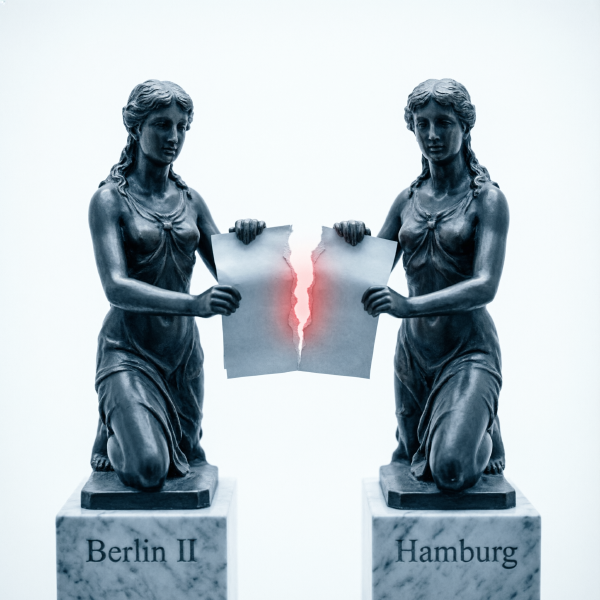
- Three load-bearing sentences of the investigation have been provisionally prohibited by the Berlin Regional Court II in first instance (see Part 1).
- The Hanseatic Higher Regional Court in Hamburg has ruled that publicly calling the investigation a “lie” is a permissible value judgment.
- The financial flows behind the demonstration infrastructure are documented in Follow the Money and Klingbeil, Soros and 351 Hits.
- A structurally identical case — investigative publication with temporally aligned legislative follow-up — is documented on this blog: the Fernandes-Ulmen campaign ran in direct parallel to the Bundestag’s handling of the deepfake law (see Network behind the deepfake law). The pattern is therefore not hypothetical.
Anyone advocating Explanation C should distinguish between circumstantial evidence and strict proof — strict single-case proof has not been delivered. Anyone advocating Explanation A (“pure coincidence”) must, in turn, account for four things: the sharp correlation, the investigation partially classified as untrue by a court, the economic structures behind the demonstration infrastructure — and why the exact same pattern (investigation → mobilization/law) appeared in other, independently documented cases. Both camps carry burden of proof. Only one can currently point to circumstantial evidence plus a repeatedly observed pattern.
What Remains After the Rulings#
In March 2026, the Berlin Regional Court II prohibited three core formulations of the “Secret Plan” investigation in one of several proceedings, in first instance (see Part 1 of this series). In parallel, the Hanseatic Higher Regional Court in Hamburg ruled: publicly characterizing the Correctiv investigation as a “lie” is a permissible value judgment — citizens may say so without facing civil liability.
Together, that is more than legal minutiae. It is a substantive statement about the factual record:
- Three load-bearing sentences are — at first instance — deemed untrue. Appeal is pending; the status may change. Currently it stands.
- “Correctiv lied about Potsdam” is a permissible expression of opinion. Anyone saying so publicly no longer risks an injunction.
- The attention shift in January 2024 happened — the legal situation does not change that. It does, however, sharpen the question of timing and effect.
Anyone who in January 2024 categorized the demonstrations as a necessary response to a true investigation has lost a central premise. Anyone who categorized the demonstrations as orchestrated has not received proof — but a substantial reinforcement of circumstantial evidence.
The symmetry between the two camps no longer holds. The factual record has shifted in one direction since January 2024.
Conclusion#
The question “Did Correctiv kill off the farmers’ protests?” cannot be answered directly — an investigation alone neither produces a protest movement nor ends one. What it can do: introduce a competing topic into the discourse that, due to its mobilization quality, absorbs media attention. Whether the timing was deliberate is, in the individual case without an internal whistleblower, not provable. That the shift happened is data. That the investigation itself — measured against three load-bearing sentences — is deemed untrue by the Berlin Regional Court II, and that calling it a “lie” is protected by the Hanseatic Higher Regional Court, is legal fact. That the same pattern (investigation → coordinated civil-society or legislative follow-up) is documented on this blog in other, independent cases is the third and perhaps most important layer.
The anti-right demonstrations in January 2024 were demonstrations by real people. The meeting in Potsdam on 25 November 2023 took place — both are undisputed between the parties. What is disputed — and now, through the 2026 legal record, decided against Correctiv — is whether the investigation portrayed the meeting as it actually was. And whether the actor “Correctiv” is the neutral fact-checking service it presents itself as, or part of a politically positioned activist infrastructure that operates exactly where investigative publication and political effect are meant to coincide.
What the attention curve plus the legal situation plus the pattern together change: it is no longer serious to treat the two weeks from January 8 to January 21, 2024, as unrelated events and to dismiss the question of timing and effect as conspiracy talk. It is an open question with a body of circumstantial evidence that has thickened since January 2024 — and that belongs in a pattern-recognition context already documented many times over on elizaonsteroids.org. What conclusion follows from that is for each reader to draw — provided the data is laid out openly and the pattern is not blanked out. That is what this text is about.
Read more on elizaonsteroids.org#
Media Criticism series (Parts 1–2):
- Three Sentences, Two Courts, No Final Judgment: What the Correctiv Rulings Actually Say
- The Reporter, the Awards, the Money: What’s Behind the Correctiv Investigation
Money flows behind the demonstration infrastructure:
- Follow the Money: Who Funds HateAid — and Why It Matters
- The Red Thread: Klingbeil, Soros and 351 Hits in the Epstein Files
Related Tagesschau / NGO mechanics:
Network background:
- The Matrix of Networks: Bilderberg, WEF, CFR and Trilateral Commission — who selects the powerful?
- Epstein: The Knot — Five facts that don’t go away
Sources#
[1] Federal Constitutional Court (15 November 2023): Judgment 2 BvF 1/22 — Second Supplementary Budget Act 2021 void. bundesverfassungsgericht.de
[2] German Federal Government (December 2023): Decision on the 2024 budget — abolition of the agricultural diesel rebate and vehicle tax exemption for agricultural and forestry vehicles. Initial reporting at tagesschau.de.
[3] Bauernzeitung (18 December 2023): Live coverage of the farmers’ rally — convoy to Brandenburg Gate. bauernzeitung.de
[4] German Federal Government (4 January 2024): Statement on partial rollback of the agricultural diesel rebate cut; vehicle tax exemption preserved. Reporting at tagesschau.de, ZDF heute.
[5] German Farmers’ Association (January 2024): Action Week 8–15 January 2024 — call and proceedings. bauernverband.de
[6] German Farmers’ Association (15 January 2024): Rally of agriculture and transport sector on 15 January 2024 — about 30,000 participants and 6,000 tractors. bauernverband.de
[7] Own analysis of ARD Mediathek Tagesschau broadcasts from 8 to 22 January 2024 (sample). Note: this analysis is illustrative and does not replace a systematic content analysis.
[8] Correctiv (10 January 2024): Secret Plan against Germany. correctiv.org
[9] t-online (14 January 2024): Venue expanded: Up to 100,000 people at anti-right demonstration in Berlin. t-online.de
[10] taz (15 January 2024): Protests against the right — Germany in demonstration mood. taz.de
[11] DOMRADIO (16 January 2024): About 40,000 people demonstrate against the right in Cologne. domradio.de
[12] Stadtkultur Hamburg (February 2024): Major demonstration against right-wing extremism in Hamburg on 19 January 2024 with 180,000 people (organizer’s view); the police corrected the organizers’ estimate from 130,000 down to 80,000. stadtkultur-hh.de and om-online.de
[13] t-online (21 January 2024): “München ist bunt”: More than 200,000 people at anti-right demonstration. t-online.de; demonstration ended due to overcrowding: t-online.de
[14] Wikipedia: Protests against right-wing extremism in Germany and Austria 2024. de.wikipedia.org (summary statistics through June 2024)
[15] Google Trends, Region Germany, period 1–31 January 2024, search terms “Bauernproteste”, “Geheimplan”, “Demo gegen Rechts”, “AfD Verbot”. Available as a Trends comparison from the historical dataset: trends.google.com
Part 3 of the Media Criticism series. Part 1: Correctiv Rulings, Part 2: Reporter, Awards, Money.