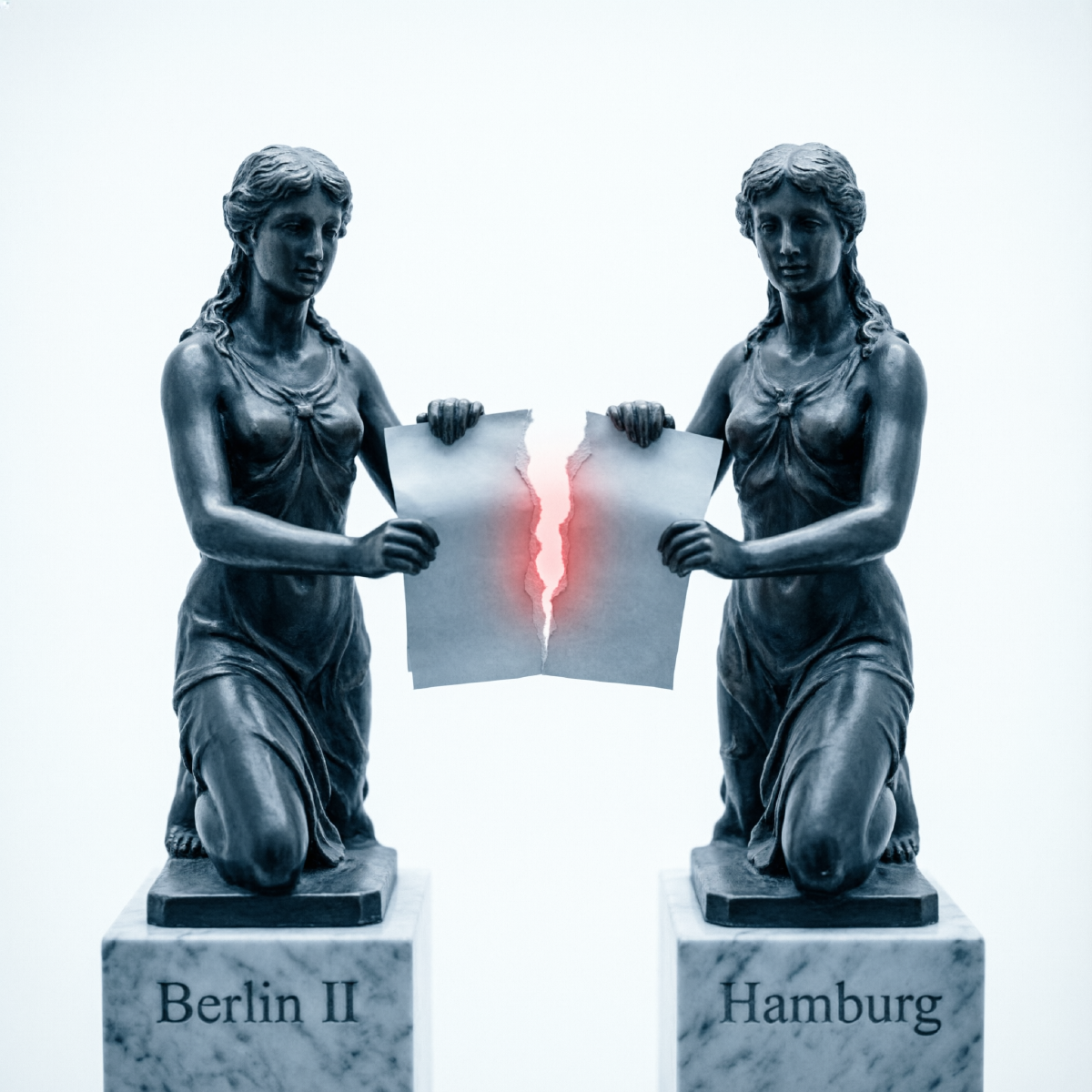
Two months after the Berlin II Regional Court’s ruling against Correctiv, two versions of the same story are circulating. In one, a “painstakingly constructed edifice of lies” is collapsing, prizes must be returned, the democracy rallies were propaganda. In the other, Correctiv has won “a victory for press freedom” and the investigation stands.
Both are reductive. The court files say something else.
What the Berlin II Regional Court Actually Prohibited#
On 17 March 2026, the Berlin II Regional Court (case no. 27 O 379/25), on the motion of AfD Member of Parliament Gerrit Huy, ordered a total of seven defendants to cease and desist: the Correctiv gGmbH, five persons working for it, and one further person who had attended the Potsdam meeting (referred to in the press release as “Defendant 7”) [1]. The further defendants were each individually prohibited from making the cited statements, depending on which assertions they themselves had made. The notarized affidavit of meeting participant Erik Ahrens dated 12 August 2025, which Correctiv had cited in its reporting, was also part of the case. Three specific formulations from the Potsdam coverage are prohibited [1]:
- A “master plan” to deport German citizens — that is, a plan to circumvent Articles 3, 16 and 21 of the Basic Law.
- “But he claims not to remember the bit about the expatriation idea for [German] citizens in Sellner’s talk.”
- “Member of Parliament Gerrit Huy proposed ’taking back’ German citizenship from people with dual nationality.”
The chamber considered the “master plan” statement to be “not only essentially untrue, but also unclear, imprecise and incomplete” [2]. The core finding: it was undisputed between the parties that no plan for the forced deportation of German citizens was presented in Potsdam. In his talk, Martin Sellner had expressly stated that German citizens would not have to leave.
What the ruling does not say: that the investigation as a whole is false. Neither the meeting itself, nor the list of participants, nor Sellner’s “remigration” concept are in question. Three sentences are prohibited, at first instance, vis-à-vis a single claimant and seven defendants.
The ruling is not final. Correctiv has announced an appeal. Editor-in-Chief Justus von Daniels said he was “very surprised by the ruling of the Berlin Regional Court, especially compared to the clearly won proceedings in Hamburg” [3].
The Hamburg Counterpart#
Three months earlier, on 19 December 2025, the Hamburg Regional Court (case nos. 324 O 6/25 and 324 O 7/25) dismissed in full lawsuits by the lawyer Ulrich Vosgerau and the host Gernot Mörig against Correctiv [4].
The same formulation — “master plan to deport German citizens” — was classified by the Hamburg press chamber as a permissible value judgment on the basis of a true factual foundation. Readers would recognise that it was a summarising assessment, not a factual claim. This ruling is also not final; the claimants have filed appeals.
Earlier, in March 2024, the Hamburg Higher Regional Court (case no. 7 W 34/24) had rejected most of Vosgerau’s immediate appeal in preliminary injunction proceedings [5]. Vosgerau prevailed only on one partial aspect — a shortened quotation concerning the likely success of an election challenge. All other injunctive claims were dismissed.
The Third Ruling: What One May Say ABOUT Correctiv#
The rulings covered so far turn on statements that Correctiv itself made — which of those are impermissible factual claims and which are permissible value judgments. There is a second judicial construction site which is structurally at least as weighty: which statements about Correctiv are legally permissible?
On 11 December 2024 — about a year before the Hamburg main-proceedings rulings and fifteen months before the Berlin II ruling 27 O 379/25 — the Berlin Regional Court II dismissed a claim by Correctiv gGmbH against AfD Bundestag member Beatrix von Storch [9]. Correctiv had sought to prohibit von Storch from calling the Potsdam investigation “dreckige Correctiv-Lügen” (“dirty Correctiv lies”) — a formulation she had used at an AfD state party convention in October 2024.
The outcome: the claim was dismissed after oral proceedings. The court classified the formulation as permissible expression of opinion. The decisive reasoning goes beyond what a mere “permissible value judgment” finding would require:
“Correctiv had, at the very least, created an incorrect impression.”
— Reasoning of the Berlin Regional Court II as reported by Legal Tribune Online, 12 December 2024.
Specifically: the court examined whether there were “concrete indications” that Correctiv had disseminated “false facts” — and whether Correctiv had been aware of this. The judges affirmed both. The text had, in the court’s view, produced an “incorrect impression” of the Potsdam meeting for many readers, especially journalists — particularly as to whether a deportation of German citizens had been discussed there.
This is a structurally different category from the Hamburg and Berlin main-proceedings rulings. There the question was: May individual passages of the investigation remain as they stand? Here the question was: May critics label the investigation a lie? The second question is the harder one — because it releases the language ABOUT Correctiv. The court expressly answered it by finding that the underlying creation of a false impression by Correctiv was, in the court’s view, also knowing.
Important qualification: the von-Storch decision is a first-instance ruling; like the Hamburg and Berlin main-proceedings rulings, it is not legally final. Its operative tenor is the dismissal of an injunctive claim, not a conviction of Correctiv. But the load-bearing reasoning contains, as shown, a judicial finding about the impression created by the investigation which did not have to be made in order to dismiss the claim on free-speech balancing grounds alone — and which can be cited in later proceedings.
The Legal Situation in One Table#
| Court / Case no. | Date | Claimant | Outcome | Final? |
|---|---|---|---|---|
| LG Berlin II — 27 O 379/25 | 17.03.2026 | Huy (AfD) | 3 passages prohibited | no (appeal announced) |
| LG Berlin II — 27 O 135/25 | 09/2025 | Vosgerau | Partial injunction | no |
| LG Hamburg — 324 O 6/25 | 19.12.2025 | Vosgerau | Dismissed | no |
| LG Hamburg — 324 O 7/25 | 19.12.2025 | Mörig | Dismissed | no |
| LG Berlin II — v. Storch | 11.12.2024 | Correctiv v. v. Storch | Claim dismissed — “dirty lies” permissible | no |
| OLG Hamburg — 7 W 34/24 | 26.03.2024 | Vosgerau (prel. inj.) | Partial shortening confirmed, rest dismissed | final (preliminary proceedings only) |
None of the main rulings is final. The central question — is the “master plan” summary an untrue factual claim or a permissible value judgment? — lies with the appeals courts. A Federal Court of Justice decision or a unified line does not exist. In parallel, however, the language ABOUT Correctiv has been, since the von-Storch ruling of 11 December 2024, released at first instance — with a reasoning that characterises the investigation’s impression as “incorrect” and that can resurface in the pending appeals.
What Is Undisputed#
Beyond the contested formulations, the following is undisputed between all parties and courts [6]:
- The meeting took place on 25 November 2023 at the Landhaus Adlon on Lake Lehnitz near Potsdam.
- Participants included Martin Sellner (Identitarian Movement), Gernot Mörig (host), Ulrich Vosgerau, Roland Hartwig (then aide to Alice Weidel), Gerrit Huy (AfD), Silke Schröder (Werteunion). Weidel parted ways with Hartwig after the publication.
- Sellner presented his “remigration” concept with three target groups: asylum seekers, foreigners with residency rights, and German citizens who are not “assimilated”. The last group was to leave not through expulsion, but through “assimilation pressure”.
The contested point is whether summarising the third group as a “plan to deport German citizens” constitutes an impermissible shortening — or a permissible editorial value judgment. Berlin says the former, Hamburg the latter. Both at first instance, both under appeal.
What This Means — And What It Doesn’t#
The investigation has not “collapsed”. Three formulations have been prohibited at first instance in one of several proceedings. Correctiv has had its core claims expressly confirmed in two Hamburg main proceedings. Demands to return prizes or cut state funding, based on a non-final ruling, are political positions, not legal conclusions.
Correctiv’s self-presentation is also not complete. The Hamburg courts did not protect the passage as a factual claim, but as a value judgment — a legally significant distinction. The Berlin chamber considers the same passage to be factually untrue. “The investigation stands” is only true if one adopts the Hamburg reading and ignores the Berlin one.
What should interest us: how is it that two regional courts with comparable facts arrive at opposing results? This is not a scandal — it is the normal operation of a judiciary without a unified line from the higher courts. The question of which reading holds will be decided by the appeals instances, and possibly the Federal Court of Justice.
The Context: What Makes the Difference#
The Correctiv investigation does not stand in isolation. It was published into an environment in which demonstration infrastructures already existed — Campact alone had a donation volume of €24.6 million in 2024 [7] — and in which the allegation that campaign NGOs steer political mobilisation with narratives from research portals has its own court history. That the same structures brought 13,000 people onto the street 72 hours after the Spiegel Fernandes cover story [8] is documented. That the main person did not come, is documented too.
The NGO complex behind the demonstrations is therefore not speculative. What cannot be derived from the Correctiv rulings is a direct link between this infrastructure and the investigation itself. That is a separate question — and it is not answered by the Berlin ruling.
Closing#
The temptation to turn a first-instance injunction into either a collapse or a victory is strong on both sides. Both are wrong.
What remains: a legally fascinating juxtaposition of two regional courts, an open question about the boundary between factual claim and value judgment, several pending appeals — and a meeting whose core content is undisputedly documented.
The investigation is neither dead nor exonerated. It is where investigative reporting on politically charged topics regularly ends up: in court, for years.
Further Reading on elizaonsteroids.org#
- Follow the Money: Who Funds HateAid
- The Landecker Network: Who Pays Germany’s Opinion Gatekeepers?
- 72 Hours: How a Spiegel Cover Story Became a Rally of 13,000
- Shadowban and the Lobby Register
Sources#
[1] Berlin II Regional Court (17.03.2026): Press Release 13/2026, case no. 27 O 379/25. berlin.de
[2] Legal Tribune Online: So begründet das LG Berlin II die Correctiv-Niederlage [How the Berlin II Regional Court justifies Correctiv’s defeat]. lto.de
[3] Correctiv (March 2026): Press statement on the Berlin II Regional Court ruling. correctiv.org
[4] beck-aktuell (19.12.2025): LG Hamburg, case nos. 324 O 6/25 and 324 O 7/25. beck-aktuell.de
[5] Hamburg Higher Regional Court (26.03.2024): Decision case no. 7 W 34/24, justice press office. justiz.hamburg.de
[6] aufrecht.de / Terhaag: Correctiv reporting on the Potsdam meeting — facts or value judgments: inconsistent case law in Hamburg and Berlin. aufrecht.de
[7] Campact e.V., annual report 2024 (€24.6 million donation volume). See also Follow the Money: HateAid.
[8] Own reporting: 72 Hours: How a Spiegel Cover Story Became a Rally.
[9] Legal Tribune Online (12.12.2024): Court finds false impression concerning the Potsdam meeting — AfD politician may accuse Correctiv of “dirty lies”. lto.de. See also NIUS report (11.12.2024): nius.de.