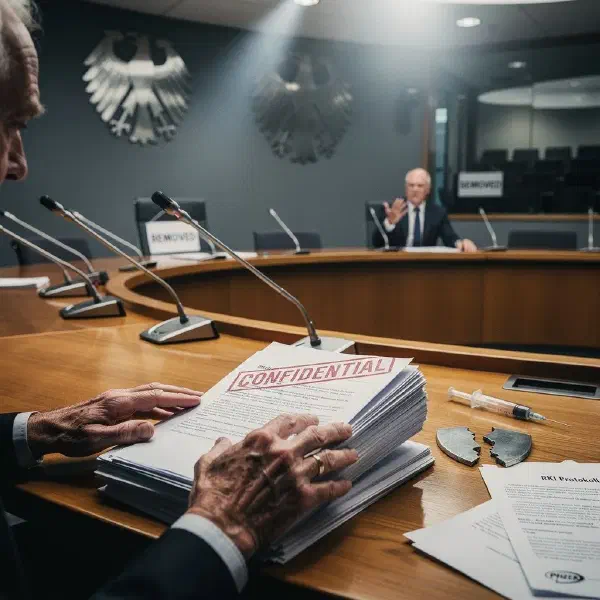
On April 23, 2026, the Bundestag Enquete Commission “Processing the Covid Pandemic and Lessons for Future Pandemic Events” convened in public session. Block subject: Critical Infrastructures (KRITIS) and the role of the Bundeswehr in pandemic situations. Expert witness: Stephan Kohn, former senior official at the Federal Interior Ministry (BMI), author of the 80-page internal evaluation of May 2020 that assessed the then-current Covid policy as a false alarm — a paper that has since served as a case study, depending on whom you ask, of either bureaucratic dissent or bureaucratic discipline.
CDU member of parliament questioning the witness: Axel Müller, jurist, eleven years a judge at the Regional Court of Ravensburg — most recently as presiding judge of a criminal chamber — member of the Bundestag since 2017, directly elected three times. A man who spent his professional life examining witnesses and weighing credibility.
Commission chair: Franziska Hoppermann, CDU, Hamburg-Wandsbek, in the chair since September 2025, under her own declared motto:
“We want to understand, not to judge.”
— Franziska Hoppermann, inaugural statement, 09 September 2025, documented on cducsu.de
What happens next is not a reckoning. It is its opposite. And it happens in a public session, on video, in the first Enquete Commission the German parliament has convened on the Covid era.
The Recording#
Public session of the Bundestag Enquete Commission “Processing the Covid Pandemic and Lessons for Future Pandemic Events”, April 23, 2026, critical-infrastructure / Bundeswehr block. The transcript below is transcribed from this recording and verified against the primary source Apollo News.
The Sequence — From the Transcript#
The trauma question does not fall from nowhere. It is the end of a line of questioning Müller builds in this order — the transcript of the session of April 23, 2026, records each step.
Step 1 — Müller tries to delegitimize the institutional competence:
Müller: “Which department in the Federal Interior Ministry did you actually belong to? And connected to that is question two: Was that department competent for an assessment of the kind you submitted?”
Kohn replies with the formal job-distribution plan:
Kohn: “I belonged to the department for Crisis Management, Civil Protection and Crisis Management, and in the job-distribution plan competence for crisis management, and in particular in the case of a pandemic, is fixed in such a way that this unit belongs to the crisis staff — the crisis staff to be formed in a pandemic, composed of BMI and BMG. Beyond that, the task of this unit was to gather and deliver the information necessary for assessing the situation, the severity of the danger. That is exactly what I did.”
Then, as a substantive addendum, Kohn adds: “Not through a virus, but through the measures.” His 2020 thesis, restated before the commission.
Step 2 — Müller tries the cover-up insinuation directly:
Müller: “Did you have the impression that something was being covered up there?”
Kohn refuses:
Kohn: “On that I will not comment.”
That is the key moment. The witness does not confirm the cover-up framing. A member interested in the substance would now ask a follow-up: on the data basis, on the internal BMI conflict, on the role of the Robert Koch Institute. Not Müller.
Step 3 — Müller pivots to the childhood:
Müller: “All right. You had a heavy fate, I am well aware. A great injustice was done to you in your childhood and youth, because something was covered up …”
The key word returns. And again.
Müller: “… because something was covered up … because something was covered up …”
The logic of the sequence is unambiguous. Because the witness will not confirm the cover-up claim on the merits, the word is grafted through the biography. What the witness refuses in substance is imputed to him through his childhood.
The Objection — and the Half Intervention#
Kay-Uwe Ziegler, AfD, the party’s representative on the commission, on a point of order:
Ziegler: “We have a subject for this session, and I would ask that Mr Kohn not be held to account here in any way for his personal life. You are speaking about his personal fate. What exactly is this meant to mean in this context? I would ask that this stop.”
At this point chair Franziska Hoppermann had to decide: is the trauma examination stopped, or not. She says:
Hoppermann: “All right, let us all calm down for a moment, and I interpret your intervention, Mr Ziegler, as a request to return to the substance of the hearing. I now give this indication to our colleague Müller, and the last thirty-three seconds, the last thirty-three seconds for a new question.”
That is not an intervention. It is a half-measure with an afterburner. She interprets Ziegler’s objection as being about “substance” — not about the personal vulnerability of a witness. She does not sanction the behaviour, she wraps it into a procedural hint. And she gives Müller thirty-three more seconds of speaking time in which he can do whatever he wants.
Müller uses the thirty-three seconds for precisely the question whose direction Ziegler had just objected to:
Müller: “Once one has experienced that something was covered up, does that trigger something in one? Did it trigger something in you, and if so, in what form in connection with this crisis?”
An off-mic call from the room — “He just carries on.” Hoppermann does not intervene a second time. Kohn has fifteen seconds left for a reply.
The Reply#
What is remarkable about Stephan Kohn’s answer in those fifteen seconds is that he does not accept the frame of the question. He does not contest the biographical facts — he recontextualizes them:
Kohn: “It is a transparent attempt to question, of course, my competence or authority. But I believe that when one has accumulated life experience — that one has, at one point, experienced injustice, or heavy blows of fate, and has had to represent a reasonable position against resistance — then one is a bit robust and resilient against demands to streamline oneself into some mould, regardless of whether that is right or not. And I believe that is not a bad qualification.”
Translated: Yes, I have experienced injustice in life. That does not make me a symptom-bearer. It makes me a witness with identifiable reasons not to fall in line. The question posed as a delegitimization device receives its inversion: the biography meant to disqualify becomes the qualification for dissent.
He must have improvised this in fifteen seconds. He delivers it in one sentence.
The Method: Medicalization as Delegitimization#
Müller’s question is not stupidity. It is technique.
A presiding judge of a criminal chamber at the Regional Court of Ravensburg — eleven years in office, several as chamber lead — knows what a witness examination is. He knows what questions do. He knows that sequence matters: first try to attack the competence (“which department? competent?”). When that fails against the written job-distribution plan, try to confirm the substance (“cover-up?”). When the witness refuses, pivot onto the person — using the same key word the witness has just declined in substance. First the factual predicate (“heavy fate”), then the repetition of the key verb (“covered up”, “covered up”, “covered up”), then the invitation to introspection (“does that trigger something in you?”). This is not a question directed at the matter. It is a question directed at the person. And it follows, measurably in the transcript, as the third step after two failed attacks on the substance.
The technique is old and it has a name: medicalization of dissent. The witness’s assessment is not substantively refuted. The witness’s assessment is recoded as a symptom. Not: your analysis is wrong because — but: your analysis does not come from the matter, it comes from your biography.
This is the same mechanism that late-twentieth-century Soviet psychiatry deployed against dissidents under the label “sluggish schizophrenia.” The same mechanism that nineteenth-century German asylum courts used to pathologize political opponents as “moral insanity.” The procedure is the same: the witness is not speaking about the world, he is speaking about himself — and we are not obliged to listen. Anyone expecting at this point a disclaimer about the differences between the political systems will not receive one. A procedure is assessed by what it does to the witness, not by the name on the courtroom door.
That a former presiding judge of a criminal chamber deploys precisely this technique in public, inside a parliamentary body, is not a slip. It is, in the literal sense, professional competence applied in the wrong room against the wrong person under the wrong mandate.
The Motto and Its Inversion#
The commission’s official motto — Hoppermann’s own formulation, documented on 09.09.2025 on the CDU/CSU parliamentary-group site — is: “Understand, don’t judge.”
If the formula were meant in good faith, it would apply first to those who made decisions during the crisis: health ministers, state premiers, the Chancellery, the leadership of the Robert Koch Institute. It would be a formula of protection for decision-makers against retrospective criminal or political accountability. That is defensible. That is the point of an inquiry commission and not a criminal trial.
What is demonstrated on April 23, 2026, is the inversion: the formula does not protect the decision-makers. It protects the operators of the post-inquiry. Those who issued orders are to be understood. Those who objected are to be judged — not for their analysis, but for their trauma.
This is not processing. This is a second punishment of those who, back then, objected from inside the bureaucracy. The first punishment arrived in 2020 through Kohn’s immediate suspension and removal from service, confirmed by the Berlin Administrative Court in March 2022. The second arrives six years later, in a commission officially convened to heal, administered by a former judge who knows how to inflict one.
Hoppermann — the Case and the Pattern#
The case of Hoppermann on April 23, 2026, is: she intervenes, but only halfway. She does not cut the trauma line — she reinterprets the opposition’s objection as a “please return to substance” notice and hands the same member thirty-three more seconds. In those thirty-three seconds the actual trigger question is asked. A second intervention does not come. She does not protect the expert witness from a member of her own parliamentary group relocating the examination from the matter into the person. Procedurally she “reacted”. In substance she permitted.
The Hoppermann pattern is older. Already in the commission’s session of January 29, 2026, the AfD parliamentary group recorded an incident in which Kay-Uwe Ziegler charged that Hoppermann had “abused her authority to curtail the rights of the opposition”. Subject of that session: the role of the opposition during the pandemic, specifically the hearings of Hans-Georg Maaßen and Tom Lausen. Ziegler: “The subject was ’the role of the opposition’ and not ’the role of the parliamentary opposition.’” Documented in the AfD press statement of 30 January 2026.
The pattern is independent of which party happens to be playing opposition. A chair who takes office under the motto “Understand, don’t judge” cuts off opposition questioning and allows, on the other side, a member of her own parliamentary group to conduct witness delegitimization. This is not neutrality. This is partisanship under the cover of neutrality.
And it takes place in the one parliamentary body this country has to learn, structurally, from three years of pandemic policy.
What Kohn Wrote — and What the Commission Is Not Processing#
Stephan Kohn, on May 8, 2020, submitted within the Federal Interior Ministry an evaluation report of over 80 pages: “Covid Crisis 2020 from the Perspective of Critical-Infrastructure Protection.” Core theses:
- The damage from governmental interventions already at that point exceeded the damage from the virus.
- The figures of the Robert Koch Institute were “not meaningful”.
- The “collateral damages” in the health domain were being systematically underestimated.
He distributed the paper to leadership at the BMI and at state interior ministries. He used BMI insignia. He was suspended immediately. His work computer was confiscated. The Berlin Administrative Court confirmed his removal from service in March 2022. Documented in Cicero, in the Wikipedia entry for Stephan Kohn, and in the Preußische Allgemeine.
Six years later he is asked, then — not about the substance, not about the methodology, not about the KRITIS question itself — but whether his childhood has triggered something. There is no follow-up on the validity of the 80-page analysis in retrospect. No follow-up on the suspension process. No follow-up on which officials in the BMI regarded which figures as “not meaningful” and whether that assessment has since been vindicated — the RKI internal protocols published in November 2025 expose precisely that debate inside the institute itself.
These questions are not asked. Instead: the trauma question.
The Lesson of the Mainstream’s Silence#
The incident is public. It is on video. It was documented in the following days by Apollo News, by Philosophia Perennis and by the AfD parliamentary group. Tagesschau is silent. ARD is silent. Spiegel Online is silent. Zeit Online is silent. In Germany’s mainstream news environment, this incident does not exist.
That is the actual structural finding.
When a member of the governing party in the parliamentary body tasked with processing the Covid years publicly uses the documented childhood-abuse history of a bureaucratic dissident to delegitimize his professional assessment, and not one leading media organization in this country reports it — then the scandal is not only the incident itself. The second scandal is the decision of the editorial desks that this incident does not exist. That is not a marginal media critique. That is the core of what this blog documents.
Who Wins, Who Loses#
Winners: The CDU/CSU, which holds the “reckoning” narrative in its hands but deploys it as a discipline instrument against those who once objected from inside the bureaucracy. Concretely: Hoppermann, who retains her chair authority without having to discipline a member of her own group. Concretely: Axel Müller, whose method passes ungraded. Concretely: the editorial desks that, through non-coverage, archive the credibility debate under “fringe.”
Losers: Stephan Kohn, for the second time. Every other potential witness who has now seen with what technique the commission is capable of operating when it chooses — and who will recalibrate their willingness to testify. The Enquete Commission itself, which has burned its own credibility before it has submitted an interim report. And — probably the most important group — the citizens who need an open-ended parliamentary reckoning to understand why schools were closed, freedoms revoked, livelihoods broken.
We#
We do it, by installing this body and then letting it run. We do it, by allowing ourselves to be soothed by mottos like “Understand, don’t judge” without checking to whom the formula is applied and to whom it is not. We do it, by waiting for Tagesschau to tell us when a scandal has taken place.
The question is not Kohn’s fallibility. The question is by what method the commission operates when someone objects — and whether a parliamentary body is capable of examining an analysis on its substance, without dismantling the witness over his childhood.
The answer is public, is on video, and it is: no.
See also#
- Correctiv & Potsdam — Part 1: The Court Rulings — Structural analysis of how a “research narrative” holds up against later court decisions.
- Amadeu-Antonio Foundation Structural Analysis — the same pattern in its extra-parliamentary variant: delegitimization by framing rather than by substantive rebuttal.
- Obama–Neubauer Pipeline Structural Analysis — pipelines, foundations, celebrity. There it was communication. Here it is examination. The mechanism — do not discuss the matter, displace the person — is the same.
Note: This text is structural analysis. The verbatim quotations are verified against the primary source Apollo News. The Hoppermann motto is primary-source documented on cducsu.de (press statement of 09.09.2025). The January 29, 2026, pattern is documented in the AfD press statement of 30.01.2026. Stephan Kohn’s 80-page report is publicly documented via Cicero, Wikipedia, and the Berlin Administrative Court ruling of March 2022. The political assessment is the author’s.